Dealing With Crazing and Crackle in Antique Doll Glaze
When the Surface Cracks
Crazing — a network of fine cracks in the glaze — is common on antique porcelain dolls. It results from differential thermal expansion between the glaze and the underlying porcelain body: over time and temperature cycling, the glaze contracts more than the body, creating tension that relieves itself as a crack network.
How Crazing Affects Color
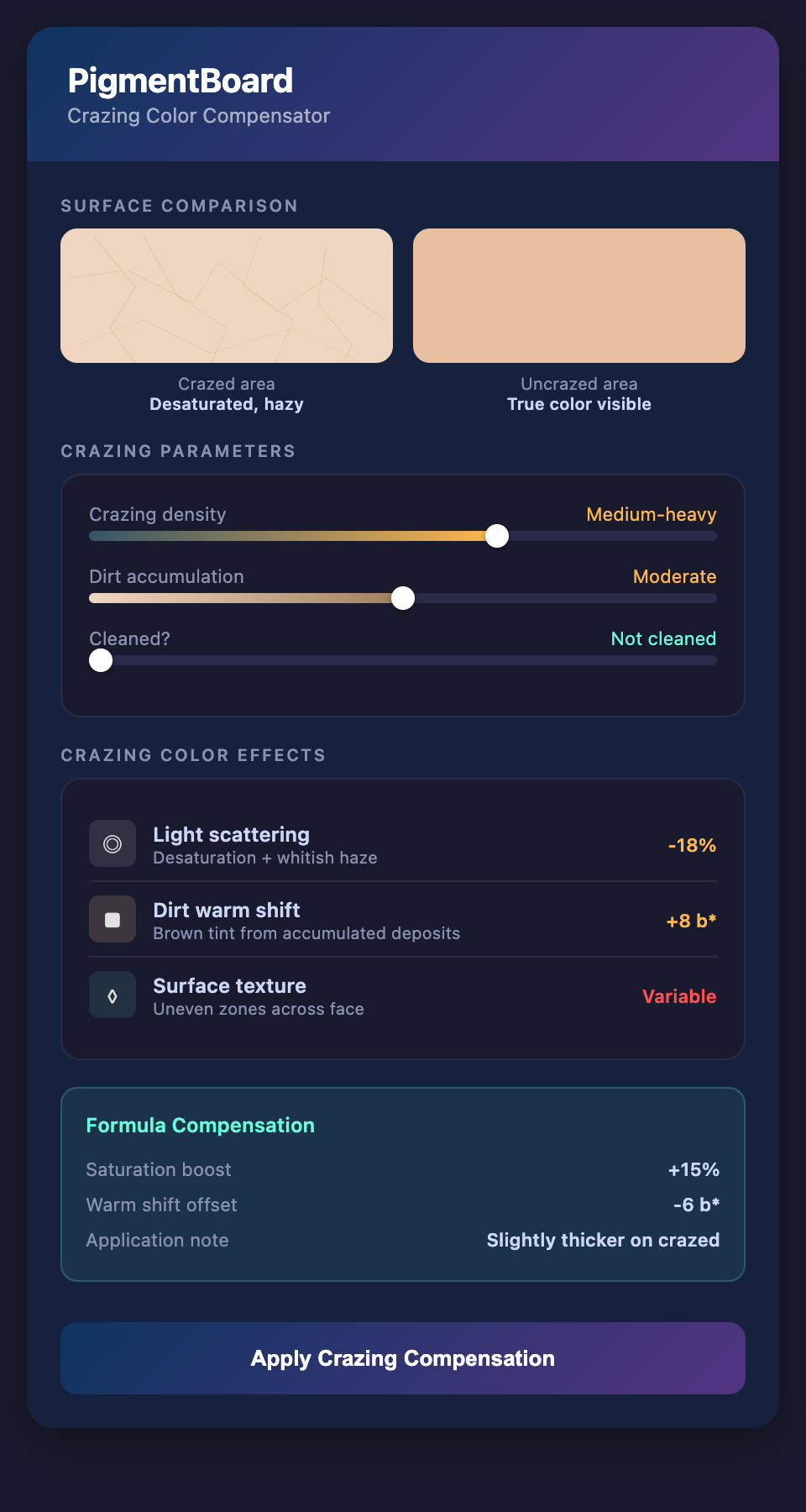
Light scattering. Each crack surface reflects and refracts light, creating a subtle haze that reduces color saturation and adds a whitish cast. Heavily crazed areas appear lighter and less vivid than uncrazed areas.
Dirt accumulation. Craze lines trap dirt, dust, and environmental deposits that darken the network and add a warm brownish tone to the overall appearance. Cleaned crazing appears as light scattering only; uncleaned crazing adds its own color contribution.
Moisture absorption. Craze lines allow moisture to penetrate beneath the glaze, potentially causing staining from dissolved minerals or biological growth.
Differential appearance. Crazing is rarely uniform across the entire head. Some areas may be heavily crazed while others are clear, creating visible zones of different apparent color and texture.
Matching Color Over Crazed Surfaces
Do not try to match the crazed and uncrazed areas to the same formula. The same paint formula will look different on a crazed surface versus an uncrazed surface because the underlying optical properties differ.
For restoration over crazed areas:
- The craze lines will partially show through semi-transparent china paint, adding their own visual texture
- You may need a slightly more saturated formula to compensate for the light-scattering desaturation of the crazing
- The final result will have a different surface character from restoration over uncrazed areas
For restoration over uncrazed areas adjacent to crazed areas:
- The uncrazed restoration will appear more vivid and smooth than the crazed original
- Consider whether this contrast is acceptable or needs mitigation
The Decision: Clean or Leave?
Cleaning crazing (removing dirt from the crack network) changes the color appearance:
- Before cleaning: Warm, brownish-tinted network adding warmth and depth
- After cleaning: Cooler, whiter light-scattering effect
If you clean the crazing, your color-matching target changes. If you leave it, your restoration must account for the warm tint.
Working With Clients
Some collectors view crazing as part of the doll's character and do not want it altered. Others find it distracting and want it minimized. Discuss this before beginning restoration — the decision affects your entire color-matching approach.
Crazing in the Degradation Model
A comprehensive degradation model for doll restoration should include a crazing parameter that modifies:
- Overall desaturation (from light scattering)
- Warm shift (from accumulated dirt in craze lines)
- Surface texture variation (from uneven crazing patterns)
These modifications apply to the entire surface, affecting every other color prediction.
Want to account for crazing in your degradation predictions? Join the PigmentBoard waitlist.