French vs. German Doll Pigment Palettes and Their Aging Differences
Two Traditions, Two Palettes
The golden age of bisque doll manufacturing (1860-1910) was dominated by French and German traditions. They used different pigment palettes, application techniques, and firing protocols — all affecting how their dolls look today.
The French Palette
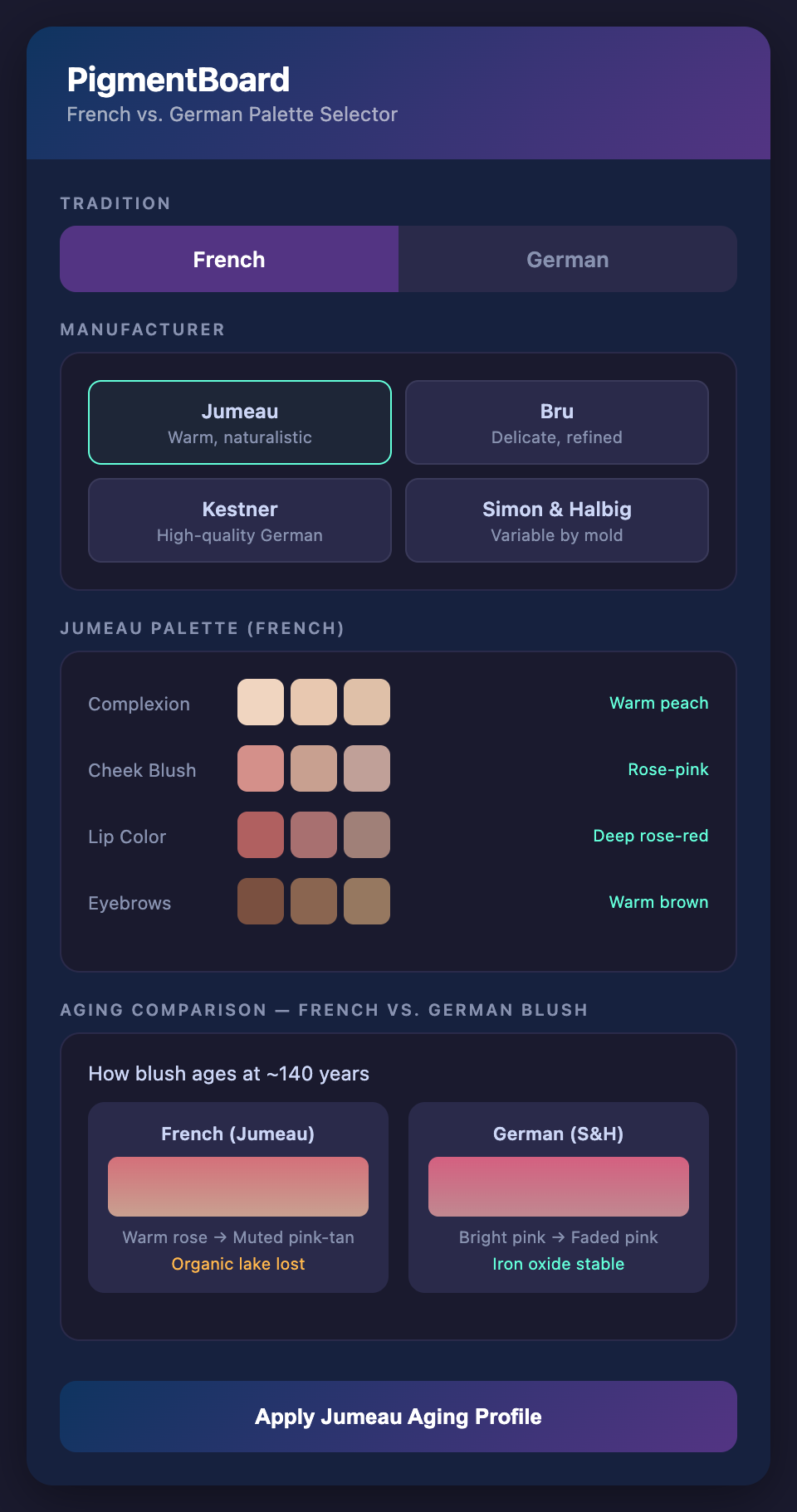
Complexion: Warm, creamy bisque with subtle pink-peach base wash. Softer, more opaque complexion.
Cheek blush: Delicate warm rose-pink. Stippled for soft diffused edges. Often included organic lake pigments over iron oxide base.
Lip color: Deep rose-red with sophisticated modulation. Softer outlines than German.
Eyebrow color: Warm brown to reddish-brown. Multi-stroke with individual hair strokes visible.
The German Palette
Complexion: Cooler, pinker bisque with thinner base wash. Whiter and crisper.
Cheek blush: Brighter, more opaque pink. Defined circular pattern. Primarily iron oxide based.
Lip color: Brighter red, more uniformly applied. Harder outline. More orange-toned.
Eyebrow color: Darker, more uniform brown. Painted as solid shape on production dolls.
How They Age Differently
French blush: Organic lake fades under UV, shifting warm rose-pink toward cooler, flatter pink-tan. Ages to a subtle warm skin tone that barely reads as "blush."
German blush: With less organic lake, retains iron oxide base more consistently. Fades primarily through mechanical wear rather than chemical change.
French lips: Complex layered application partially survives. Overall shift from deep rose toward muted brownish-pink.
German lips: Brighter, uniform color fades more evenly. Defined outline may survive better.
Restoration Implications
- Identify before you restore — positively identify the national tradition before selecting your palette
- Match the tradition, not just the color — A Jumeau needs warm, subtle, diffused pink; a Simon & Halbig needs bright, defined, opaque pink
- Account for tradition-specific aging — Use the correct aging model for the manufacturer's palette
- Study reference examples — Build a visual library from auction catalogs, museums, and collector references
Manufacturer-Specific Notes
Jumeau: Especially warm, naturalistic complexion. Late Jumeau/SFBJ quality declined. Bru: Often the most delicate and sophisticated painting. Kestner: Among highest-quality German. Approaches French standards on character dolls. Simon & Halbig: Wide quality range by mold and era. Armand Marseille: High-volume, more standardized painting.
Ready to match manufacturer-specific palettes with historical accuracy? Join the PigmentBoard waitlist.