Handling Doll Heads Safely During Restoration Color Matching
Every Touch Is a Risk
An antique bisque doll head is a thin-walled, hollow porcelain vessel that has survived 100-150 years of varied handling. It may have hairline cracks invisible to the naked eye, stress points from old repairs, or weakened areas from composition deterioration. Every time you pick it up for color comparison, you are accepting risk.
The Handling Hazards
Physical impact. Bumping the head against the workbench, another object, or even a spectrophotometer during measurement.
Pressure damage. Squeezing too hard at a stress point can crack or crush thin-walled areas. Eye sockets, ear openings, and neck sockets are especially vulnerable.
Drop risk. China paint comparison requires holding the head in one hand and a test tile in the other, sometimes under a specific light angle. This is when drops happen.
Thermal shock. Moving a head from a cool storage area to a warm workstation (or vice versa) can stress the porcelain. More critically, placing a head in a kiln that is not at room temperature can cause cracking.
Surface contamination. Oils from skin, even from clean hands, deposit on the bisque surface and can affect how china paint adheres and fires.
Safe Handling Protocols
Always wear nitrile gloves. They protect both the doll and your hands. Cotton gloves, while traditional in museums, can be slippery on porcelain — nitrile provides better grip.
Support the head from below. Cradle the head in your palm or in a padded support, never grip by the neck socket alone.
Use a dedicated padded surface. A foam-padded turntable or padded cradle keeps the head stable and cushioned during evaluation.
Minimize lift-and-replace cycles. Every pickup is a risk event. Arrange your workspace so the head can stay in its padded support during as much of the comparison process as possible.
Bring the reference to the head, not the head to the reference. Hold test tiles next to the stationary head rather than picking up the head and moving it to the tiles.
Reducing Handling Through Better Prediction
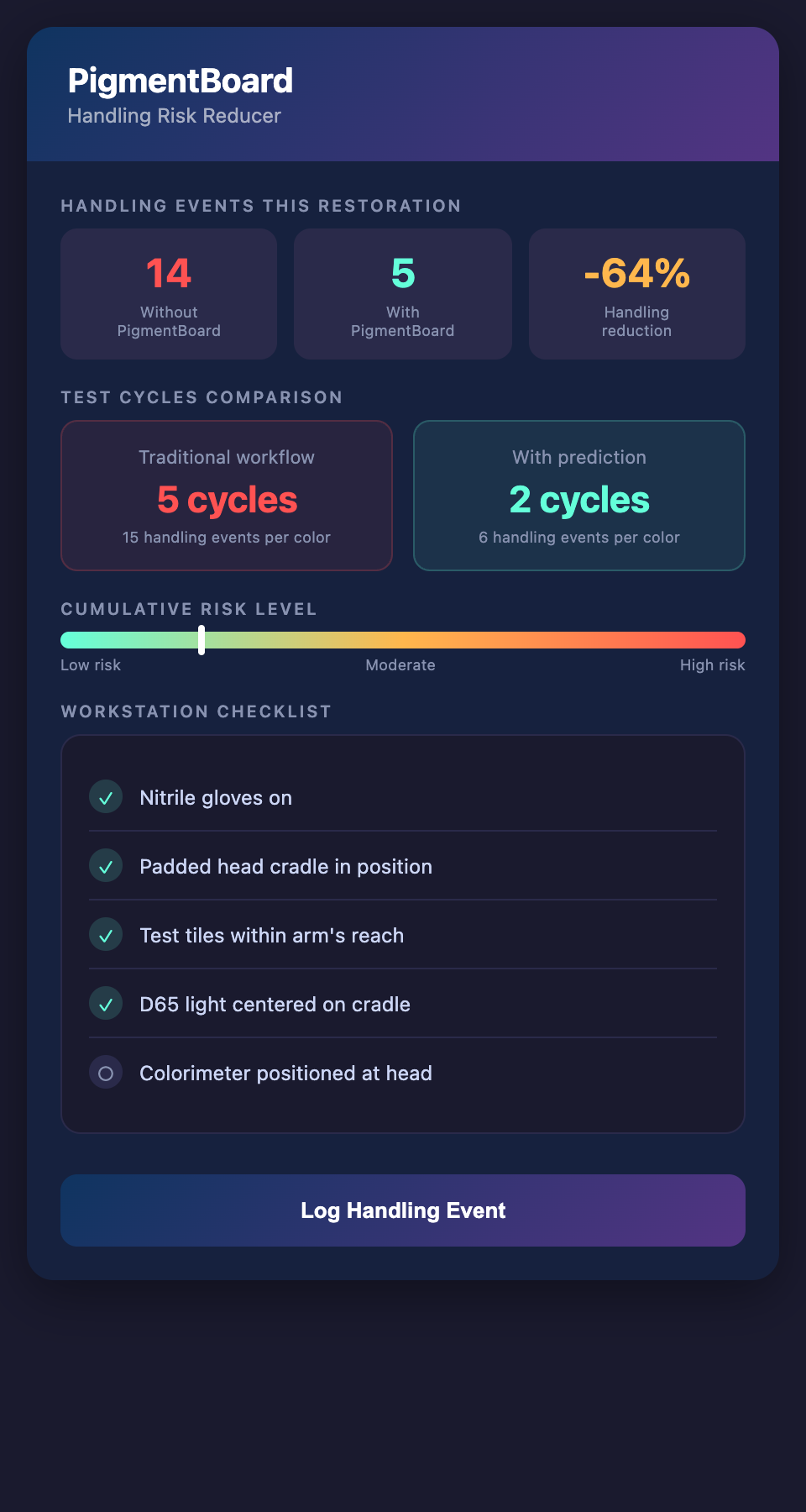
Every eliminated test cycle eliminates comparison handling events. If better prediction reduces your test iterations from 5 to 2, you have eliminated 3 sets of handling per color — potentially 9-12 fewer handling events per restoration.
Over a career of thousands of restorations, the cumulative risk reduction is substantial.
When You Must Handle
For some evaluations, handling is unavoidable — viewing under multiple light sources, measuring with instruments, rotating to see different angles. In these cases:
- Move slowly and deliberately
- Keep the head close to its padded surface — do not lift it high
- Have a clear plan for each handling event (know exactly what you are checking before you pick it up)
- Return to the padded support immediately after
The Workstation Setup
Design your workstation to minimize handling:
- Head cradle at comfortable working height, centered under your D65 light
- Test tiles and palette within arm's reach
- Spectrophotometer or colorimeter positioned so the head does not need to move to the instrument
- Secondary light sources (for metamerism checking) directed at the head's position
Want to reduce handling risk with fewer, more accurate test cycles? Join the PigmentBoard waitlist.