How to Match Faded Cheek Blush on Antique Bisque Dolls
The Blush That Time Changed
The cheek blush on antique bisque dolls is one of the most scrutinized details in doll restoration. Collectors notice immediately when it is wrong. The original blush was applied as a thin wash of mineral pigment over the matte bisque surface, then fired. Over 100-150 years, that blush has changed.
What the Original Blush Was Made Of
French and German manufacturers in the 1860s-1910s used:
- Iron oxide reds (rouge de fer, English red) — The primary colorant
- White pigments (zinc white, lead white) — Mixed with red to create pink tones
- Occasionally, carmine or rose pigments — Organic lake pigments for delicate pink tones, far less stable than iron oxides
- China paint medium — A flux-based medium for fusing pigments to bisque
French dolls typically had warmer, more delicate blush than German dolls, which tended toward brighter, more opaque application.
Why It Faded
Under-firing. Not all china paint was fired at optimal temperature. Under-fired blush sits on the surface rather than fusing into the glaze.
Organic lake component. Carmine or rose lake pigments fade dramatically under UV. The result is a shift from warm rose-pink toward a cooler, flatter pink as the warm organic component disappears.
Mechanical wear. 150 years of handling wears away the thin blush layer, especially on cheek high points.
Atmospheric exposure. Sulfur pollutants can react with lead white, causing darkening. Humidity causes micro-flaking of under-fired china paint.
The Color Shift Pattern
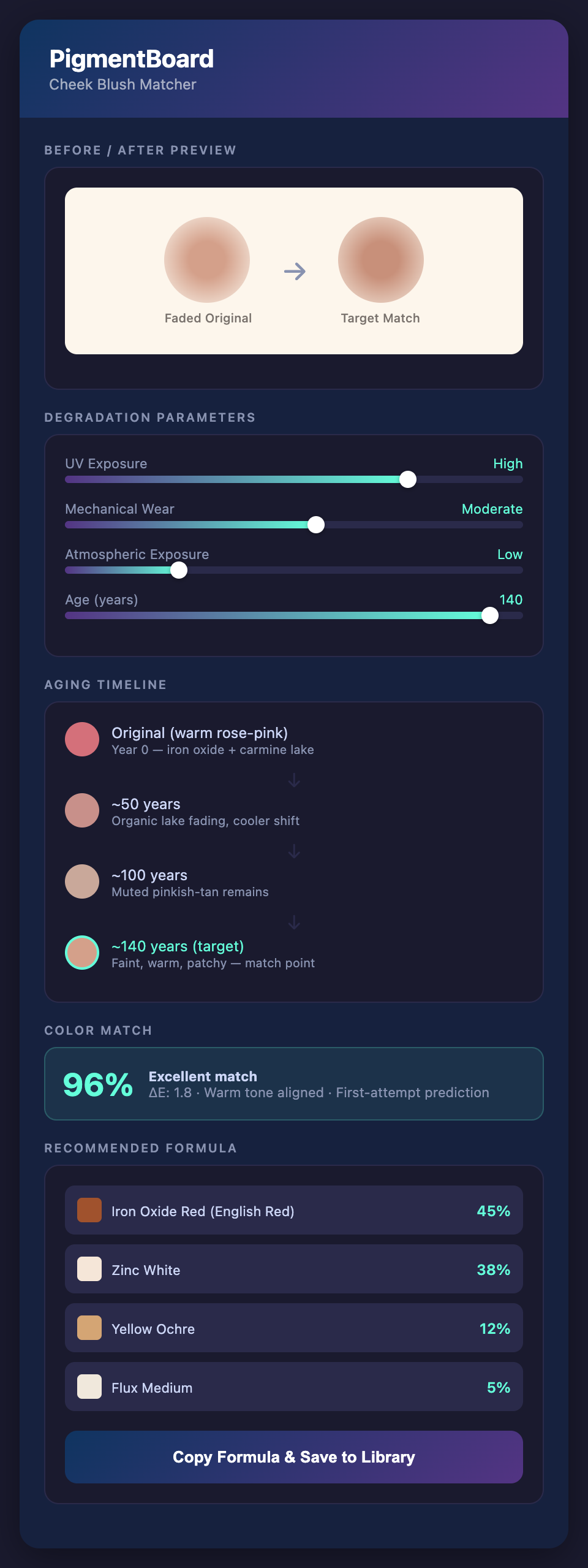
- Stage 1 (0-50 years): Organic lake fades. Color shifts from warm rose toward cooler pink.
- Stage 2 (50-100 years): Organic lake largely gone. Remaining color is muted pinkish-tan.
- Stage 3 (100-150+ years): Mechanical wear has thinned the layer. Color is faint, warm, and patchy.
The Trial-and-Error Trap
The traditional approach — mix china paints, apply to scrap bisque, fire, compare, adjust, repeat — is slow and wasteful. Each cycle takes hours due to kiln firing and cooling time. A typical restoration involves 3-5 iterations per color.
A Better Approach: Model the Aging First
- Identify the manufacturer and era to determine likely original blush composition
- Assess the current state — organic lake fading, mechanical wear, chemical discoloration
- Set degradation parameters — UV exposure, atmospheric exposure, wear, age
- Generate a predicted target color before mixing anything
- Mix to the prediction — with confidence, on the first attempt
- Fine-tune if needed — small adjustments rather than wholesale guessing
The Economic Argument
If a degradation model saves you two kiln cycles per restoration (conservative), that is 4-6 hours saved per project. Over 50 restorations per year, that is 200-300 hours returned to productive use.
Ready to nail the blush on the first try? Join the PigmentBoard waitlist and match aged cheek colors with scientific precision.