Matching Eyebrow Paint on 19th-Century Bisque Dolls
More Than Just Brown
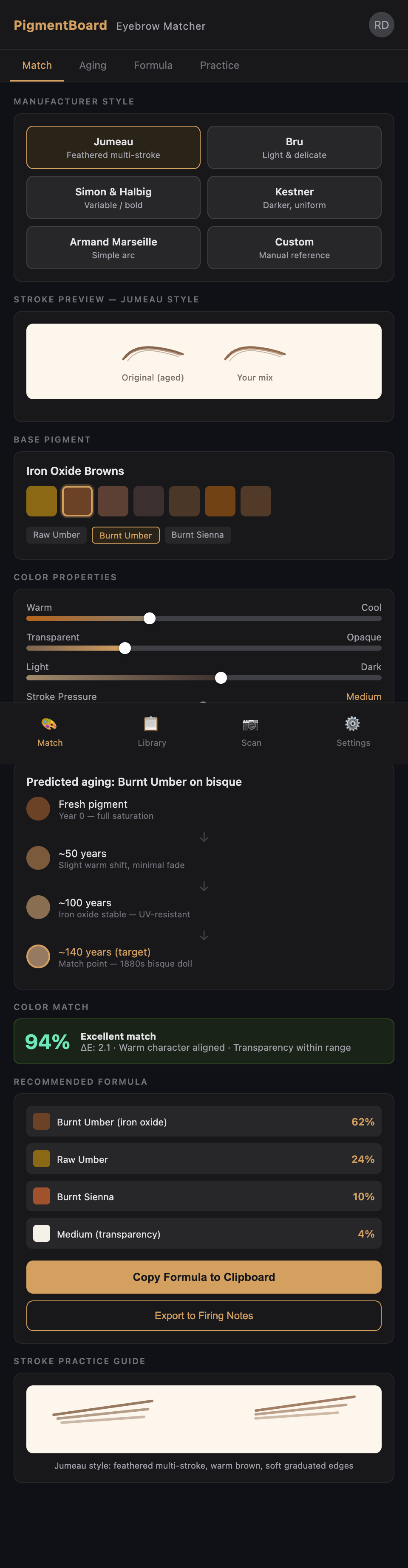
Eyebrows are technically demanding because, unlike blush or lips, they are visible individual brush strokes. The restorer must match color, transparency, stroke direction, pressure variation, and manufacturer-specific style.
Original Eyebrow Pigments
- Iron oxide browns (raw umber, burnt umber, burnt sienna) — most common
- Manganese brown — for darker, cooler browns
- Mixed browns — iron oxide red + black
- Chrome oxide green + iron oxide red — documented for specific olive-brown tones
How Eyebrow Paint Ages
Less wear than cheeks (slightly recessed on brow ridge). More UV exposure on upper face. High pigment stability — iron oxide browns resist UV. The net effect: eyebrows are often among the best-preserved painting, making close matching essential.
Color-Matching Strategies
- Identify warm-cool character — reddish vs. neutral vs. grayish brown
- Match transparency — semi-transparent, not opaque
- Match technique before color — practice strokes on test tiles first
- Study manufacturer's style — Jumeau feathered vs. Armand Marseille solid arc
Technique by Manufacturer
Jumeau: Feathered multi-stroke, warm brown, softly graduated edges. Bru: Similar to Jumeau, lighter and more delicate. Simon & Halbig: Variable by mold, character faces may have bold brows. Kestner: Well-painted, slightly darker, more uniform. Armand Marseille: Simple arc, minimal internal detail.
Common Mistakes
Too dark, too opaque, wrong stroke character, ignoring surviving original, wrong brown temperature.
Want to predict exactly how a 19th-century eyebrow brown has aged? Join the PigmentBoard waitlist.