How to Price Doll Restoration Based on Color-Matching Complexity
The Pricing Problem
Doll restoration pricing typically accounts for structural repair, cleaning, and painting. But within "painting," the time required varies enormously depending on color-matching complexity. A simple touch-up on well-preserved paint might need one kiln firing. A full face restoration on a heavily degraded doll with multiple previous restorations could need 15+ firings.
If you price both the same, you lose money on complex jobs and overprice simple ones.
Complexity Factors
Factor 1: How much original paint survives?
- 80%+ surviving: Minor touch-up. Low complexity.
- 40-80% surviving: Moderate in-painting. Medium complexity.
- Under 40% surviving: Extensive restoration. High complexity.
- Near zero: Full recreation. Highest complexity — you are matching to manufacturer references, not to the specific doll.
Factor 2: How many colors need matching?
- Cheek blush only: One color system.
- Blush + lips: Two systems, needing to harmonize.
- Blush + lips + eyebrows: Three systems.
- Full face including eyes: Four or more systems — each needing to harmonize with every other.
Factor 3: How degraded is the surviving paint?
- Mildly faded: Clear reference for matching. Lower difficulty.
- Heavily faded: Ambiguous reference. Requires degradation analysis to determine original.
- Multiple previous restorations: Must untangle layers before matching.
Factor 4: How demanding is the client?
- Museum or institutional: May require documentation, spectral analysis, reversibility.
- Dealer: Usually wants fast, good-enough restoration for resale.
- Private collector: Variable — some want museum-grade, some want affordable.
A Pricing Framework
Tier 1: Touch-up ($150-400)
- One or two small areas needing color matching
- Original paint well-preserved as reference
- 1-2 kiln firings expected
- 2-4 hours total
Tier 2: Moderate restoration ($400-1,200)
- Multiple areas needing matching
- Original paint moderately degraded
- 3-6 kiln firings expected
- 8-20 hours total
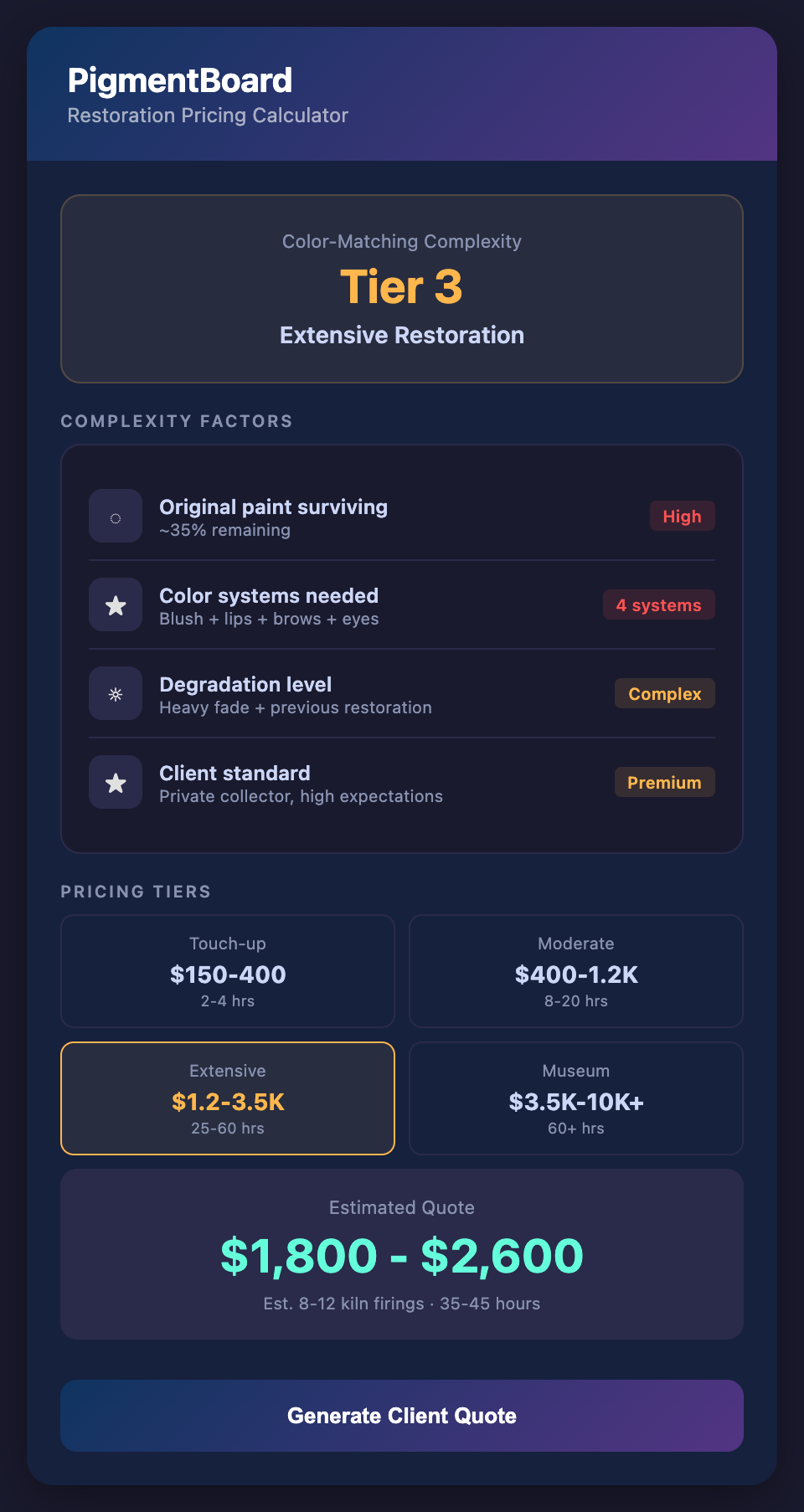
Tier 3: Extensive restoration ($1,200-3,500)
- Major paint loss requiring matching to manufacturer references
- Possible previous restoration removal
- 8-15 kiln firings expected
- 25-60 hours total
Tier 4: Museum-grade full restoration ($3,500-10,000+)
- Near-complete paint loss or extensive previous restoration
- Requires analytical identification of original pigments
- Full documentation package
- 15+ kiln firings possible
- 60+ hours total
Communicating Value
Clients who understand the complexity of color matching are more willing to pay appropriately. Brief explanations help:
- "Each color requires separate kiln firings to test and apply — and each firing takes several hours"
- "The faded original paint has shifted in ways that require careful analysis to match accurately"
- "Getting the color wrong risks damage when removing and reapplying"
How Better Tools Affect Pricing
Degradation modeling tools reduce complexity by:
- Providing better first-attempt accuracy (fewer kiln cycles)
- Making complex projects more predictable
- Reducing the risk premium you need to build into quotes
This lets you offer competitive pricing on complex jobs while maintaining your margin — or complete the same tier of work in less time, increasing throughput.
Want to reduce color-matching complexity and improve your pricing accuracy? Join the PigmentBoard waitlist.