Restoring Faded Eye Paint on Antique Character Dolls
Eyes That Tell a Story
Character dolls (Heubach, Kestner, Simon & Halbig character molds) have painted eyes that are among the most expressive and detailed elements in all of doll manufacturing. Unlike glass-eyed dolls where the eyes are separately manufactured, character doll eyes are painted directly on the bisque — and they are often masterworks of miniature painting.
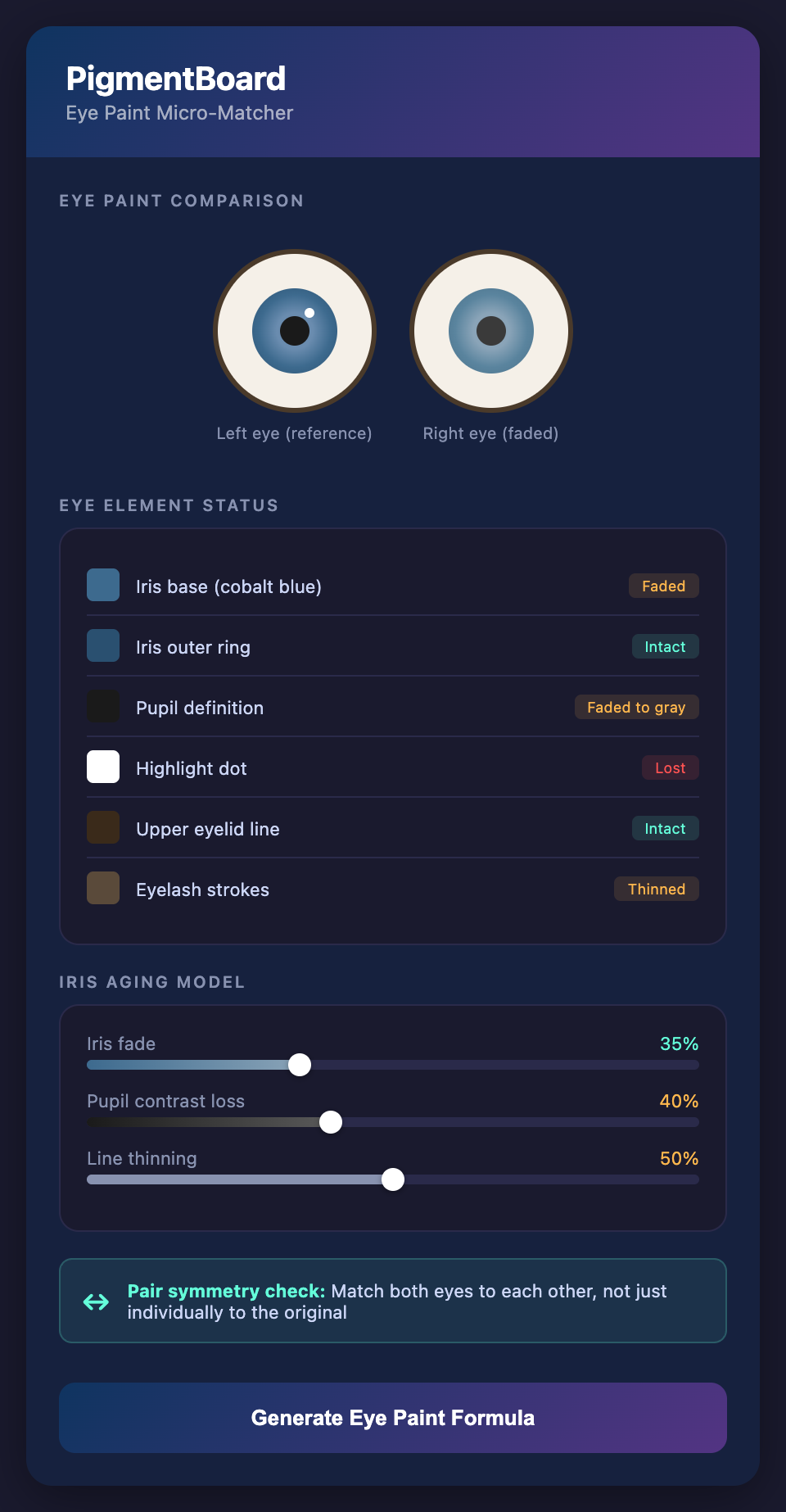
The Anatomy of a Painted Doll Eye
A well-painted character doll eye contains:
- Iris base color — The fundamental eye color (blue, brown, green, gray), applied as a semi-transparent wash
- Iris modulation — Darker outer ring, lighter inner area, sometimes radial streaking
- Pupil — Black or near-black center dot, precisely placed and sized
- Upper eyelid line — Dark line defining the upper lid, often the heaviest painted line on the face
- Lower eyelid line — Lighter, softer line below the eye
- Eyelash strokes — Individual fine strokes extending from the upper lid line
- Highlight dot — A tiny white or light dot in the iris, suggesting a light reflection
- Eyebrow — Positioned above to frame the eye (covered separately)
Degradation of Eye Paint
Iris color fading. Blue irises (cobalt) are very stable. Brown irises (iron oxide) are stable. Green irises (chrome oxide + yellow) may lose the yellow component. Gray irises (mixed pigments) may shift subtly.
Line wear. The fine eyelash strokes are the most vulnerable — thin lines on an exposed surface wear quickly. Upper lid lines are more robust but may thin at the outer corners.
Highlight loss. The tiny white highlight dot is often the first element lost — it is small, exposed, and on the most prominent part of the eye.
Pupil fading. Black pupils can fade to dark gray or dark brown over time, reducing the contrast that gives the eye its lifelike quality.
The Matching Challenge
Eye restoration demands:
- Color matching at microscopic scale — The iris is perhaps 5-8mm in diameter, containing multiple colors
- Precise placement — A pupil that is 0.5mm off-center makes the doll look cross-eyed
- Consistent pair matching — Both eyes must match each other, not just match the original individually
- Integration with surviving paint — Restoration must blend seamlessly with whatever original eye paint survives
Restoration Strategy
1. Document exhaustively before touching the eyes. Photograph at high magnification. Map every surviving element.
2. Assess symmetry. If one eye is better preserved, use it as the primary reference for the other.
3. Work in layers. Restore the iris base first, then modulation, then lines, then details. Fire between each major layer.
4. Match the faded state. A brand-new cobalt blue iris next to a faded original will look glaringly wrong. Age the blue.
5. Place highlights precisely. Both eyes should have highlights in corresponding positions. Study the original placement direction (suggesting a specific light source).
6. Test on flat tiles first. Before working on the curved eye surface, practice the exact colors and scale on flat porcelain tiles.
The Degradation Model for Eye Colors
Eye paint uses a narrower color range than face paint (primarily blues, browns, greens, and blacks), but the precision requirements are higher. A degradation model for eye restoration should predict:
- How the specific iris pigment has faded under the doll's conditions
- The expected contrast between iris and pupil at the current state of aging
- The expected visibility of the highlight dot after fading
- The expected width and opacity of surviving eyelash strokes
These predictions guide the restorer toward appropriately aged eye colors rather than fresh, vivid ones.
Want to model eye paint aging with micro-precision? Join the PigmentBoard waitlist.