Working With Doll Dealers on Restoration Color Standards
The Dealer Perspective
Doll dealers operate in a different context than private collectors or museums. Their priorities:
- Turnaround time — Dolls in the workshop are dolls not generating revenue
- Cost-effectiveness — The restoration cost must be justified by the doll's resale price increase
- Market appeal — The restoration must look good to buyers
- Honest disclosure — Reputable dealers disclose all restoration
What Dealers Need
Speed without sacrifice. Dealers do not need the slowest, most meticulous restoration possible. They need the fastest restoration that meets market standards. This is a legitimate request, not a call to cut corners.
Predictable pricing. Dealers send many dolls for restoration. They need to budget. Unpredictable color-matching time makes budgeting impossible.
Consistent quality. A dealer who sends 20 dolls per year expects the same quality standard on each. Inconsistency damages the business relationship.
Appropriate level of restoration. Not every doll needs museum-grade treatment. A $300 doll getting $2,000 of restoration makes no economic sense. The restorer should advise on appropriate investment levels.
Calibrating Restoration to Value
High-value dolls ($5,000+): Full-quality restoration with degradation modeling, multiple test cycles, and thorough documentation. The investment is justified by the value increase.
Mid-value dolls ($1,000-5,000): Good-quality restoration with efficient color matching. One or two test cycles rather than five. Documentation but less extensive.
Lower-value dolls ($200-1,000): Touch-up restoration focused on the most visible issues. Efficient matching using reference library formulas. Minimal documentation.
Meeting Dealer Standards Efficiently
Build dealer-specific reference formulas. If a dealer consistently sends the same type of dolls (e.g., Armand Marseille 390s), develop and validate formulas that work repeatedly for that type.
Batch similar dolls. Process similar dolls together. The color mixing and kiln setup for one Kestner blush serves all Kestners in the batch.
Communicate proactively. Before starting a complex restoration, contact the dealer with a time-and-cost estimate. Ask whether the investment is warranted for that doll.
Offer tiered services. Give dealers a menu: touch-up, standard restoration, full restoration. Let them choose the appropriate level for each doll.
The Tools Advantage
Degradation modeling tools benefit dealer work especially because they reduce the time variable. When color matching is faster and more predictable, you can offer dealers the turnaround time and pricing consistency they need while maintaining quality.
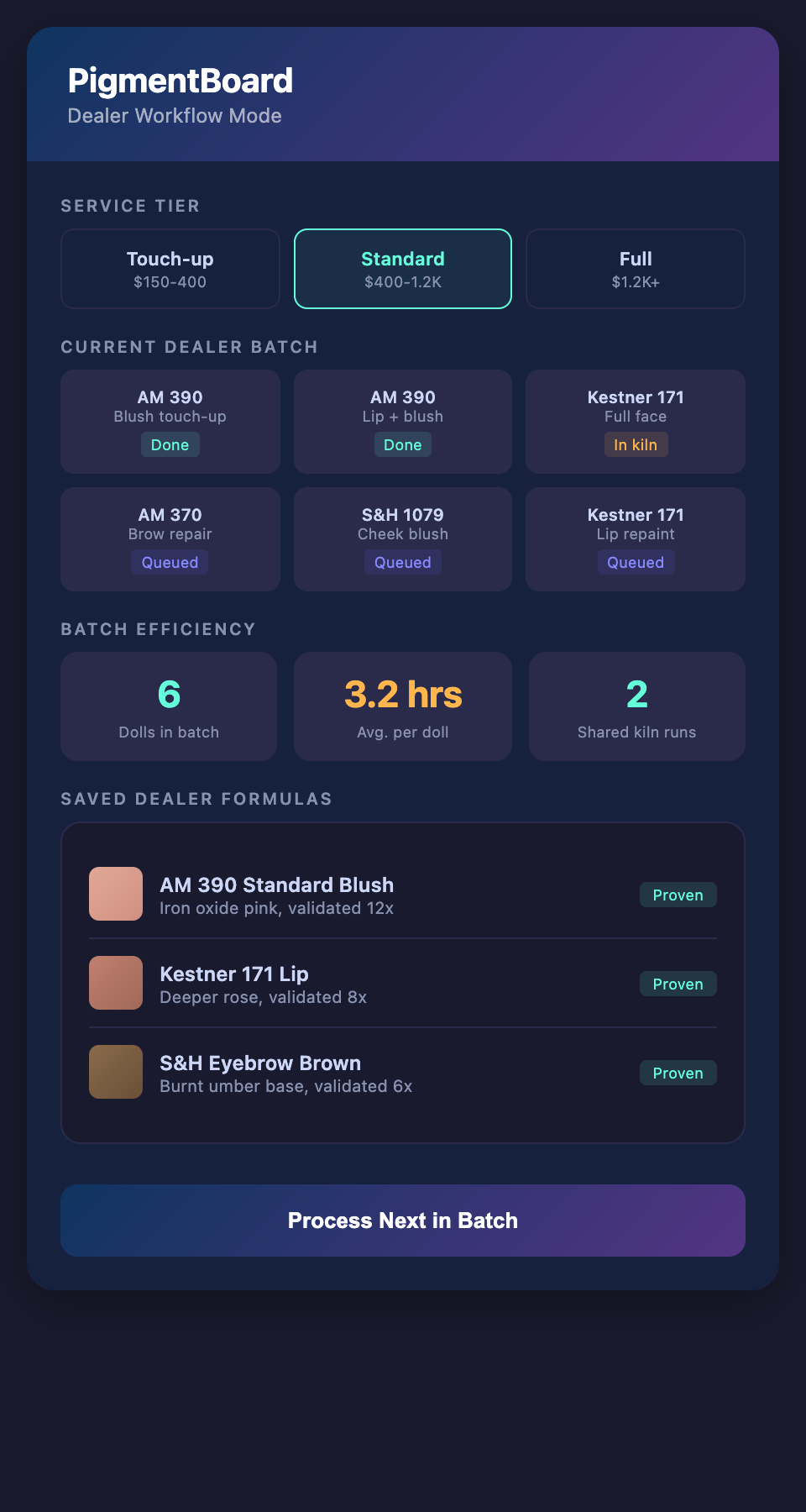
Want to deliver dealer-grade speed with collector-grade quality? Join the PigmentBoard waitlist.