Aging Costumes That Progress Through a Story Timeline
Aging as Narrative
Some productions span years or decades within the story. Characters age, and their costumes should age with them. This requires multiple versions of key costumes at different aging levels, with each version looking like a natural progression from the last.
Planning Progressive Aging
Define the timeline. Work with the designer and director to establish:
- When does the story start and end?
- How many distinct costume "periods" are needed?
- What is the aging increment between each period?
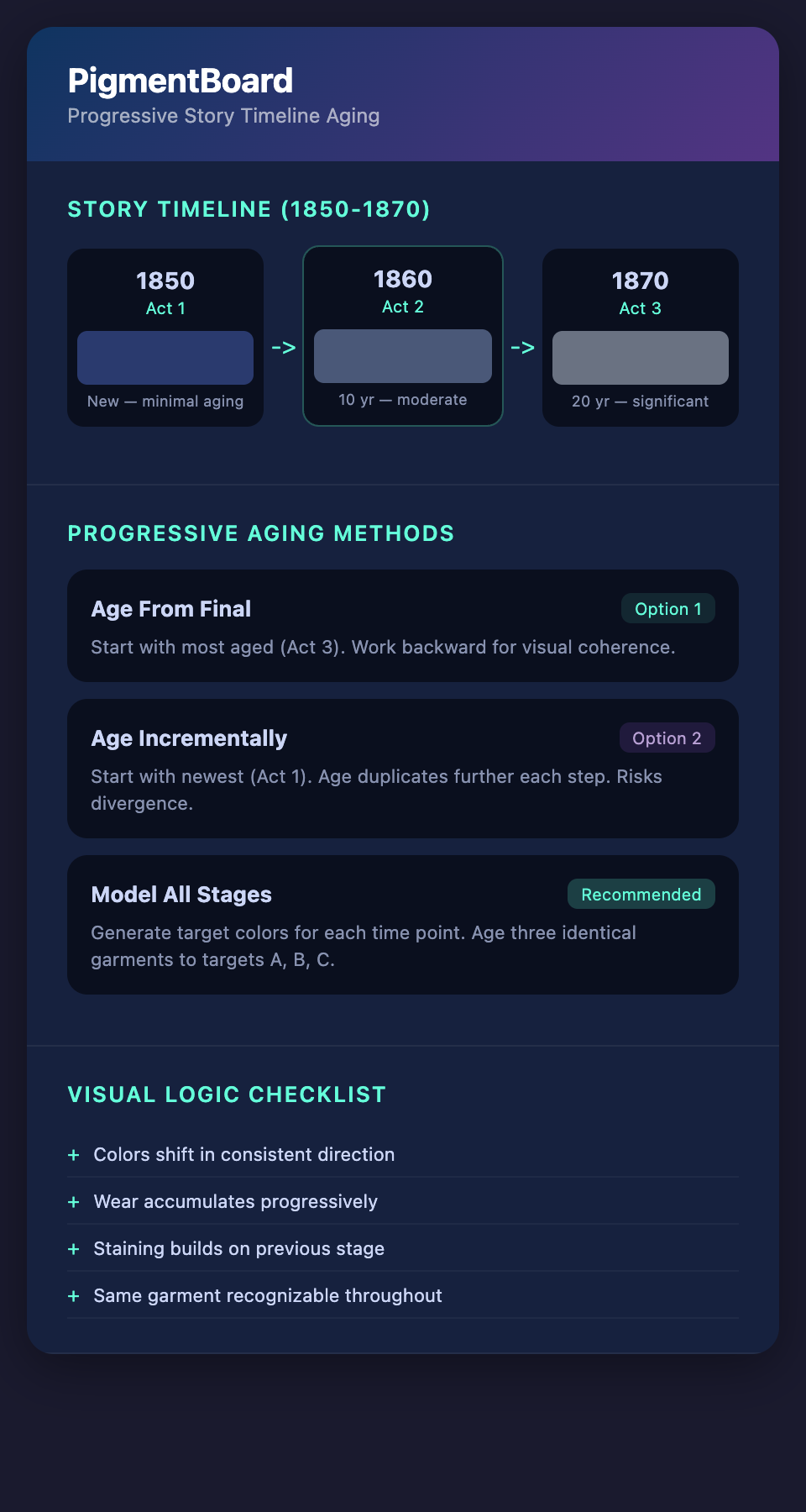
Example: A play spanning 1850-1870 with three acts:
- Act 1 (1850): Costume is new — minimal aging
- Act 2 (1860): Costume is 10 years old — moderate aging
- Act 3 (1870): Costume is 20 years old — significant aging
Creating Progressive Versions
Option 1: Age from one base. Start with the most aged version (Act 3). Work backward by making less-aged versions. This ensures the progression is visually coherent.
Option 2: Age incrementally. Start with the newest version (Act 1). Create Act 2 by aging a duplicate further. Create Act 3 by aging another duplicate further still. This is intuitive but risks divergence between versions.
Option 3 (recommended): Model all stages. Use the degradation model to generate target colors for each time point:
- 0 years aging (new): target color A
- 10 years aging: target color B
- 20 years aging: target color C
Age three identical garments to targets A, B, and C respectively. The model ensures that the progression is scientifically consistent.
Maintaining Visual Logic
The progression must be visually logical:
- Colors should shift in a consistent direction (not redder in Act 2 and bluer in Act 3)
- Wear should accumulate (Act 3 should show all of Act 2's wear plus more)
- Staining should build (Act 3 includes Act 2's stains plus additional)
- The garment should look like the same garment throughout — same fabric, same cut, just progressively older
Quick Changes
If the actor changes between acts, the quick change must be planned:
- Fastenings designed for speed
- Dresser rehearsed on the change
- Costumes stored in order backstage
If the aging change happens within an act (e.g., a time-passage montage in film), multiple versions may need to be swapped rapidly.
Ready to generate a complete aging timeline for progressive costume aging? Join the PigmentBoard waitlist.