Aging Military Uniforms for Historical Film Productions
Military Aging Is Specific
Military uniforms age in patterns that are distinct from civilian clothing. The combination of outdoor exposure, physical activity, equipment contact, and field conditions creates a characteristic aging signature that military history consultants and knowledgeable audiences recognize.
Universal Military Aging Patterns
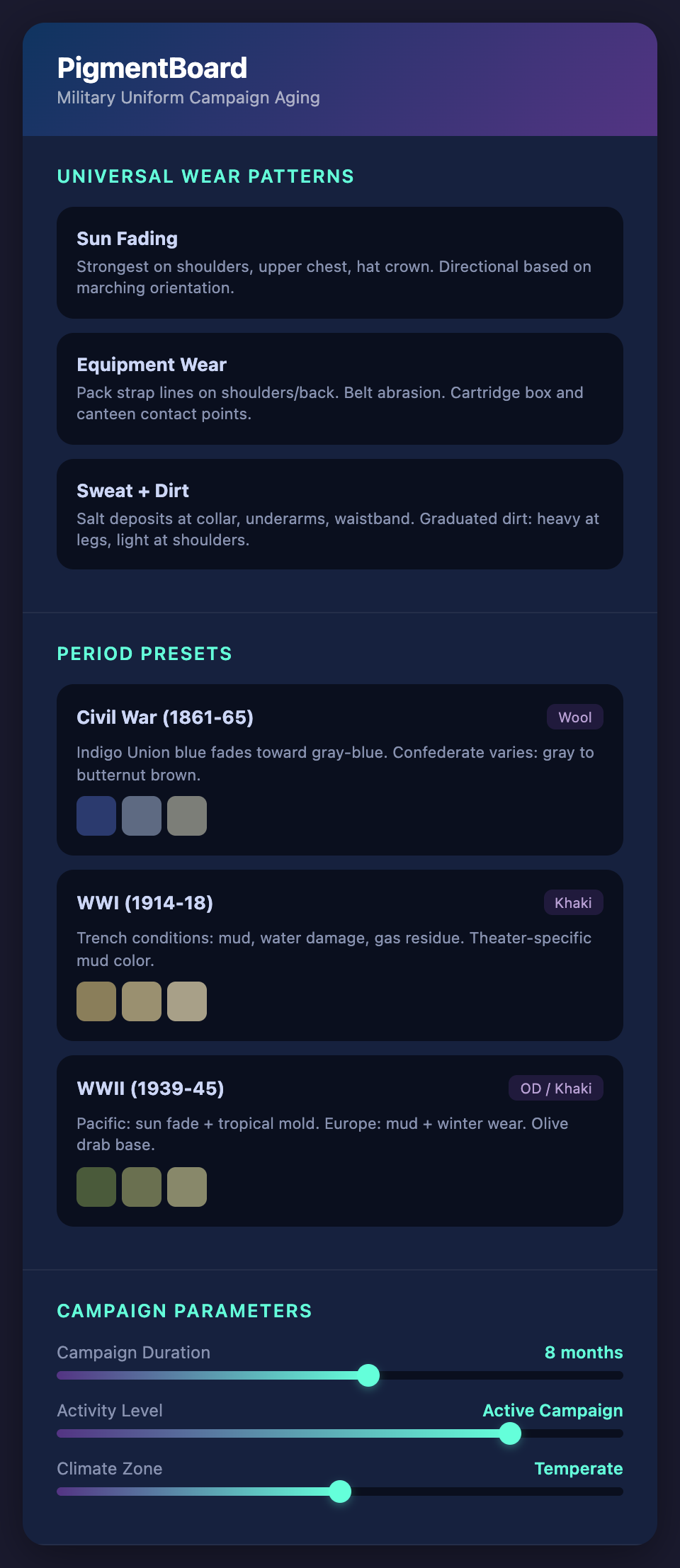
Sun fading: Strongest on shoulders, upper chest, and hat/kepi crown — the horizontal surfaces that receive the most direct sunlight. The back may fade differently from the front depending on marching orientation.
Equipment wear: Pack straps create characteristic wear lines on shoulders and upper back. Belt and cross-belt contact points show compressed, polished wear. Cartridge box and canteen contact points show localized abrasion.
Sweat patterns: Concentrated at collar, underarms, waistband, and inner hat band. Sweat deposits mineral salts that lighten and stiffen the fabric.
Dust and dirt: Graduated from heavy (trouser legs, shoe tops) to moderate (waist and chest) to light (upper body). Color and type depend on geography — red clay, yellow dust, dark mud.
Laundering (or lack thereof): Field conditions meant infrequent laundering. Accumulated grime, salt, and body oil produce a characteristic overall darkening that is different from fresh fabric.
Period-Specific Notes
Civil War (1861-1865): Wool broadcloth uniforms. Indigo-dyed Union blue fades toward gray-blue. Confederate uniforms varied enormously — from proper gray to butternut brown to homespun. Campaign aging could be severe after months in the field.
WWI (1914-1918): Khaki and field gray wool. Trench conditions added mud, water damage, and chemical exposure (gas residue). Aging should include the specific mud color of the theater of operations.
WWII (1939-1945): Olive drab, khaki, field gray. Cotton and wool blends. Theater-specific aging: Pacific campaigns show more sun fading and tropical mold; European campaigns show more mud and winter wear.
The Modeling Approach
Military aging can be modeled with specific parameters:
- Campaign duration: months in the field
- Climate zone: tropical, temperate, arctic
- Activity level: garrison (less wear) vs. active campaign (heavy wear)
- Equipment loadout: determines equipment wear patterns
- Laundering frequency: field conditions vs. garrison laundry
Each parameter set produces a specific aging prediction, ensuring that the costume department can reproduce the exact level and character of aging that the director and military consultant specify.
Want to model campaign-specific military uniform aging? Join the PigmentBoard waitlist.