Communicating Color Aging Specifications to Dye Houses
The Outsourcing Challenge
Large productions or costume rental houses often outsource fabric aging to commercial dye houses. The dye house has the equipment, chemicals, and capacity. What they do not have is the costume designer's creative vision or the historical context of the production.
The specification document bridges this gap. A good spec gets the right result on the first attempt. A vague spec produces expensive rounds of revision.
What the Spec Must Include
1. Target color specification.
- Lab* values (measured from an approved swatch or generated by degradation model)
- Physical reference swatch (attached to the spec document)
- Munsell notation (if applicable)
- Acceptable tolerance (e.g., ΔE < 2.0 from target)
2. Base fabric specification.
- Fabric type, fiber content, supplier, product code
- Pre-treatment requirements (wash out sizing, remove OBAs)
3. Process constraints.
- Any methods that must NOT be used (e.g., "no chlorine bleach on this silk blend")
- Fiber-safe temperature limits
- Finishing requirements (softness, hand, drape)
4. Quantity and timeline.
- Total yardage or number of garments
- Delivery date
- Whether the entire run must be identical or whether controlled variation is acceptable
5. Quality control method.
- How the result will be evaluated (visual comparison under D65, spectrophotometer measurement, or both)
- Who approves (designer, head dyer, or production manager)
- What happens if the result is out of tolerance (re-dye, adjust, or reject)
The Degradation Model as Specification Generator
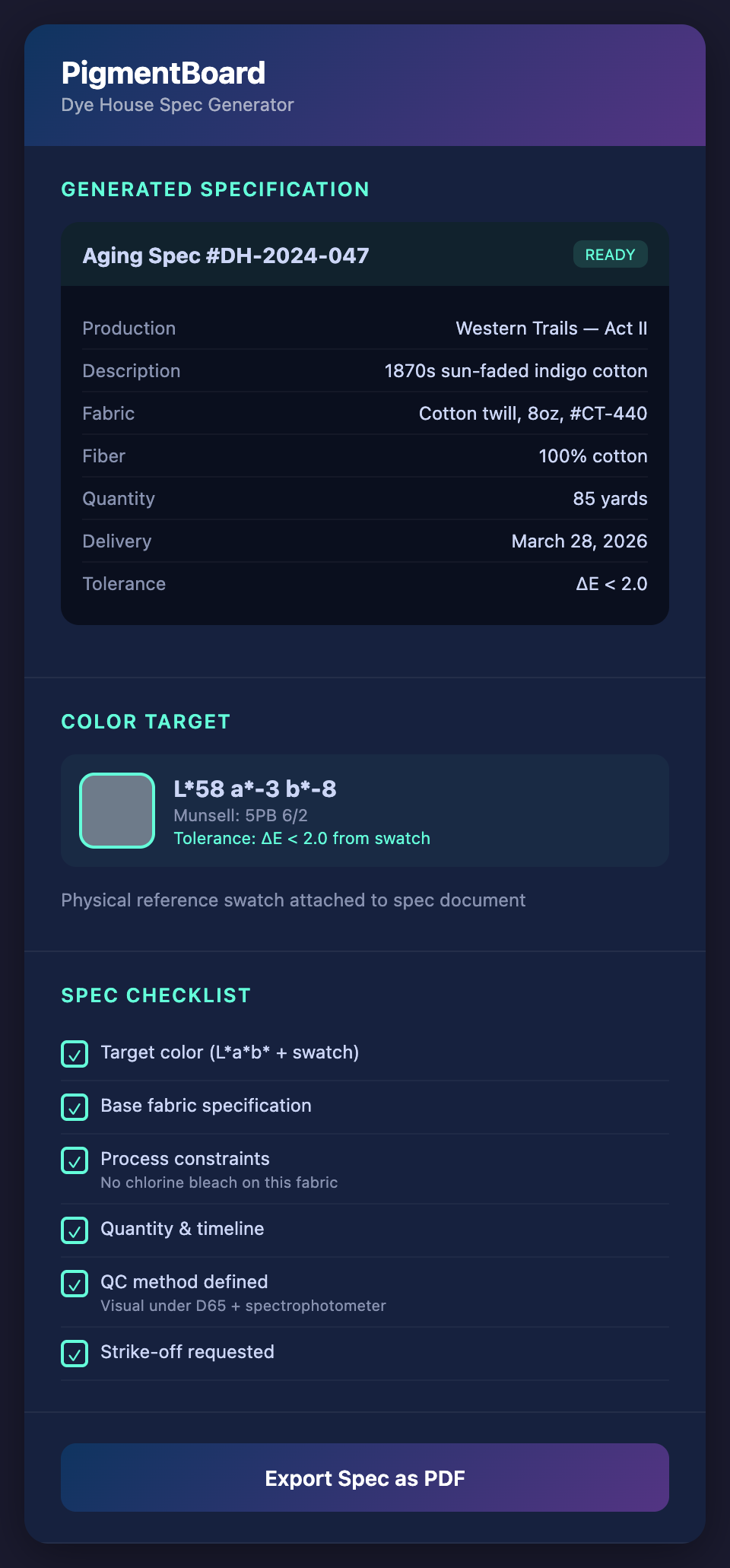
A degradation model translates creative direction into dye house specifications:
- Designer says "1870s sun-faded indigo cotton"
- Model outputs: Lab* = 58, -3, -8 (a grayish medium blue)
- This value becomes the target in the dye house spec
- The dye house matches to the number, not to a subjective description
This eliminates the most common source of miscommunication: different people interpreting the same words differently.
Managing Dye House Relationships
Provide physical swatches, not just numbers. Even with Lab* values, a physical swatch gives the dye house operator a tangible reference.
Request a strike-off. Before the full run, ask the dye house to produce a small sample (strike-off) for approval. This adds a day to the timeline but prevents the entire run from being wrong.
Visit the facility. If possible, visit the dye house and review the strike-off in person, under your controlled lighting. Different lighting at the dye house may cause them to approve a result that looks wrong under your studio's lights.
Build long-term relationships. A dye house that understands your standards, has processed your specifications before, and knows your designer's aesthetic produces better results than a new vendor.
Ready to generate precision dye specifications from degradation models? Join the PigmentBoard waitlist.