Creating Consistent Aged Fabric Across Large Costume Runs
The Scale Problem
A hero costume (the lead actor's garment) receives individual attention. The costume designer and head dyer can spend days achieving the perfect aged quality. But when that same aged quality needs to be replicated across 50 chorus costumes, the individual approach collapses.
Why Consistency Fails at Scale
Human variation. Different dyers perceive and execute "the same" aging differently.
Batch variation. Dye baths change as garments are processed — concentration decreases, pH shifts, temperature varies.
Fabric variation. Even bolts from the same mill lot vary slightly in weight, weave density, and dye uptake.
Process variation. Aging steps (soaking time, bleach concentration, drying conditions) vary between garments unless strictly controlled.
Building a Reproducible Aging Process
Step 1: Define the target. Use degradation modeling to generate a specific color target with Lab* values or a physical reference swatch. This target is the standard against which every garment is measured.
Step 2: Develop the recipe. Through controlled testing, develop a multi-step aging recipe that reliably produces the target color on the specific fabric being used. Document every parameter:
- Dye/bleach concentrations (by weight or volume)
- Bath temperature
- Immersion time
- Agitation method
- Rinse protocol
- Drying method
Step 3: Batch control. Process garments in controlled batches:
- Same number of garments per batch
- Fresh dye/bleach bath for each batch (or measured replenishment)
- Same processing sequence
- Same timing
Step 4: Quality check. Compare a sample from each batch against the reference swatch under controlled lighting. Adjust subsequent batches if drift is detected.
Step 5: Secondary aging. After the base dye treatment, apply localized aging effects (distressing, staining, shadowing) using templates or guides to ensure consistency.
The Degradation Model's Role
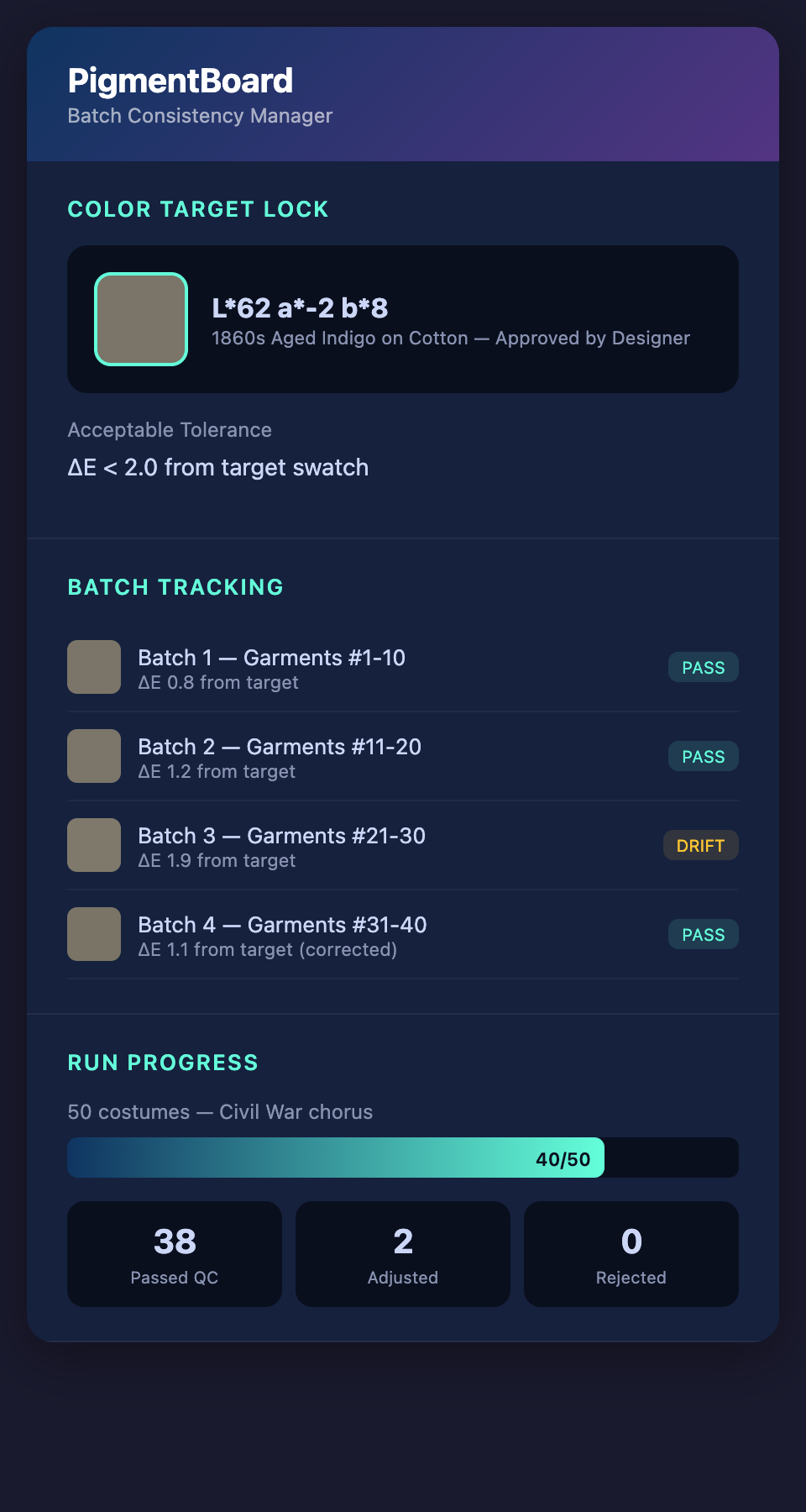
The model provides:
- A specific, measurable color target (not a subjective impression)
- The scientific basis for choosing aging agents (which chemicals replicate which degradation effects)
- Prediction of how the base fabric color will shift under each aging treatment
- A reference point for quality control throughout the run
Practical Tips for Large Runs
Pre-wash everything. All garments should be pre-washed identically to remove sizing and ensure uniform dye uptake.
Use weight-based measurements. "A splash of bleach" is not reproducible. "12ml of 5.25% sodium hypochlorite per liter of water" is.
Control temperature. Dye and bleach reaction rates are temperature-dependent. A 10°C difference in bath temperature changes the result.
Process in order. Label garments numerically and process in order. If batch variation occurs, it creates a gradient that can be managed rather than random variation.
Keep the hero costume as reference. Once the designer approves the hero costume, it becomes the physical standard. Compare every chorus garment against it.
Ready to standardize your aging process with scientific color targets? Join the PigmentBoard waitlist.