Period-Accurate Dye Colors for Victorian Era Productions
The Palette Changed Rapidly
The Victorian era (1837-1901) saw the most dramatic transformation in textile dye history. In 1837, every dye was natural. By 1901, the palette was overwhelmingly synthetic. Costume designers who treat "Victorian" as a single color period are making a historical error.
The Dye Timeline
Pre-1856: The Natural Palette
- Reds: Madder (alizarin), cochineal, brazilwood, safflower
- Blues: Indigo, woad (archaic by this period), Prussian blue (a synthetic mineral pigment, not a dye, but used for printing)
- Yellows: Weld, quercitron, fustic, turmeric
- Greens: Over-dyeing of indigo + yellow; no reliable single green dye
- Purples: Logwood (with chrome mordant), orchil, cudbear
- Blacks: Logwood (with iron mordant), iron gall
- Browns: Cutch, walnut, oak bark, catechu
1856-1870: The Aniline Revolution
- 1856: Mauveine (Perkin's mauve) — the first synthetic dye. Extremely fashionable.
- 1859: Fuchsine (magenta) — brilliant pink-red, hugely popular
- 1862: Aniline blue (Bleu de Lyon)
- 1863: Aniline black — the first reliable black
- 1868: Alizarin synthesized — began replacing natural madder
- Colors from this era are characteristically VIVID — brighter than any previous period. The "aniline craze" produced garments in intense magentas, violets, and blues that had never been seen before.
1870-1890: Synthetic Expansion
- 1876: Methyl violet — range of purples
- 1880: Congo red — first dye that did not need a mordant
- 1884: Synthetic indigo becomes commercially viable
- The palette becomes increasingly diverse. Both natural and synthetic dyes are used, sometimes on the same garment.
1890-1901: Synthetic Dominance
- Natural dyes are largely replaced except for specialty applications
- The color range is essentially unlimited
- New color categories (specific shades of teal, chartreuse, cerise) become possible
Production Implications
Know the decade. A costume for 1855 should not contain magenta (Perkin invented mauveine in 1856). A costume for 1845 should not contain chrome yellow on fabric (though it was available for paint).
Match the saturation to the era. Pre-1856 colors are generally more muted than post-1860 colors. The aniline dyes of the 1860s-1870s are strikingly vivid. Colors from the 1880s-1900s are diverse but somewhat more restrained than the initial aniline craze.
Account for aging. Aniline dyes fade dramatically — much more than natural dyes. A garment that was vivid magenta in 1860 would be pale lilac or grayish-pink by 1880. If your production is set in 1880 but the garment is supposed to be "a few years old," it should already show significant fading.
Aging Aniline Dyes
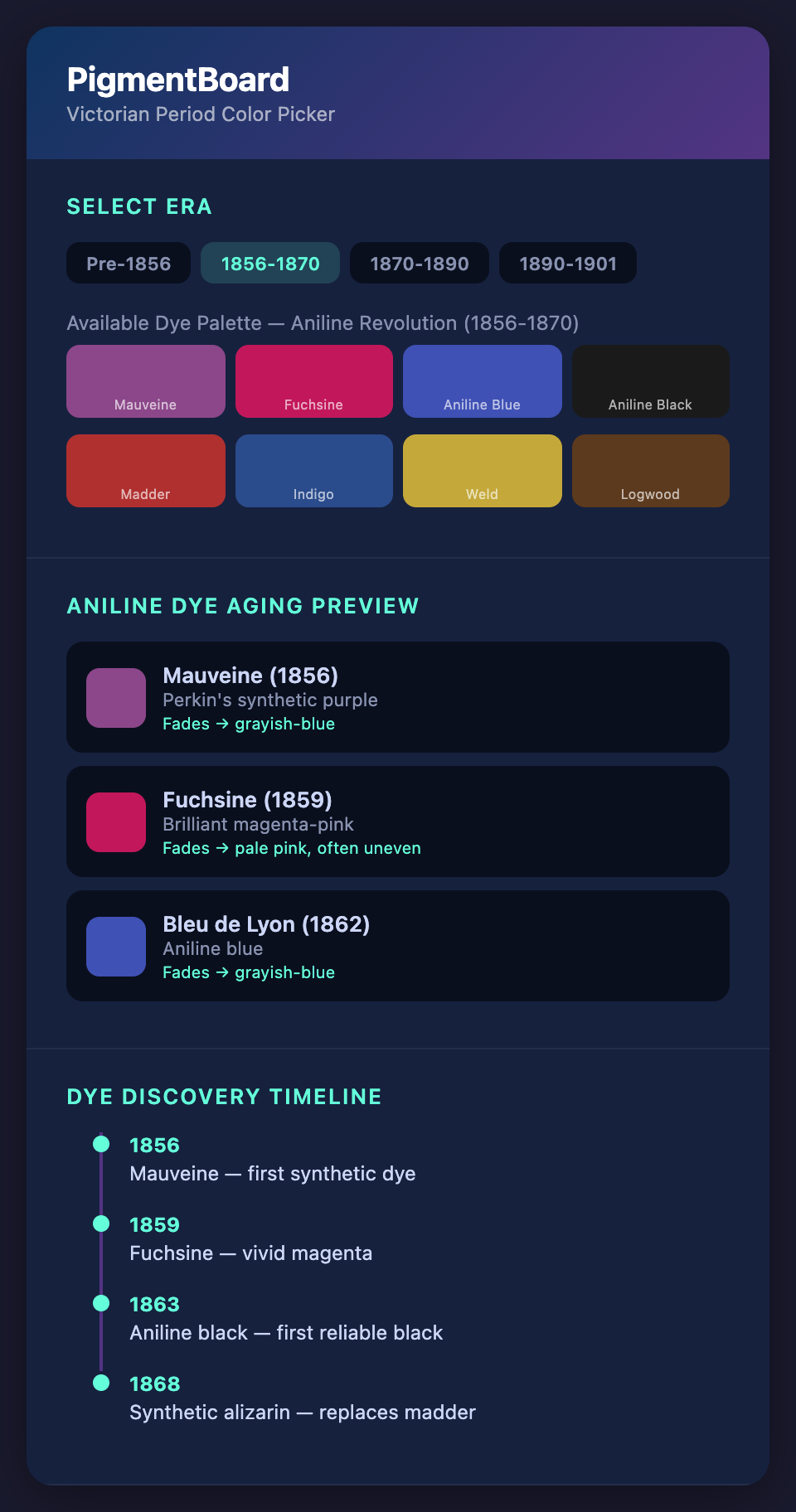
Early synthetic dyes have specific and often dramatic fading patterns:
- Mauveine fades from purple toward grayish-blue
- Fuchsine fades from vivid pink-red toward pale pink, often unevenly
- Aniline blue fades toward grayish-blue
- Aniline black is relatively stable but can develop a greenish or bronzy cast
These fading patterns differ from natural dye fading, and a degradation model needs to account for the specific dye type, not just "old red" or "old blue."
Working With Designers
Help designers make historically informed color choices:
- Provide a period-specific color palette for their production's era
- Explain the difference between "the color when new" and "the color after 20 years of wear" — both are period-accurate, but they look different
- Show reference images from museum collections of surviving garments from the target era
- Demonstrate how the degradation model predicts aging for specific period colors
Ready to dial in era-specific aged colors for your next Victorian production? Join the PigmentBoard waitlist.