Reducing Fabric Waste in Costume Aging Through Digital Preview
The Waste Problem
Costume aging through dyeing, bleaching, and chemical treatment is inherently destructive and irreversible. Once you have over-bleached a fabric or dyed it the wrong shade of aged brown, you cannot undo it. The fabric becomes waste.
For theater and film productions with tight budgets, this waste is significant:
- Fabric cost: Period-appropriate fabrics (woolens, silks, fine cottons) are expensive. Specialty fabrics can cost $30-100+ per yard.
- Dye and chemical cost: Professional textile dyes, discharge chemicals, and finishing agents add up.
- Labor cost: Each test cycle consumes hours of skilled dyer time.
- Time cost: Failed aging attempts consume days that cannot be recovered against a hard opening night or shoot date.
Where Waste Occurs
Trial-and-error testing. The traditional approach: age a test swatch, compare to the design reference, adjust, repeat. Each failed test is a swatch of wasted fabric.
Over-processing. The dyer goes one step too far — too much bleach, too long in the dye bath, too heavy with the aging spray. The result cannot be rescued.
Inconsistency across runs. Garment #15 in a batch comes out too dark or too light. It does not match the others and must be rejected or reworked.
Color miscommunication. The designer says "aged dusty rose" and means something different from what the dyer produces. Several yards of fabric are processed to the wrong target.
Digital Preview as Waste Prevention
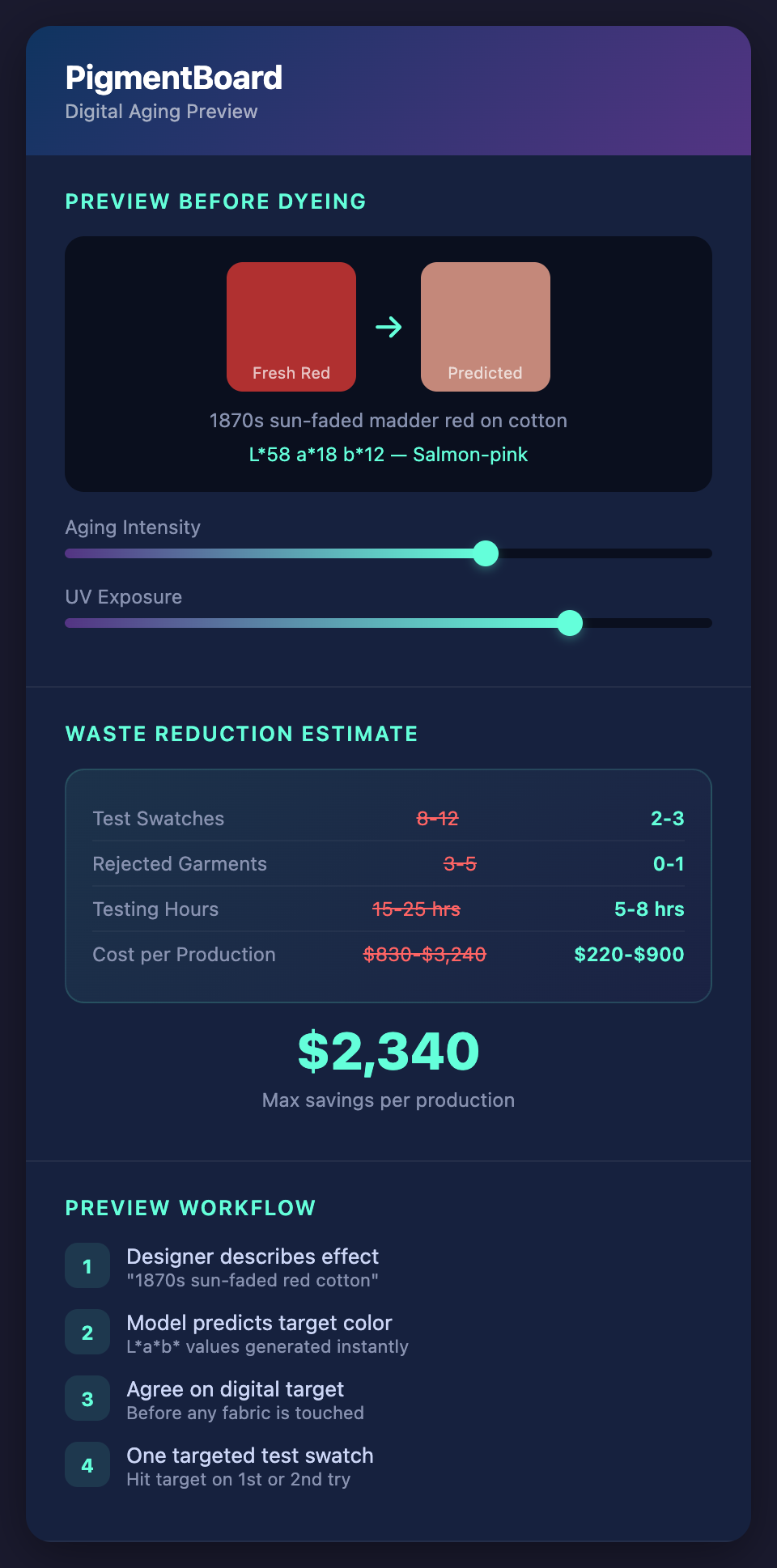
A degradation modeling tool can reduce waste at every stage:
Before any dye touches fabric:
- The designer describes the desired effect ("1870s sun-faded red cotton")
- The dyer inputs the parameters into the degradation model (era-appropriate dye, years of aging, UV exposure level)
- The model outputs a specific color prediction
- The designer and dyer agree on the digital target BEFORE any fabric is touched
This eliminates the most expensive waste: color miscommunication.
During recipe development:
- The model suggests which aging agents will produce the target color shift
- The dyer creates a small test (one swatch, not ten)
- If the first swatch is close (and it should be, because the model guided the recipe), minor adjustment gets it right on the second try
- Total test swatches: 2-3 instead of 8-10
During production runs:
- The model provides a measurable color target for quality control
- Each batch is checked against the target
- Drift is detected early (after one garment, not after twenty)
- Corrections are made before significant waste accumulates
Quantifying the Savings
A typical period production aging process without digital preview:
- 8-12 test swatches at $10-20 each in fabric = $80-240
- 3-5 rejected garments at $50-200 each = $150-1,000
- 15-25 hours of testing time at $40-80/hour = $600-2,000
- Total waste per production: $830-3,240
With digital preview:
- 2-3 test swatches = $20-60
- 0-1 rejected garments = $0-200
- 5-8 hours of testing time = $200-640
- Total waste per production: $220-900
Savings: $600-2,340 per production
For a costume house doing 6-10 productions per year, annual savings of $3,600-23,400 are realistic.
Beyond Cost: The Time Savings
In production, time is often more valuable than money. Digital preview compresses the aging development timeline:
- Traditional: 2-3 weeks of iterative testing before production aging begins
- With digital preview: 3-5 days of targeted testing before production aging begins
Those recovered days are available for other production tasks — fitting, construction, detailing, dress rehearsal preparation.
Ready to preview aging digitally and eliminate fabric waste? Join the PigmentBoard waitlist.