Standardizing Aging Recipes Across Entire Costume Runs
Why Standardization Matters
In a long production run (months of performances for theater, weeks of shooting for film), costumes wear out, get damaged, and need replacement. If the aging treatment was done by feel, recreating it on a replacement garment is a stressful guessing game under deadline pressure.
Standardized recipes solve this by making every aging treatment reproducible.
The Recipe Format
A complete aging recipe documents:
Garment identification: Production name, character, garment type, fabric type.
Target color: Lab* values, Munsell notation, and/or a physical reference swatch stored with the recipe.
Base fabric: Supplier, product code, fiber content, pre-treatment (washing instructions).
Step-by-step process:
| Step | Agent | Concentration | Temperature | Duration | Agitation | Notes |
|---|---|---|---|---|---|---|
| 1 | Pre-wash | [Detergent], [amount] | [Temp] | [Time] | [Method] | Remove sizing |
| 2 | Base dye | [Dye name], [g/L] | [Temp] | [Time] | [Method] | To base aged color |
| 3 | Discharge | [Agent], [concentration] | [Temp] | [Time] | [Method] | Selective fading |
| 4 | Over-dye | [Dye name], [g/L] | [Temp] | [Time] | [Method] | Aging tint |
| 5 | Distress | [Method] | N/A | [Duration] | N/A | Wear simulation |
| 6 | Final rinse | [Method] | [Temp] | [Time] | [Method] | Fix and clean |
Finishing: Pressing method, final spray treatments, any surface applications.
Quality check: Color comparison method, acceptable tolerance, reference swatch location.
Building the Recipe
- Define the target using degradation modeling
- Develop the process through controlled testing (with documented parameters at each step)
- Validate by producing the first production garment and comparing to the target
- Refine if the first garment is not within tolerance
- Lock the recipe once it produces consistent results
- Store the recipe with the production documentation AND a physical reference swatch
Mid-Run Replacement Procedure
When a replacement garment is needed mid-run:
- Pull the recipe file
- Source the same base fabric (same supplier, same product code)
- Follow the recipe exactly
- Compare the result to the reference swatch under controlled lighting
- Adjust only if the batch shows deviation (different fabric lot, different chemical batch)
This procedure should produce a match within one or two attempts — compared to starting from scratch with trial and error.
Cross-Production Reuse
Recipes can be reused across productions:
- "Standard aged white cotton (1860s)" becomes a base recipe adaptable to multiple Civil War productions
- "Standard smoke-yellowed linen" serves any production needing period yellowish linen
- A library of validated aging recipes, built over years, becomes one of the costume house's most valuable assets
The Degradation Model as Recipe Generator
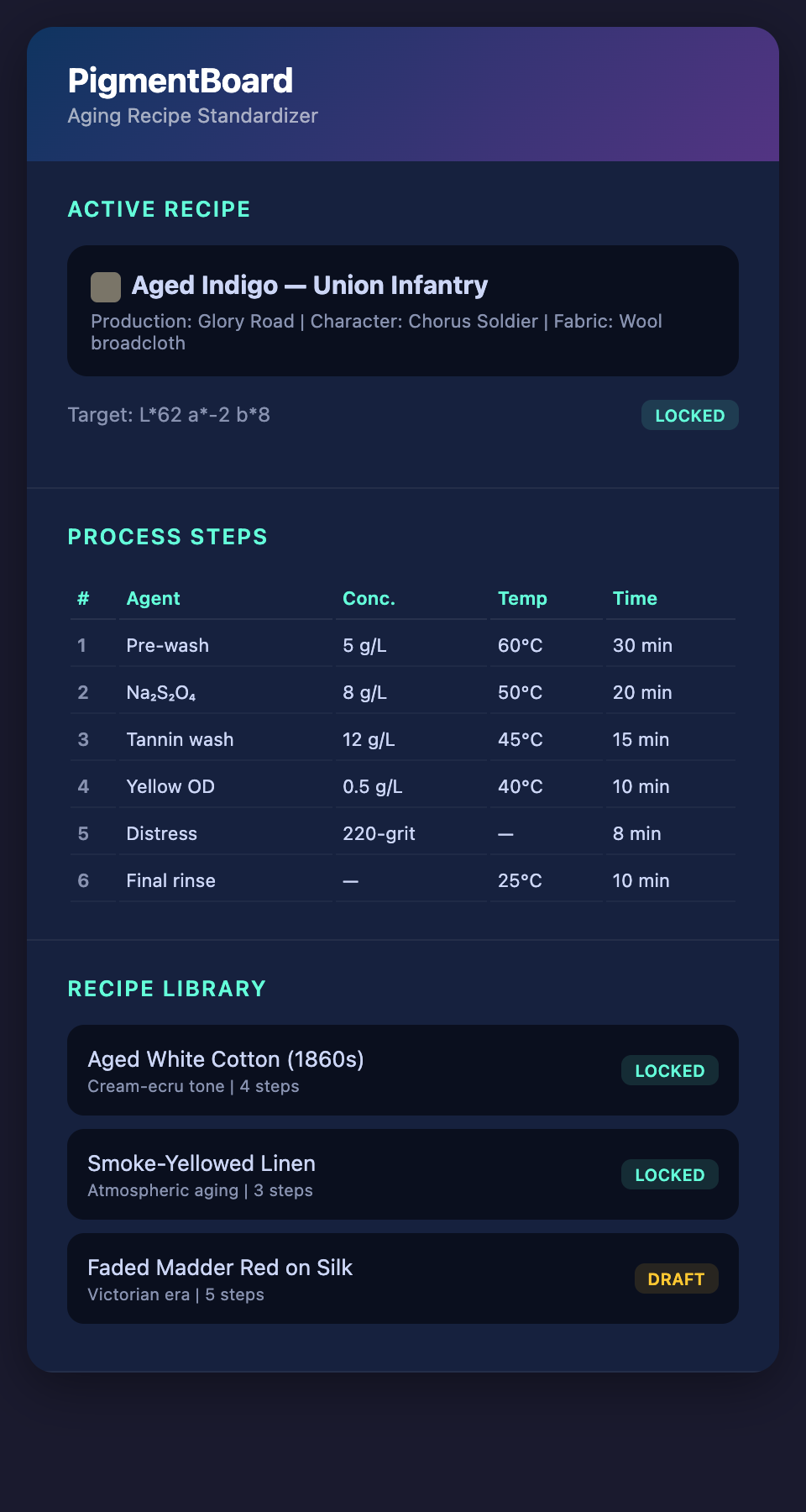
The model accelerates recipe development by:
- Predicting the target color for any era, dye, and aging scenario
- Suggesting which aging agents produce the required color shift
- Enabling the dyer to start from an informed prediction rather than guessing
Want to generate standardized aging recipes from degradation predictions? Join the PigmentBoard waitlist.