Working With Costume Designers Who Think in Mood Not Munsell
The Translation Problem
Costume designers are visual thinkers who communicate in references, feelings, and associations. They might say:
- "Dusty, like it has been sitting in an attic for decades"
- "Sun-bleached, but with warmth — not cold"
- "The blue of a well-worn chambray work shirt, not a fashion denim"
- "Like the last color before it fades to nothing"
These are evocative, useful descriptions. They are also unmeasurable and unreproducible. The dyer's job is to translate this creative vision into a specific, achievable color target — without losing the emotional quality the designer is after.
Building a Translation Process
Step 1: Collect visual references. Ask the designer for images: photographs of museum textiles, paintings, film stills, fabric samples, anything visual. "Show me what you mean" is more productive than "tell me what you mean."
Step 2: Identify the degradation story. From the references and the designer's description, determine:
- What was the original color? (Era-appropriate dye and shade)
- What happened to it? (Sun, wear, washing, smoke, age)
- How much aging? (A few years? A few decades? A lifetime?)
Step 3: Model the degradation. Input the identified parameters into a degradation model to generate a specific color target.
Step 4: Present the prediction. Show the designer the model's output — either as a digital color sample or a quickly dyed test swatch. Ask: "Is this the feeling you described?"
Step 5: Adjust collaboratively. The designer's feedback ("warmer," "a little more faded," "less gray") translates directly into model parameter adjustments. Slide the UV fader up for more fading. Adjust the oxidation channel for more brown. The designer sees the result change in real time.
Step 6: Lock the target. When the designer approves, the model parameters and output color are locked as the production specification.
The Language Bridge
Over time, build a shared vocabulary with your regular designers:
- "Dusty" typically means low chroma, slightly warm, with a gray quality → Model: moderate UV + moderate atmospheric exposure
- "Sun-bleached" means reduced chroma with a shift toward the UV degradation pathway of the specific dye → Model: high UV, low humidity
- "Warm" means the aging has produced brown oxidation products rather than cool gray fading → Model: emphasize oxidation over UV
- "Fresh fade" means moderate lightening without the accumulated grime of long aging → Model: moderate UV, low atmospheric exposure
Common Communication Pitfalls
"Make it old." Too vague. What kind of old? Sun-faded old? Attic-stored old? Well-worn old? Smoke-darkened old? Each is a different degradation profile.
"Like the reference, but different." Ask specifically: "What should be different? Lighter? Darker? Warmer? Cooler? More worn? Less worn?"
"I'll know it when I see it." The most challenging directive. Prepare 3-5 options at different aging levels and let the designer choose. Then lock the chosen target.
"Can you make it more... you know?" Gentle probing: "More faded? More warm? More distressed? More natural?" Usually one of these hits.
Why Degradation Modeling Helps the Conversation
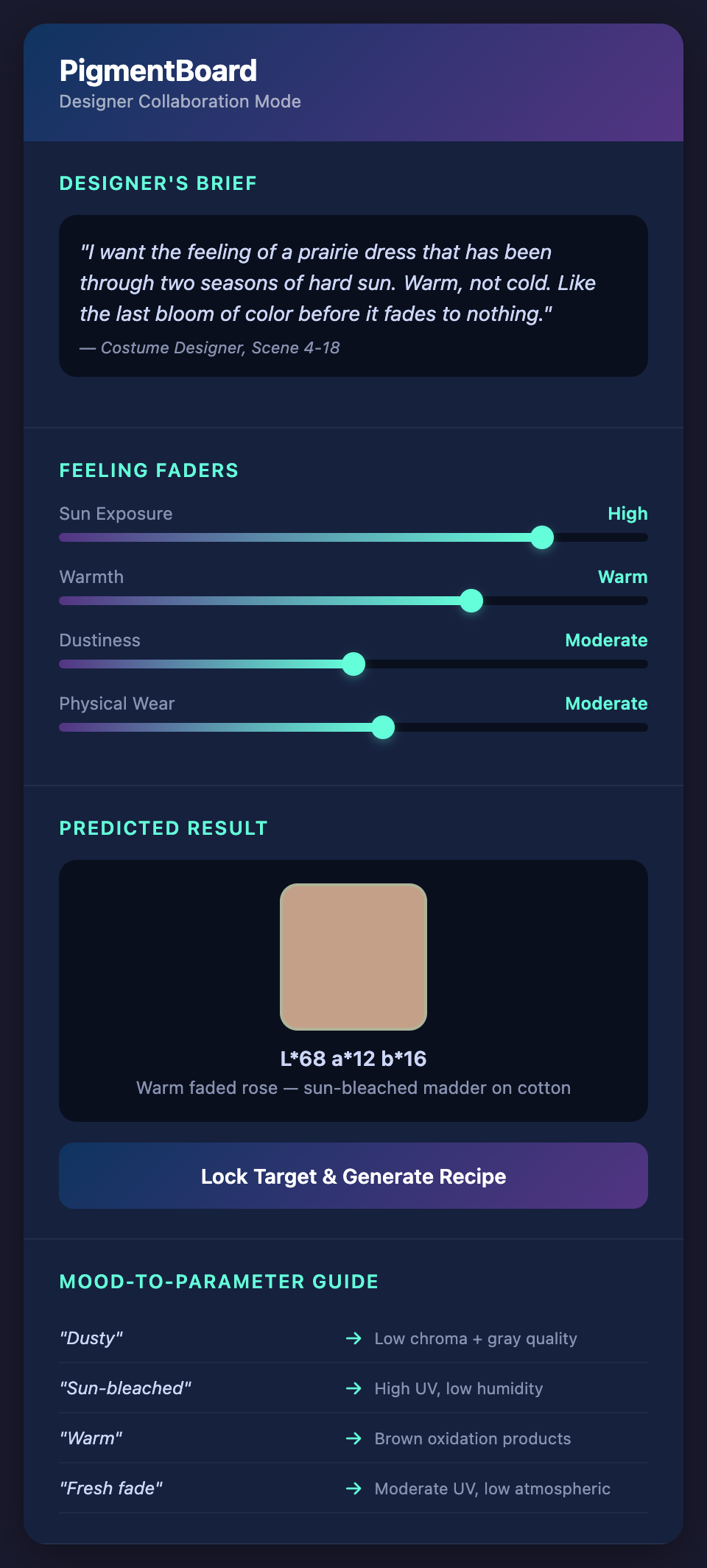
The model serves as a shared visual tool between designer and dyer:
- The designer adjusts the "feeling" by moving faders
- The dyer translates the fader settings into chemical processes
- Both see the same predicted result
- Neither needs the other's technical vocabulary
This transforms a potential communication struggle into a collaborative, iterative, visual process.
Ready to bridge the gap between creative vision and reproducible dye specs? Join the PigmentBoard waitlist.