How Biological Agents Alter Pigments in Stored Textiles
The Living Threat to Color
When conservators think about pigment degradation, they think about light, oxygen, humidity, and pollutants — abiotic, chemical processes. But many historic textiles, especially those that have been in uncontrolled storage, carry the marks of biological degradation: mold, bacteria, and insect activity that chemically alters pigments in distinctive ways.
Biological degradation is the fifth major factor in pigment color change, and it produces signatures that cannot be predicted by UV, oxidation, humidity, or pollutant models alone.
How Mold Changes Color
Mold affects textile pigments through several mechanisms:
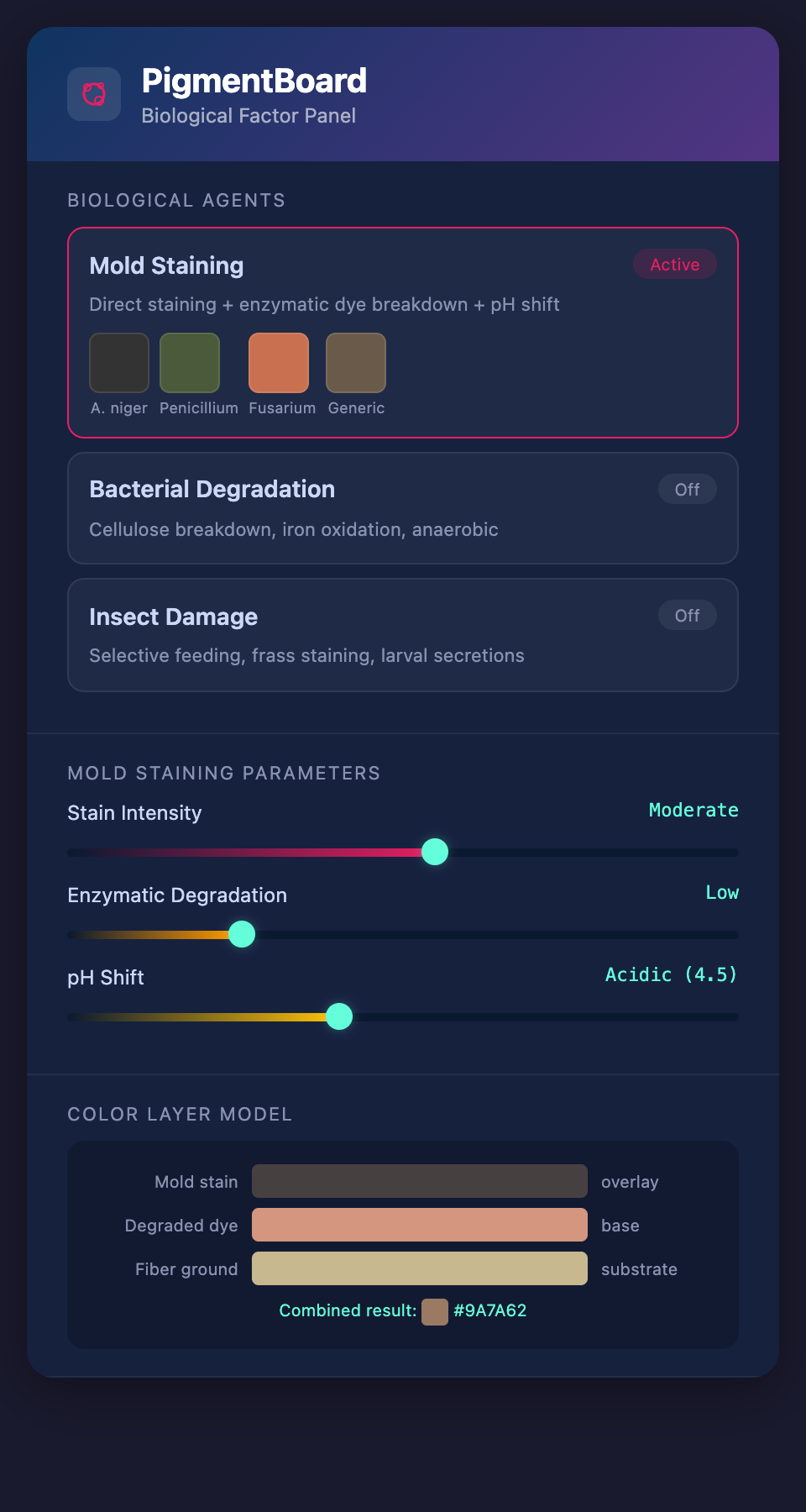
Direct staining. Many mold species produce pigmented metabolic byproducts (mycotoxins and other compounds) that stain fibers. These stains range from black (Aspergillus niger) to green (Penicillium species) to pink or orange (Fusarium species). The stain overlays the original dye color, creating a compound color that is neither the original nor a simple fade.
Enzymatic degradation. Mold produces enzymes (cellulases, proteases, oxidases) that break down both fibers and dyes. These enzymatic attacks are chemically different from abiotic oxidation — they target specific molecular structures and produce different degradation products.
pH alteration. Mold metabolism produces organic acids that lower the local pH. Many historic dyes are pH-sensitive:
- Litmus and other pH-indicator dyes shift color dramatically
- Madder shifts toward orange in acidic conditions
- Indigo can be reduced (and partially dissolved) by some mold metabolites
- Iron mordant complexes can be disrupted by organic acid chelation
Moisture retention. Mold-affected areas retain more moisture than clean areas, creating localized high-humidity zones that accelerate other degradation mechanisms.
Bacterial Degradation
Bacteria are less commonly identified in textile degradation than mold, but they are present, especially in textiles that have been wet or buried:
- Cellulose-degrading bacteria break down cotton and linen fibers, weakening the substrate and altering how dyes are presented
- Purple sulfur bacteria can produce colored metabolites on organic-rich textiles stored in anaerobic conditions
- Iron-oxidizing bacteria can transform iron mordants, changing the color of iron-complexed dyes
Insect Damage and Color
Insects (carpet beetles, clothes moths, silverfish) primarily cause physical damage — consuming fibers and creating holes. But their activity also affects color:
- Selective feeding — Some insects preferentially consume certain fibers or dye-treated areas, creating uneven color loss
- Frass staining — Insect excrement (frass) can stain surrounding areas, typically in brown or dark tones
- Larval secretions — Moth larvae produce alkaline secretions that can shift dye colors locally
Identifying Biological Degradation in Color Assessment
Before attempting to match a biologically degraded textile, you need to identify the biological component:
Visual clues:
- Spotty, irregular discoloration (vs. the gradual gradients of light damage)
- Fuzzy or powdery surface deposits (active or residual mold growth)
- Circular or irregular tide lines from moisture associated with mold growth
- Localized darkening or staining not explainable by light exposure patterns
- Physical damage (fiber loss, holes, brittleness) accompanying color change
Smell: Musty, earthy odors indicate current or recent mold activity.
Microscopic examination: A stereomicroscope reveals mold hyphae, spore structures, insect frass, and larval webbing that confirm biological agency.
UV fluorescence: Some biological degradation products fluoresce distinctively under UV light, helping map the extent of biological damage.
Implications for Color Matching
Biological degradation creates unique color-matching challenges:
1. The color change is layered, not transformed. Unlike UV fading (which changes the dye molecule itself) or oxidation (which changes the dye's chemistry), biological staining often adds a colored layer on top of the original dye. Matching requires accounting for both the underlying dye color and the overlying stain.
2. Cleaning may change the target. If the textile will be cleaned to remove mold staining before repair, the target color after cleaning will be different from the target color before cleaning. Match to the post-cleaning color, not the pre-cleaning color.
3. The degradation may be localized. Biological damage is often patchy — one area may be heavily mold-stained while an adjacent area is clean. This creates steep color gradients that are difficult to match with a single formula.
4. Multiple biological agents may be present. A textile may have both mold staining and insect frass discoloration, each producing different color effects in different areas.
Factoring Biology Into Degradation Models
A comprehensive degradation model needs a biological factor, though it operates differently from the abiotic factors:
- Abiotic factors (UV, oxidation, humidity, pollutants) produce predictable, gradual, chemistry-based color changes
- Biological factors produce more variable, localized, and compound color changes
The biological fader in a degradation model might control:
- Intensity of mold staining (from none to heavy)
- Color of mold staining (brown, gray, green, black — depending on species)
- Degree of enzymatic dye degradation
- Extent of pH-related color shifts
Because biological degradation is inherently more variable than abiotic degradation, the model output should be treated as an approximation that requires more visual fine-tuning than an abiotic-only prediction.
Practical Workflow for Biologically Degraded Textiles
- Identify and document all biological degradation before any treatment
- Determine whether cleaning will precede repair — this changes the target color
- Separate biological staining from dye degradation — look for areas where only one factor is active
- Model the abiotic degradation (UV, oxidation, humidity) first, to understand what the color would be without biological damage
- Add the biological layer — account for the staining, enzymatic damage, and pH effects
- Match to the combined result — the final target is the abiotic degradation plus the biological modification
- Verify extensively — biological degradation creates more variability, so check the match across a larger area
Prevention Is Better Than Matching
While this article focuses on matching biologically degraded colors, prevention is always preferable:
- Maintain storage environments at 45-55% RH and 65-70°F to discourage mold
- Ensure good air circulation in storage areas
- Implement integrated pest management (IPM) programs
- Inspect collection items regularly for early signs of biological activity
- Respond immediately to any water intrusion or humidity excursion
Need to model biological degradation alongside UV, humidity, and pollution factors? Join the PigmentBoard waitlist for the most comprehensive degradation modeling tool in conservation.