Cross-Referencing Dye Recipes With Degradation Data for Accurate Matches
The Power of Knowing What Was There
The most challenging part of matching a faded pigment is identifying the original dye. When a color has faded to a pale ghost, visual clues may be ambiguous. Historic dye recipe books provide a shortcut by narrowing possibilities based on date, origin, and fiber type.
The Literature of Dyeing
An extensive body of historic dye literature survives: published manuals (Bancroft, Hellot, Crookes), trade journals (The Textile Colourist, Journal of the Society of Dyers and Colourists), company sample cards and shade books, and patent literature for synthetic dyes post-1856.
How to Use Historic Recipes
Step 1: Date the textile. Pre-1856 means exclusively natural dyes. 1856-1880 sees early synthetics alongside naturals. Post-1880, synthetics increasingly dominate.
Step 2: Identify geographic origin. Different regions had different dyeing traditions and material access.
Step 3: Identify fiber type. Some dyes only work on certain fibers.
Step 4: Consult the literature for most likely recipes given date, origin, and fiber.
Step 5: Cross-reference with analytical data to confirm identification.
From Recipe to Degradation Model
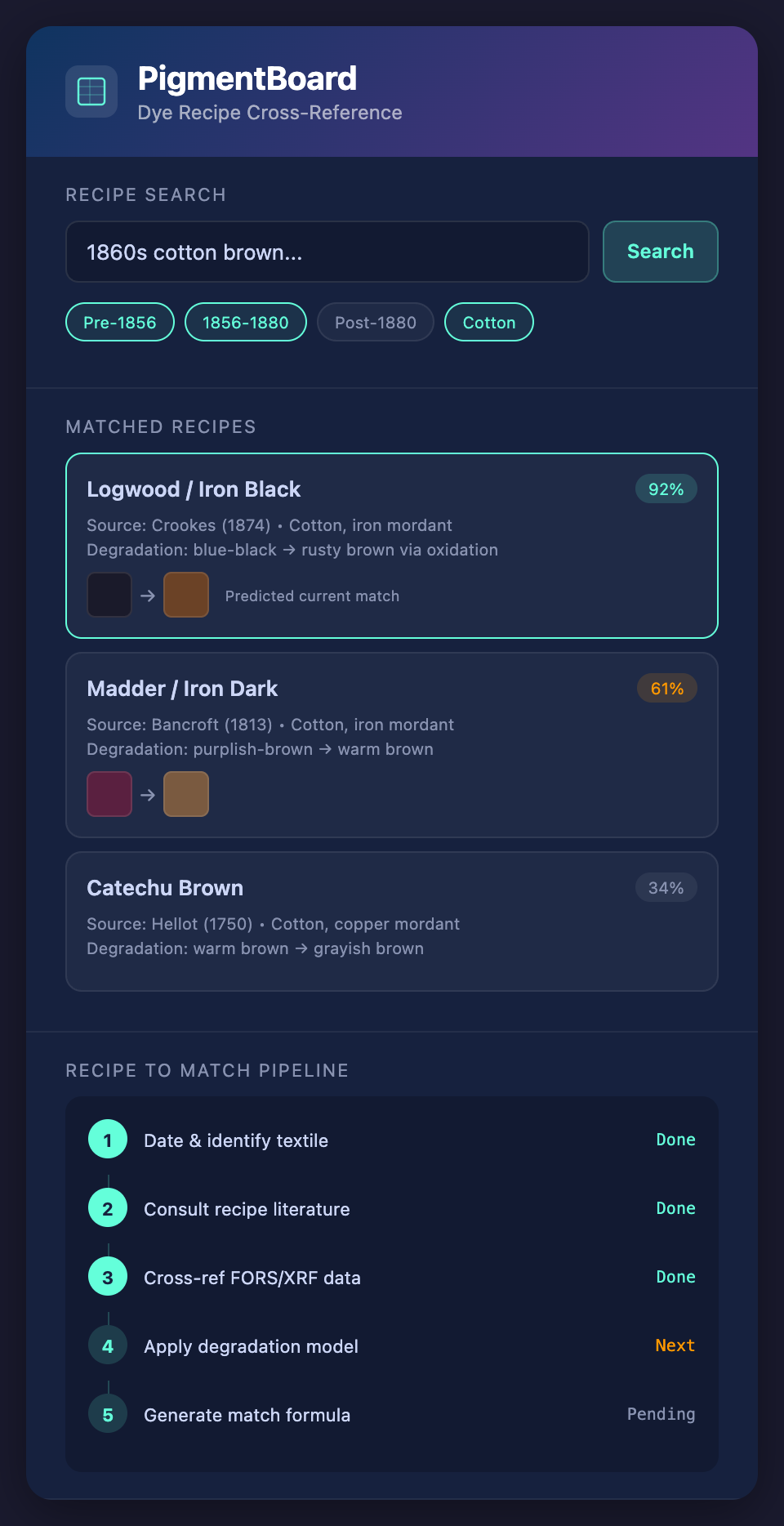
The recipe gives you: known starting color, known degradation pathway specific to the dye-mordant-fiber combination, known vulnerability factors (tin mordant, surface vs. vat application), and known interaction effects from multi-dye recipes.
Case Study: Matching a Mystery Brown
An 1860s cotton quilt's brown could originally have been brown, red, purple, green, or black. Recipe research plus FORS/XRF analysis identifies it as degraded logwood/iron black, enabling the correct degradation model and spectrally appropriate match.
Building a Recipe-Degradation Database
Over time, link historic recipes with analytical results, documented degradation pathways, and successful matching formulas. This database reduces research time and provides validated models for common dye systems.
Ready to connect historic dye recipe knowledge with precision degradation modeling? Join the PigmentBoard waitlist.