Ethical Considerations in Visible vs. Invisible Conservation Repairs
The Fundamental Tension
Conservation has a paradox at its core. On one hand, we want repairs to be invisible — to restore the object's visual integrity so it can be experienced as the maker intended. On the other hand, we value honesty — we do not want repairs to be mistaken for original material, misleading scholars and future conservators.
This tension between visual integration and legibility of treatment is one of the most debated topics in conservation ethics. The answer is not universal, and every conservator must navigate it for each object they treat.
The Case for Invisible Repairs
Aesthetic integrity. The object was created as a unified whole. A visible repair disrupts the visual experience, drawing the viewer's attention to damage rather than artistry. For textile art, where color harmony is central to the aesthetic experience, visible repairs can fundamentally alter how the work is perceived.
Visitor experience. Museum visitors, especially general audiences, engage more deeply with objects that appear complete and authentic. Visible repairs can create a sense of compromised quality that diminishes the object's impact.
Historical presentation. For textiles displayed as examples of period craftsmanship, technology, or fashion, visible repairs distract from the historical narrative. The viewer should be seeing "1820s chintz," not "1820s chintz with some modern patches."
Reversibility mitigates risk. If the repair is fully reversible — and modern conservation materials generally are — the ethical risk of an invisible repair is reduced. Future conservators can remove it if standards change.
The Case for Visible Repairs
Scholarly honesty. Researchers examining the textile need to distinguish original material from restoration. An invisible repair that is mistaken for original material can lead to incorrect conclusions about the original dyes, techniques, or conditions.
Conservation documentation. While all repairs should be documented in written records, experience shows that documentation can be lost, separated from the object, or simply not consulted. A deliberately visible (or easily detectable) repair is self-documenting.
Respect for the object's history. Some conservation philosophies hold that damage and aging are part of the object's history and should not be concealed. The faded, worn textile tells a story of use, display, and survival that invisible repair erases.
Preventing deception. In the art market, invisible repairs can mask damage that affects value. While museum conservation is not motivated by market value, the principle of transparency supports visible treatment.
International Standards and Guidelines
The major conservation organizations offer guidance but not rigid rules:
AIC Code of Ethics (American Institute for Conservation): "The conservation professional must strive to select methods and materials that, to the best of current knowledge, do not adversely affect cultural property or its future examination, scientific investigation, treatment, or function."
This supports reversibility but does not specifically mandate visible or invisible repairs.
ICOM Code of Ethics: "Conservation and restoration of specimens must be carried out with the principal aim to maintain the integrity... All alterations should be clearly distinguishable from the original object and should be documented."
This leans toward legibility — "clearly distinguishable" suggests visible repairs. But "clearly distinguishable" can also be achieved through documentation and UV-detectable materials rather than visible color differences.
ECCO Guidelines (European Confederation of Conservator-Restorers' Organisations): "Conservation-Restoration actions should not be detrimental to cultural heritage properties and should be proportionate to the situation... Any action must as far as possible be compatible with future treatments."
This focuses on proportionality and future-compatibility rather than prescribing visibility.
The Spectrum of Approaches
In practice, most conservators work somewhere along a spectrum:
Fully invisible — The repair is indistinguishable from the original under normal viewing conditions. Detectable only by technical examination (UV fluorescence, spectral analysis) or by consulting treatment records.
Tonally integrated — The repair matches the overall tone and value of the surrounding area but does not attempt to replicate specific details (patterns, textures). Blends at normal viewing distance but is identifiable upon close examination.
Discernible on close inspection — The repair is deliberately set slightly off-tone or uses a different texture, so that a careful observer can identify it without technical equipment. Unobtrusive from normal viewing distance.
Clearly visible — The repair is made in a neutral tone or contrasting material that is immediately recognizable as restoration. Common in archaeological textiles and some European conservation traditions.
Context-Dependent Decision Making
The appropriate approach depends on multiple factors:
Object type and significance:
- A unique masterwork may warrant invisible repair to preserve its aesthetic impact
- A study collection piece may be better served by visible repairs that preserve scholarly access to original materials
Display context:
- Gallery display for general audiences favors more integrated repairs
- Study room access for researchers may favor more visible repairs
Extent of damage:
- Small, isolated areas of loss can be invisibly repaired without significantly affecting scholarly interpretation
- Extensive loss may warrant visible repairs that honestly communicate the extent of damage
Institutional philosophy:
- Different museums have different traditions. Some lean toward minimal, visible intervention. Others favor full visual integration.
Client wishes (for private conservation):
- Private owners may specifically request invisible or visible repairs based on their preferences
How Color-Matching Technology Affects the Debate
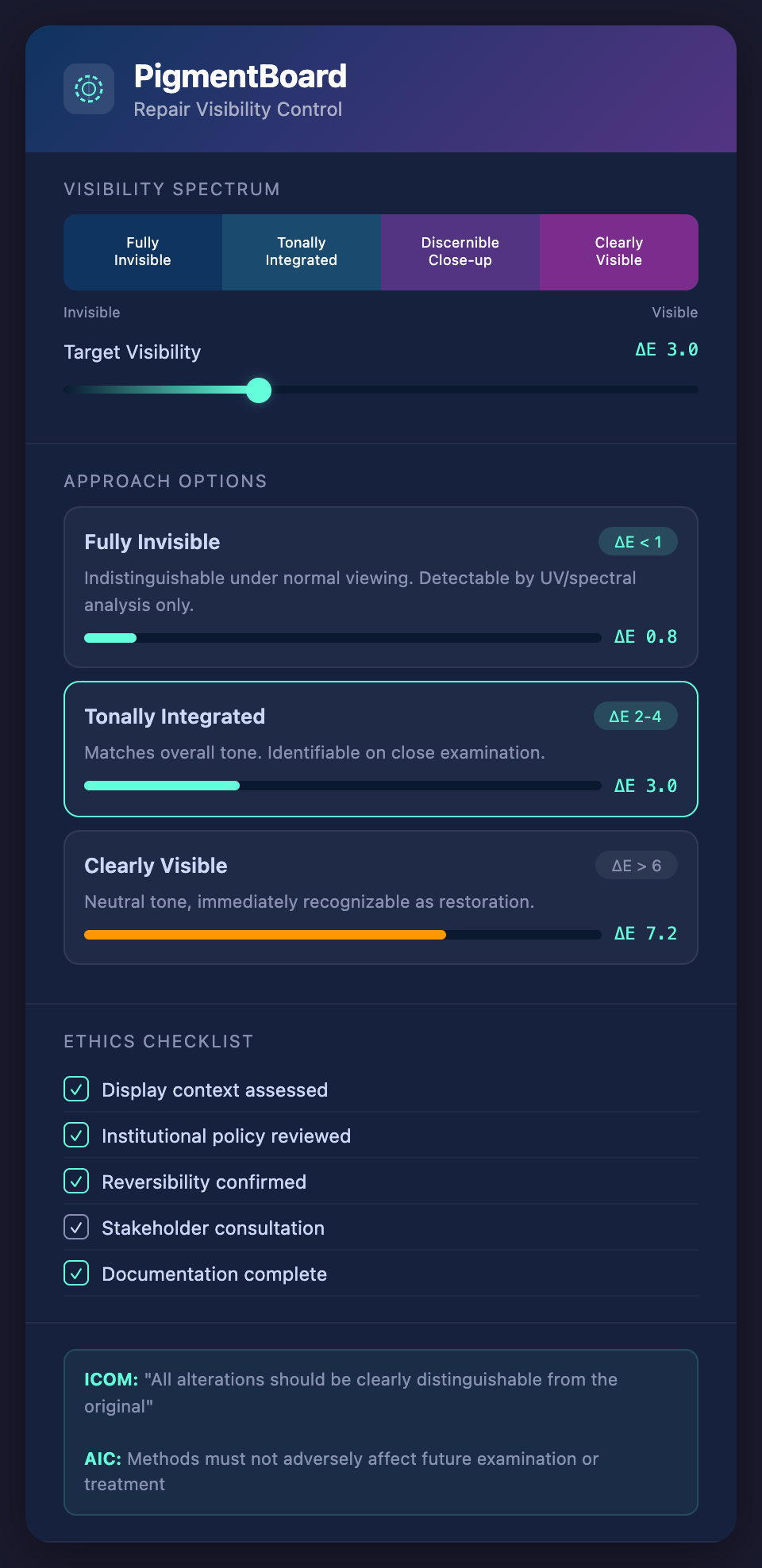
Better color-matching tools do not resolve the ethical debate — but they change it in important ways:
More choice. When color matching is expensive and uncertain, conservators may default to discernibly different repairs simply because achieving invisible matches is too difficult. Better tools give conservators the option of invisible repair, making the choice genuinely ethical rather than constrained by capability.
Graduated visibility. With precise color control, conservators can choose exactly where on the visibility spectrum to place their repair. Rather than "as close as I could get" (which might be too visible or accidentally invisible), the conservator can deliberately set the repair at, say, ΔE 3 — visible on close inspection but integrated at normal distance.
Better documentation. Digital degradation models that record every parameter create detailed, reproducible documentation of the repair. This reduces the need for visual legibility as the sole record of treatment.
Spectral detection. Repairs matched using modern pigments will always be spectrally different from the original degraded pigments, even if they are visually identical. This means invisible repairs are always detectable by technical analysis — providing scholarly access without compromising visual integration.
A Framework for Decision Making
When approaching each treatment, consider:
- What is the object's primary function? Display, research, teaching, or a combination?
- Who are the primary viewers? General public, specialists, both?
- What does the institutional policy say? Follow your institution's guidelines as a starting point.
- What does the object need? Sometimes the object itself — its condition, its significance, its fragility — makes the answer clear.
- What can you reverse? The more reversible the treatment, the more latitude you have.
- What will you document? The more thoroughly you document, the less the repair's visibility matters for scholarly purposes.
Moving the Conversation Forward
The visible vs. invisible debate will continue — and it should. It reflects genuine tensions between competing values in conservation. What should not continue is making the decision based on technical limitation rather than ethical judgment.
When conservators have the tools to make repairs as visible or invisible as they choose, every treatment becomes a considered ethical decision rather than a compromise with capability.
Want the precision to make deliberate ethical choices about repair visibility? Join the PigmentBoard waitlist.