How Iron Mordants Complicate Color Matching in Historic Textiles
The Iron Problem
Iron mordants were the workhorses of 19th-century textile dyeing. Cheap, readily available, and effective at producing dark shades (blacks, browns, dark greens, dark blues), iron salts were used on everything from everyday calicoes to mourning fabrics.
They also left a destructive legacy. Iron-mordanted areas in historic textiles are frequently the most damaged, most discolored, and most difficult to match. Understanding why requires a closer look at the chemistry.
Why Iron Is Different From Other Mordants
Aluminum, tin, and copper mordants form relatively stable coordination complexes with dye molecules. They do their job and then become chemically quiet. Iron does not become quiet. It remains chemically active throughout the life of the textile:
Catalytic oxidation. Iron ions cycle between ferrous (Fe2+) and ferric (Fe3+) states, transferring electrons between the dye molecule and atmospheric oxygen. This catalyzes oxidation of the dye far more aggressively than would occur without the mordant.
Fiber destruction. Iron-catalyzed oxidation attacks not just the dye but the fiber itself. This is why iron-mordanted areas in old textiles are often physically deteriorated while adjacent areas with aluminum mordants remain strong.
Color complexity. Iron mordants produce color through two mechanisms simultaneously: the dye's own color and the color of iron compounds themselves (rust-brown to black). As the textile ages, the relative contributions shift, creating complex, multi-layered color changes.
Environmental sensitivity. Iron-mordanted areas are more sensitive to humidity, pollutants, and pH changes than aluminum-mordanted areas.
Common Iron-Mordant Color Shifts
Logwood black on iron is the most common combination in 19th-century black textiles. Fresh logwood/iron is a deep blue-black. Over time, both the logwood dye and the iron compounds shift toward brown, producing the characteristic rusty-brown seen in Victorian mourning textiles.
Madder on iron produces a dark purplish-brown when fresh. Ages toward near-black initially before eventually lightening to a warm brown as the dye structure collapses.
Tannin on iron produces extremely destructive degradation, often leading to complete fiber loss in printed textiles where iron-mordanted black outlines have disintegrated while adjacent colors survive.
Indigo over-dyed with iron-mordanted yellow was common for greens. As the yellow degrades faster, the green shifts toward blue-gray with a brownish cast from iron compounds.
Why Standard Degradation Models Struggle
Standard models typically treat the mordant as a rate modifier. Iron requires a different approach because:
- Iron changes the degradation products, not just the rate
- Iron contributes its own color changes independent of the dye
- Iron creates feedback loops as degrading dye releases iron ions that accelerate further degradation
- Iron damage is often physically destructive, changing surface properties that affect color appearance
Practical Matching Strategies
1. Model the iron contribution separately. Think of the color as two overlapping systems: the degraded dye and the iron compounds.
2. Use iron-containing pigments. Raw umber, burnt umber, Mars colors, and raw sienna contain iron and produce spectral curves similar to aged iron compounds.
3. Account for fiber damage. Degraded fibers have different surface texture. Matching color without matching surface appearance will still look wrong.
4. Check adjacent areas. Iron may have migrated into adjacent color areas, subtly shifting those colors too.
5. Expect non-linearity. Iron-mordanted colors may darken before they lighten, or show abrupt color shifts.
The Iron Mordant as Diagnostic Tool
The state of iron-mordanted areas provides diagnostic information about the entire textile. If iron-mordanted blacks have shifted to brown, the textile has experienced significant oxidation, suggesting adjacent colors have also been affected.
Modeling Iron in a Multi-Factor System
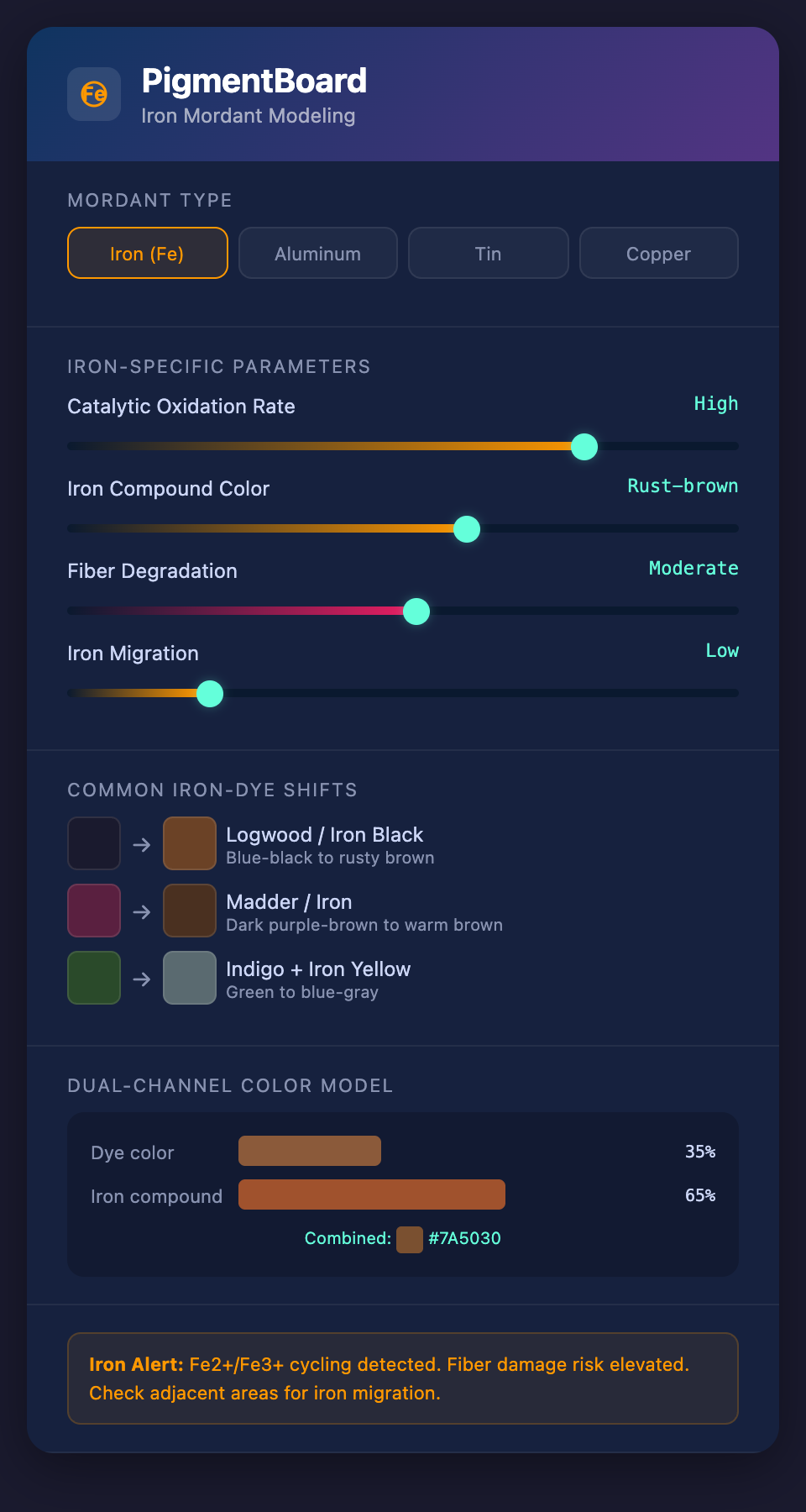
In a soundboard-style degradation model, iron mordant effects need their own channel controlling iron-catalyzed oxidation rate, iron compound color contribution, iron-fiber interaction severity, and iron migration extent.
Want to model iron-mordant degradation with dedicated parameters? Join the PigmentBoard waitlist.