Managing Metamerism in Museum Conservation Repairs
The Gallery Lighting Surprise
Every conservator has experienced this: you spend an hour matching a faded blue under your calibrated daylight lamp. The match is excellent — visually indistinguishable. You apply the repair, let it cure, and feel confident. Then the textile goes back on display, and under the gallery's warm tungsten lighting, your repair stands out like a patch.
This is metamerism — a fundamental property of color perception that cannot be eliminated, only managed. Understanding it is essential for any conservator who wants their repairs to remain invisible across different viewing conditions.
What Metamerism Actually Is
Two colors are metameric when they look the same under one light source but different under another. This happens because the two colors achieve their visual match through different spectral compositions.
Here is the key concept: your eye has three types of color receptors (cones), sensitive to roughly red, green, and blue wavelengths. A color is perceived when these three cone types are stimulated in a specific ratio. But many different spectral compositions can produce the same ratio of cone stimulation — just as many different ingredient combinations can produce the same flavor.
When you mix a conservation pigment to match a degraded historic pigment, you are almost certainly using different molecular compounds than the original. Your mixture may stimulate the three cone types in the same ratio as the target under daylight — but under tungsten light (which has more red and less blue energy), the two different spectral compositions interact differently with the changed illuminant, producing different cone ratios. The match fails.
Why Metamerism Is Especially Problematic in Conservation
Commercial color matching (paint stores, cosmetics) also deals with metamerism, but conservation faces unique challenges:
- You cannot change the gallery lighting. Curators and lighting designers choose gallery illumination for aesthetic and preservation reasons. The conservator has to match under whatever light the gallery uses.
- Lighting changes over time. Gallery lighting is updated, bulbs are replaced with different color temperatures, and exhibitions move to different venues with different lighting.
- The original pigment is degraded. A fresh, undegraded pigment has a relatively smooth spectral curve. A degraded pigment often has irregular spectral features that are extremely difficult to replicate with modern pigments — increasing metamerism risk.
- Multiple light sources. Visitors experience the textile under gallery lighting, but also during photography (flash or studio lights), condition assessments (daylight lamps), and transit (ambient light in crates and storage). The repair needs to be acceptable under all of these.
Detecting Metamerism Before It Becomes a Problem
Multi-illuminant visual check. Evaluate your color match under at least three different light sources:
- D65 daylight simulator (your standard lab light)
- Tungsten/warm white (simulating gallery lighting)
- Fluorescent/cool white (simulating office and storage conditions)
If the match holds under all three, metamerism risk is low. If it fails under any one, you have a metameric match that needs correction.
Spectrophotometric comparison. Compare the full spectral reflectance curves of your mixture and the target — not just the Lab* values. If the curves have the same shape, the match is non-metameric (or nearly so). If the curves cross (your mixture reflects more at some wavelengths and less at others), the match is metameric and will shift under different lighting.
Metameric index calculation. Some spectrophotometers can calculate a metameric index — a number that predicts how much a match will shift when the illuminant changes. A lower number means less risk.
Strategies for Minimizing Metamerism
1. Use pigments with similar spectral properties to the original.
This is the most effective strategy. If the original dye is madder, using a modern alizarin-based pigment (which has a similar spectral curve) will produce a less metameric match than using cadmium red (which has a completely different spectral curve, even if it looks the same under one light).
This requires knowing what the original pigment is — reinforcing the importance of non-destructive pigment analysis as a first step.
2. Build your mixture from fewer pigments.
Every additional pigment in your mixture adds complexity to the spectral curve and increases the chance of metameric divergence. A two-pigment mixture that hits the target is better than a five-pigment mixture, from a metamerism standpoint.
3. Match under the primary viewing illuminant.
If you know the textile will spend most of its life under gallery tungsten, do your primary matching under tungsten rather than daylight. Check under daylight as well, but optimize for the gallery condition.
4. Accept a slight ΔE under lab light for a better gallery match.
Sometimes a match that is slightly off under daylight performs better under gallery lighting. If you have to choose, optimize for the viewing condition that matters most.
5. Use degradation modeling to predict the spectral curve.
This is where degradation modeling shines. Instead of mixing pigments until they look right (which optimizes for one illuminant), you can model the specific degradation chemistry of the original pigment, generating a predicted spectral curve that naturally follows the correct spectral shape. This reduces metamerism because the model accounts for the actual molecular changes, not just the visual appearance.
A Practical Metamerism Management Workflow
- Identify the original pigment using non-destructive analysis
- Select conservation pigments with spectral properties similar to the original (and its degradation products)
- Model the degradation to predict the target spectral curve
- Mix to match the spectral curve, not just the visual appearance under one light
- Check under three illuminants before applying
- Measure the metameric index if a spectrophotometer is available
- Document the lighting conditions of the gallery where the textile will be displayed
- Recheck whenever the textile moves to a new display environment
When Perfect Is Not Possible
Sometimes metamerism cannot be fully eliminated. The degraded original pigment may have spectral features that no available conservation pigment can replicate. In these cases:
- Communicate with the curator. Explain that the repair will be optimized for the gallery lighting but may be slightly visible under other illuminants.
- Prioritize the primary viewing condition. If the textile will be on permanent display under specific lighting, match for that condition.
- Document the limitation. Record the spectral data, the metameric index, and the viewing conditions for which the match was optimized. This helps future conservators understand the choices you made.
Metamerism and Digital Tools
Digital degradation models can help manage metamerism by working at the spectral level rather than the visual level. Instead of predicting "this color will look like X," the model predicts "this pigment's spectral curve will change from A to B under these degradation conditions." This spectral prediction inherently accounts for metamerism because it models the actual molecular changes, not their visual approximation.
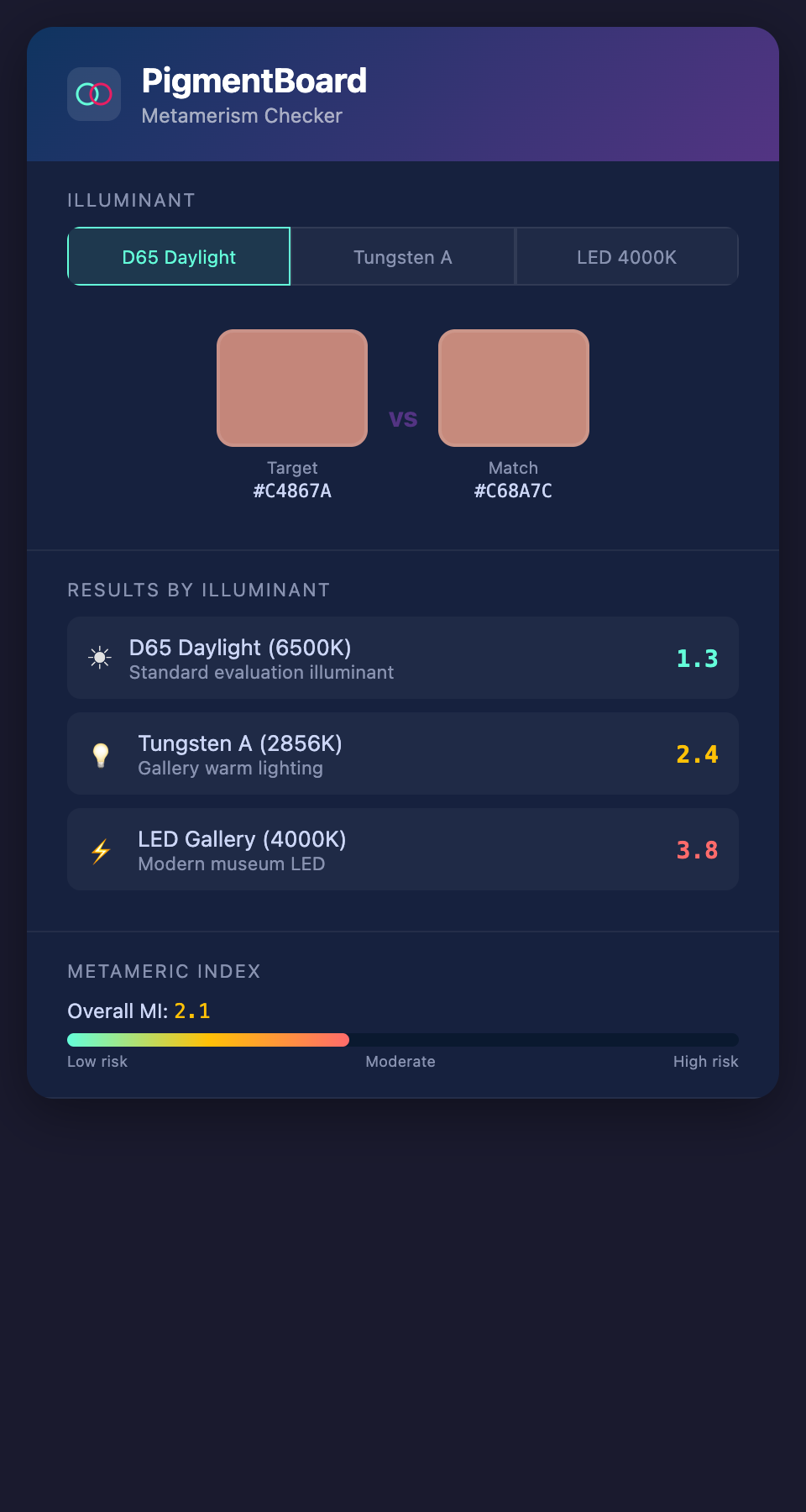
Want to model degradation at the spectral level and minimize metamerism in your repairs? Join the PigmentBoard waitlist.