Matching Colors on Mixed-Media Museum Textiles
When Everything Ages Differently
Mixed-media textiles are the norm in historic collections. A single 19th-century textile might include silk satin ground, wool embroidery threads, cotton lining, metal thread, and ribbon trim. Each component degrades at a different rate, through different mechanisms, producing different color changes.
For conservators, this means matching colors on a mixed-media textile is not one problem but several simultaneous problems that must result in a visually harmonious outcome.
Why Different Fibers Age Differently
UV sensitivity: Silk is more UV-sensitive than wool, which is more UV-sensitive than cotton. Silk's protein structure absorbs UV radiation directly.
Moisture interaction: Cotton absorbs more moisture in absolute terms, but silk's protein structure is more vulnerable to moisture-catalyzed reactions.
Surface properties: Silk, wool, and cotton reflect light differently. As fibers degrade, surface changes alter the visual appearance of the same dye.
Mordant compatibility: Different fibers accept mordants differently, creating different dye-mordant-fiber complexes that age along different pathways.
Developing a Multi-Profile Strategy
Step 1: Inventory the components. Catalog every distinct material: fiber type, dye type, mordant, and current condition.
Step 2: Group by degradation profile. Materials sharing the same fiber-dye-mordant system get grouped.
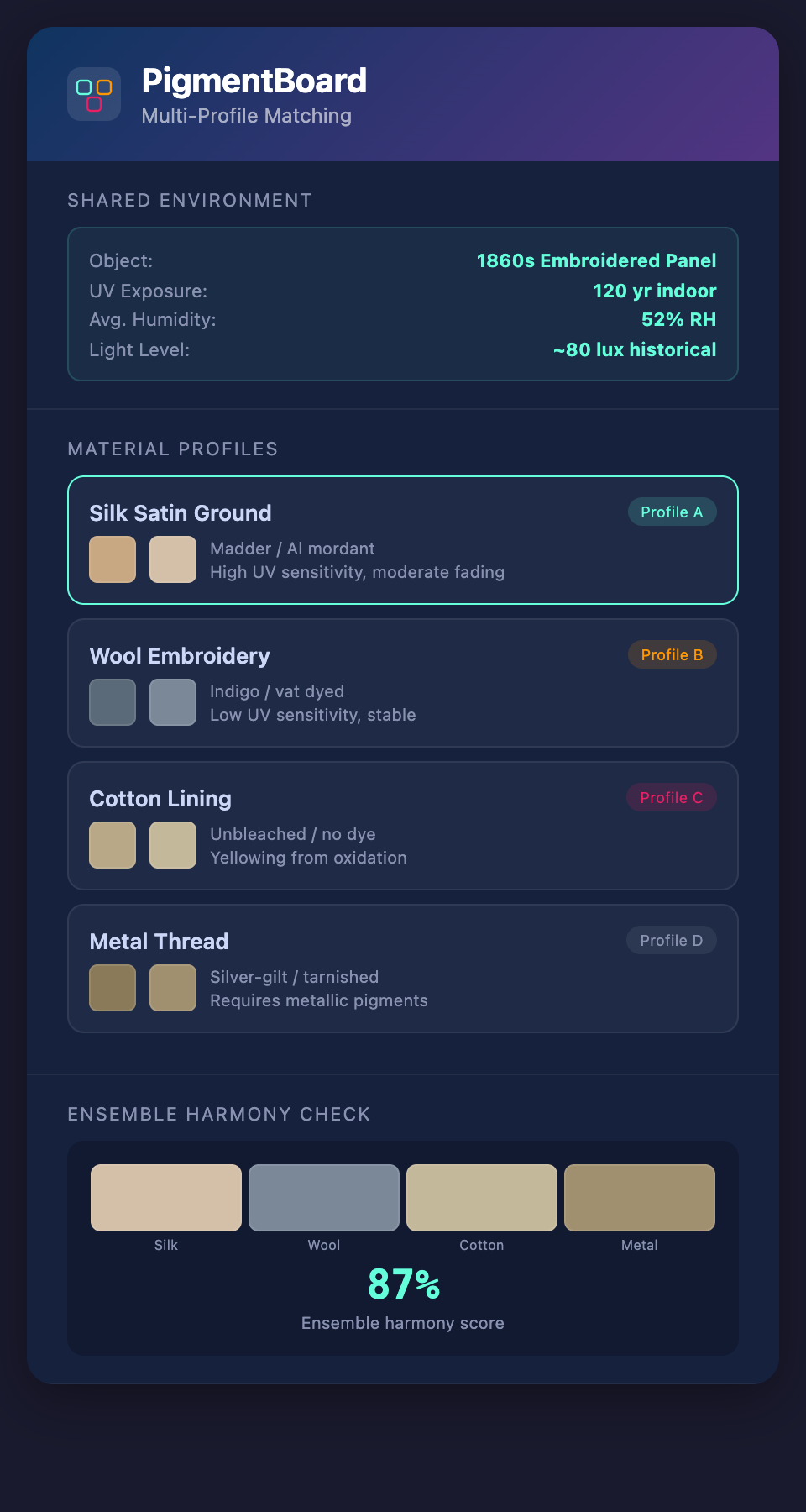
Step 3: Model each group independently. The environmental exposure is shared, but pigment, mordant, and fiber settings differ.
Step 4: Verify relationships between groups. Predicted colors should make visual sense together.
Step 5: Match each group with its own formula. Each may need different pigments, application methods, and binders.
Step 6: Evaluate the ensemble. All matched areas must harmonize with each other and surrounding originals.
Special Challenges
Metal threads require metallic pigments rather than conventional formulas. Weighted silk degrades much faster than unweighted materials. Printed vs. dyed areas may differ even when originally the same color. Layered construction creates depth effects requiring systematic treatment.
The Harmony Problem
The most technically accurate individual matches do not always produce the best visual result. Solutions include adjusting for ensemble harmony, using shared base components across adjacent formulas, and evaluating at viewing distance.
Documentation
Document each material group separately but also document the relationships between groups, including photographs at both close range and viewing distance.
Want to model multiple degradation profiles simultaneously for mixed-media textiles? Join the PigmentBoard waitlist.