Non-Destructive Pigment Analysis Methods for Museum Textiles
Identification Before Matching
Before you can match a degraded pigment, you need to know what it originally was. A faded pinkish area on an 1850s textile could be degraded madder, cochineal, safflower, brazilwood, or an early synthetic aniline — and each of these degrades along a different chemical pathway, producing a different target color at each stage of aging.
Misidentifying the original pigment means applying the wrong degradation model, which means your color match will be off in a way that is difficult to diagnose. You might achieve a visually acceptable match under one lighting condition that fails under another, because the spectral curve of your mixture does not follow the correct degradation pathway.
Non-destructive analysis lets you identify pigments without removing material from the textile — critical for objects where sampling is ethically or practically impossible.
Fiber Optic Reflectance Spectroscopy (FORS)
FORS is the workhorse of non-destructive dye identification. A fiber optic probe directs white light at the textile surface and collects the reflected light, which is then analyzed by a spectrometer.
How it works:
- The probe illuminates a small area (typically 1-3mm diameter)
- The reflected light is split into its component wavelengths
- The resulting reflectance spectrum is compared against a reference library of known dyes and pigments
Strengths:
- Completely non-contact (the probe does not touch the surface)
- Portable — can be used in galleries, storage rooms, or on-site at other institutions
- Fast — each measurement takes seconds
- Identifies most major historic dye classes reliably
Limitations:
- Cannot distinguish between dyes with very similar reflectance spectra (e.g., some red anthraquinone dyes)
- Struggles with very dark colors where reflectance is minimal
- Cannot identify mordants, only dyes
- Results depend on the quality and comprehensiveness of the reference library
X-Ray Fluorescence (XRF)
XRF identifies elements, not compounds. It works by directing X-rays at the surface and measuring the characteristic fluorescent X-rays emitted by each element present.
For textile conservation, XRF is most useful for:
- Identifying mordants (aluminum, tin, iron, copper, chromium) — which FORS cannot do
- Detecting mineral pigments that contain characteristic elements (e.g., mercury in vermilion, lead in lead white, chromium in chrome yellow)
- Identifying weighting agents in silk (tin, iron)
Limitations:
- Cannot identify organic dyes (they contain only carbon, hydrogen, oxygen, and nitrogen — elements that are also in the fiber itself)
- Penetrates through the textile, so readings may include elements from backing materials, mounting boards, or display surfaces
- Requires careful interpretation — the presence of an element does not always indicate its role (iron could be a mordant, a contaminant, or part of the water supply)
Multispectral Imaging (MSI)
MSI captures images of a textile under different wavelengths of light — from UV through visible to near-infrared. Different pigments and dyes respond differently at different wavelengths, creating distinct "signatures."
Applications in conservation:
- UV fluorescence reveals repairs, overpainting, and materials that differ from the original even if they look the same in visible light
- Infrared reflectography can reveal underdrawings and original design elements obscured by degradation
- False-color infrared helps distinguish between visually similar pigments (e.g., Egyptian blue vs. azurite)
Strengths:
- Images the entire textile at once, revealing patterns and distributions
- Non-contact and non-invasive
- Relatively accessible equipment (modified digital cameras can serve as a starting point)
Limitations:
- Provides clues rather than definitive identifications
- Interpretation requires experience
- Environmental lighting must be carefully controlled
Raman Spectroscopy
Raman spectroscopy uses a laser to excite molecular vibrations in the material. The scattered light carries information about the molecular structure of the pigment or dye.
Strengths:
- Identifies specific compounds, not just elements or broad dye classes
- Can distinguish between closely related pigments (e.g., different polymorphs of the same mineral)
- Non-destructive when properly controlled
Limitations:
- Fluorescence from organic binders, fibers, and degradation products often overwhelms the Raman signal in historic textiles
- Laser can damage sensitive materials if power is too high
- Requires expensive, specialized equipment
- Interpretation requires expertise in spectral analysis
Combining Methods for Reliable Identification
No single method identifies everything. The most reliable approach combines multiple techniques:
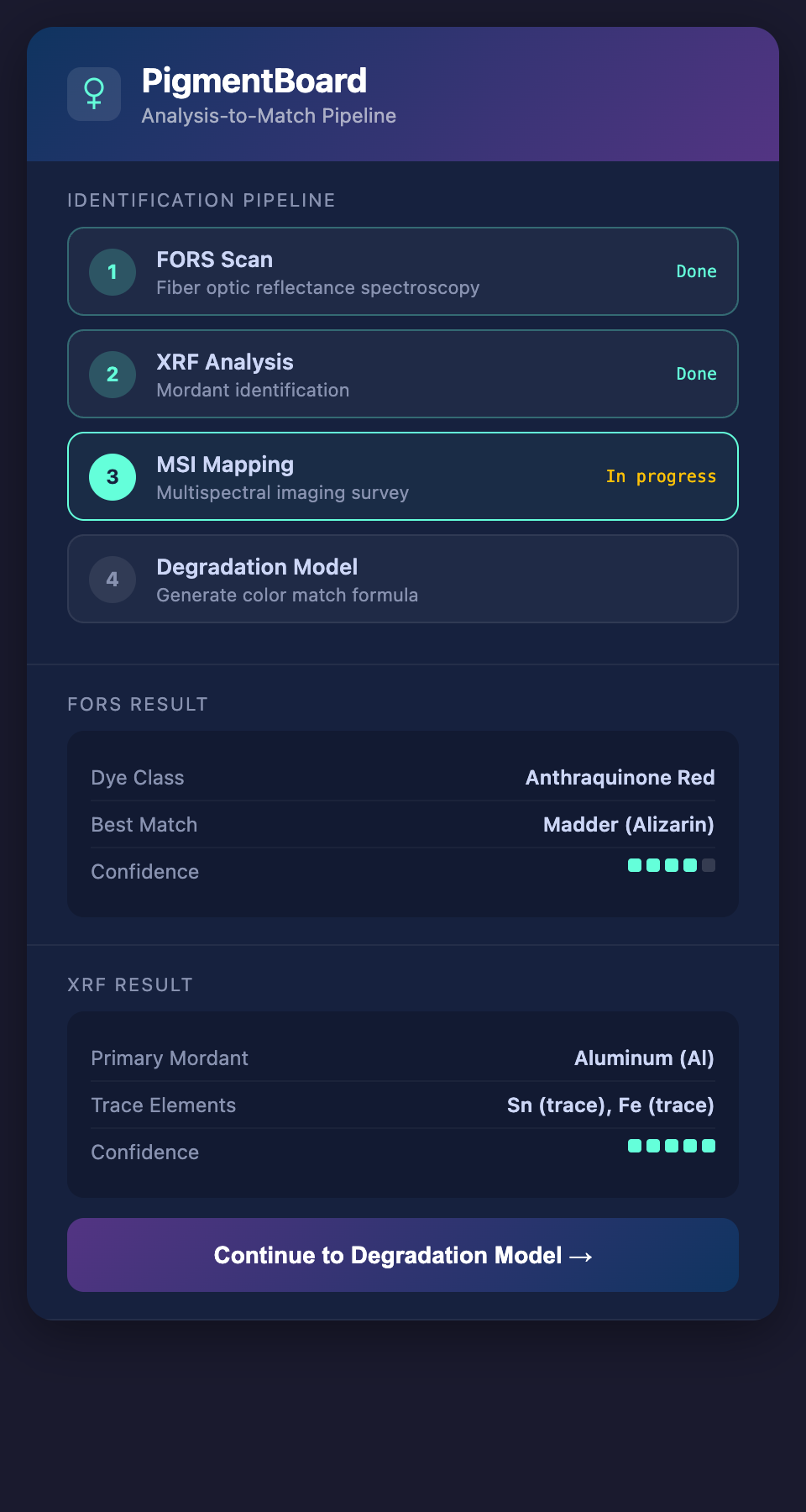
- Start with FORS to identify the dye class (e.g., "this is an anthraquinone red")
- Add XRF to identify the mordant (e.g., "mordanted with aluminum, with trace tin")
- Use MSI to map the distribution and identify areas of different treatment
- Apply Raman if FORS cannot distinguish between specific compounds within a dye class
This layered approach gives conservators a confident identification of the original pigment system, which is the essential foundation for accurate degradation modeling and color matching.
How Identification Feeds Into Color Matching
Once you know the original pigment, you can:
- Select the correct degradation model (madder ages differently from cochineal, even though both are red)
- Set the right parameters (a tin-mordanted dye degrades faster than an aluminum-mordanted one)
- Predict the correct target color for the current state of aging
- Choose the right conservation pigments for your mixture
Without reliable identification, degradation modeling is guesswork built on guesswork. With it, you have a scientific foundation for every subsequent step.
Practical Recommendations for Labs
If you have limited budget and can only invest in one method: Choose FORS. It provides the most useful information for color-matching purposes across the broadest range of textiles.
If you are building a comprehensive analytical capability: Add XRF second (for mordant identification), then MSI (for survey-level assessment), then Raman (for specific compound identification).
If you are working on a single high-value textile: Consider partnering with a university or museum with comprehensive analytical facilities rather than investing in equipment you will use infrequently.
The Analysis-to-Matching Pipeline
The ideal workflow connects analysis directly to color matching:
- Analyze the textile non-destructively to identify pigments and mordants
- Input the identification into a degradation model
- Set degradation parameters based on the textile's known or estimated history
- Generate a predicted color and formula
- Match, apply, and verify
This pipeline transforms pigment identification from an academic exercise into a practical tool that directly improves the speed and accuracy of every repair.
Ready to connect your pigment analysis directly to degradation-informed color matching? Join the PigmentBoard waitlist.