Simulating Decades of Aging for Preventive Conservation Planning
Looking Forward Instead of Back
Conservation traditionally looks backward — assessing damage that has already occurred and matching colors that have already faded. But the same degradation science that enables color matching can also look forward, predicting how textiles will change under future conditions.
This forward-looking application — degradation simulation for preventive conservation — may ultimately be more valuable than backward-looking color matching, because preventing damage is always better than repairing it.
The Basic Principle
If you know:
- What pigments are present in a textile
- What degradation conditions it will be exposed to
- How those pigments respond to those conditions over time
Then you can predict what the textile will look like in 10, 50, or 100 years.
This is not speculation — it is applied chemistry. The photodegradation rates of major historic pigments under controlled conditions are published. The effects of humidity, temperature, and pollutants on specific dyes are known. What has been missing is a practical tool to combine these factors and generate a visual prediction.
Applications in Preventive Conservation
Display rotation planning. Most museums rotate light-sensitive textiles on and off display to limit cumulative light exposure. But rotation schedules are often based on generic guidelines (e.g., "display for no more than 3 months per year") rather than object-specific predictions.
With degradation simulation, you can:
- Model how a specific textile, with its specific pigments, will change under the specific lighting in the specific gallery where it will be displayed
- Compare the predicted change at 3 months, 6 months, and 12 months of display per year
- Choose a rotation schedule that keeps the predicted change within an acceptable threshold
Light level decisions. How much difference does it make to display a textile at 50 lux vs. 100 lux vs. 200 lux? Degradation simulation provides a visual answer — showing the curator exactly what the textile will look like after 20 years at each level. This transforms an abstract "lower light is better" principle into a concrete trade-off: "at 200 lux, this red will fade to pink in 15 years; at 50 lux, it will take 60 years."
Storage condition optimization. For textiles in long-term storage, simulation can predict the effects of different temperature and humidity levels over decades. If upgrading your climate control system reduces the predicted color change by 40% over 50 years, that is a concrete argument for the capital investment.
Risk assessment for loans. Before lending a textile for a traveling exhibition, simulate the additional degradation from the proposed display conditions. If the predicted change is unacceptable, you have a documented, visual basis for declining the loan or requesting modified conditions.
Conservation treatment prioritization. With limited budgets, which textiles should receive protective treatment (UV-filtering glass, oxygen-free display cases) first? Simulation identifies the objects that will change most rapidly under current conditions — the ones that benefit most from intervention.
Building a Simulation Model
A useful preventive conservation simulation needs:
Pigment identification for each textile. Which dyes are present, and on which fibers with which mordants? This determines the degradation rates and pathways.
Current condition assessment. How far has degradation already progressed? A textile that is already heavily faded may be less sensitive to further exposure (because the most vulnerable dye molecules have already been destroyed) or more sensitive (because weakened molecular structures are more susceptible to chain reactions). The model needs to account for the current state.
Proposed environmental conditions. What light level, humidity, temperature, air quality, and display duration is planned?
Degradation rate data. Published photodegradation rates for the identified pigments under the specified conditions. These are available in conservation science literature for the most common historic pigments.
Interaction terms. How do the various degradation factors interact? As discussed in earlier posts, UV and humidity have synergistic effects that the model must account for.
What the Output Looks Like
A good simulation produces:
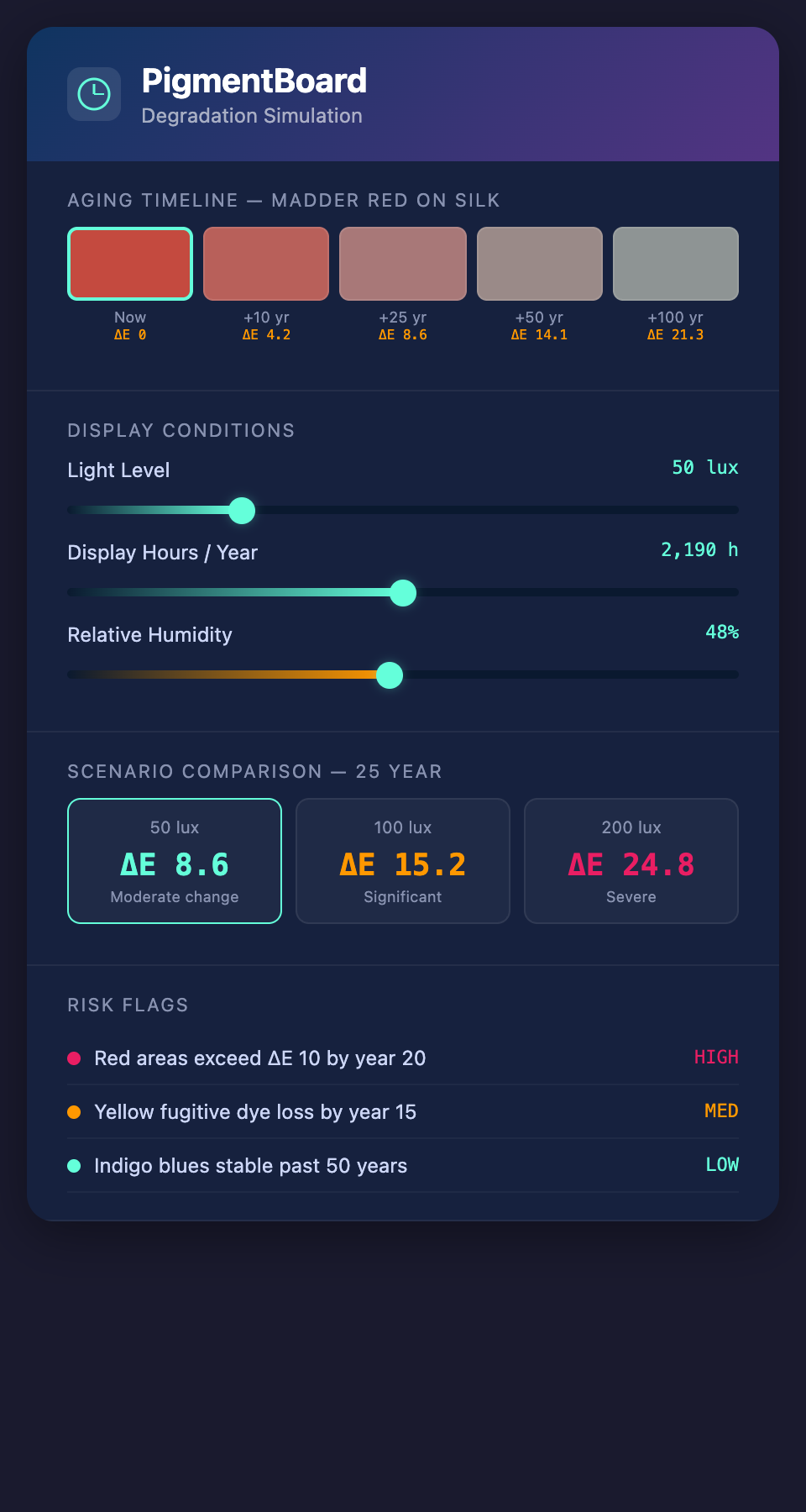
- Visual prediction images showing the textile's predicted appearance at future time points (5, 10, 25, 50, 100 years)
- Quantified color change in ΔE units for each significant area
- Risk flags identifying areas where predicted change exceeds defined thresholds
- Comparison of scenarios — side-by-side predictions for different proposed conditions
This output gives curators and administrators a concrete, visual understanding of the consequences of their decisions — far more compelling than abstract statements about "cumulative light damage."
Making the Case to Administration
Conservation departments often struggle to communicate preservation needs to administrators who think in terms of budgets, visitor numbers, and exhibition schedules. Degradation simulation provides a powerful communication tool:
"If we continue displaying this textile at current light levels, this is what it will look like in 25 years." Show them the image. The impact is immediate and visceral in a way that ΔE values and lux-hour calculations are not.
"If we invest $50,000 in UV-filtering glazing for Gallery 12, this is the difference it makes to the collection over 50 years." Show them the side-by-side comparison. The business case makes itself.
"If we loan this textile for the traveling exhibition under the proposed conditions, this is the additional color change we can expect." The curator can make an informed decision with visual evidence.
Accuracy and Limitations
Simulation is prediction, and all predictions have uncertainty:
- Pigment identification may be incomplete. If a dye is present but unidentified, it is missing from the model.
- Rate data may be imprecise. Published degradation rates have experimental uncertainty, and real-world conditions may differ from laboratory conditions.
- Interaction effects are complex. The synergistic effects of multiple degradation factors are not fully characterized for all pigment systems.
- Unexpected events are not modeled. Floods, fires, HVAC failures, and other events cannot be predicted.
For these reasons, simulation outputs should be presented as informed estimates, not guarantees. They are directionally correct and comparatively meaningful (Scenario A produces twice the change of Scenario B) even if absolute values carry uncertainty.
Starting With Simulation
You do not need a sophisticated software tool to begin using simulation concepts:
- Identify your most light-sensitive textiles based on pigment analysis
- Calculate cumulative light exposure at current display levels (lux × hours × days)
- Look up published fading rates for those pigments at those exposure levels
- Estimate the color change over your planning horizon
- Use the estimate to inform rotation schedules and light level decisions
Even this back-of-the-envelope approach is better than generic guidelines, because it is specific to your objects and conditions.
As more sophisticated tools become available — tools that model multiple degradation factors simultaneously and generate visual predictions — the accuracy and usefulness of simulation will increase dramatically.
Ready to see the future of your collection? Join the PigmentBoard waitlist and bring degradation simulation to your preventive conservation planning.