Training Junior Conservators in Pigment Matching Techniques
The Apprenticeship Bottleneck
Pigment matching is traditionally learned through apprenticeship. A junior conservator works alongside an experienced mentor, watches how they mix, listens to their reasoning, and gradually develops their own intuition over years of practice.
This model works — eventually. But it has serious limitations:
- It takes 3-5 years before most junior conservators feel confident matching degraded pigments independently
- Quality varies depending on the mentor's skill and teaching ability
- Knowledge is implicit — experienced conservators often cannot articulate why they made specific mixing decisions
- Scale is limited — one mentor can only train one or two juniors at a time
Conservation programs are graduating talented, motivated young professionals who are then stalled for years on the most practical aspect of their work. This is not a failure of talent or effort — it is a failure of method.
Why Color Matching Is So Hard to Learn
Color matching is difficult because it requires three distinct skills that develop at different rates:
1. Color perception — The ability to see subtle differences between hues, values, and chromas. This is partly innate and partly trainable, and it develops relatively quickly with practice.
2. Material knowledge — Understanding how specific pigments behave when mixed, how they look wet vs. dry, how they interact with different binders and substrates. This develops through direct experience and takes time.
3. Degradation intuition — The ability to look at a faded color and mentally "reverse-engineer" the aging process to determine what the original pigment was and how it changed. This is the hardest skill to develop because it requires synthesizing chemistry, material science, and visual perception.
Traditional training addresses the first two through hands-on practice. The third is often left to osmosis — junior conservators gradually absorb their mentor's accumulated degradation knowledge through years of observation.
A Systematic Training Framework
What if you could give junior conservators a structured framework for degradation analysis, rather than expecting them to absorb it through osmosis?
Phase 1: Pigment Identification (Weeks 1-4)
Start with the fundamentals. Junior conservators should be able to identify the major historic pigment classes by sight and by simple testing:
- Recognize the visual characteristics of major dye families (anthraquinone reds, indigoids, flavonoids, etc.)
- Understand which pigments were available in which eras
- Learn the basic non-destructive identification workflow (FORS, XRF, UV fluorescence)
- Practice identifying original pigments in degraded textiles by examining protected areas
Phase 2: Degradation Pathways (Weeks 5-8)
Once they can identify original pigments, teach the specific degradation pathways:
- How does each major pigment change under UV exposure?
- How does each major pigment change under oxidation?
- How does humidity modify these pathways?
- How do different mordants affect the degradation rate and direction?
Use a structured curriculum with real examples. Show them a series of textiles at known stages of degradation and have them identify the dominant degradation mechanism.
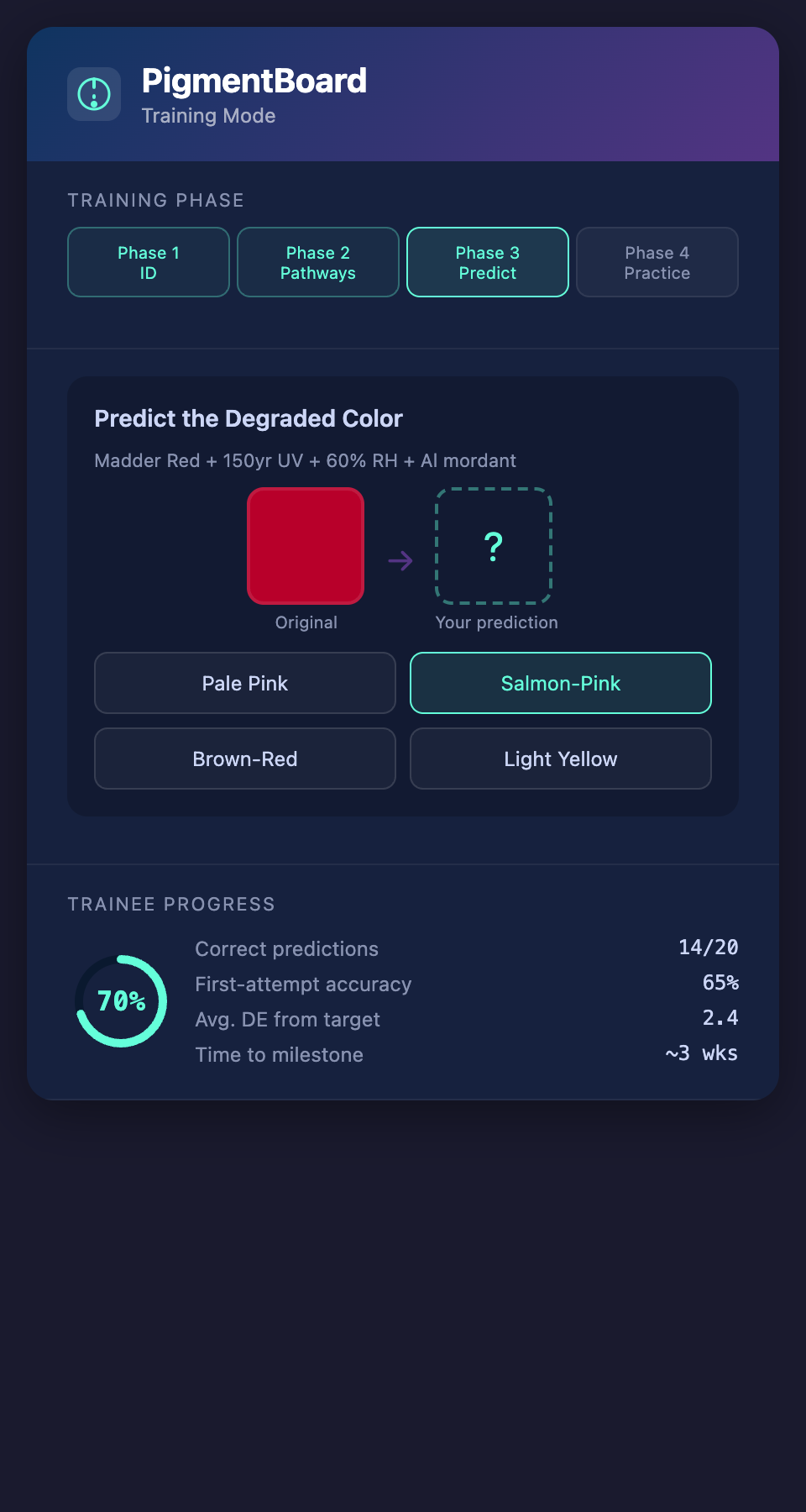
Phase 3: Predictive Matching (Weeks 9-12)
Now connect identification and degradation to actual color mixing:
- Given an identified pigment and estimated degradation history, predict the target color before looking at the sample
- Mix a formula based on the prediction
- Compare to the actual sample
- Analyze why the prediction was accurate or inaccurate
This prediction-then-comparison cycle builds the degradation intuition that traditionally takes years to develop, because it makes the reasoning explicit and testable.
Phase 4: Independent Practice (Months 4-6)
Assign real projects with increasing complexity:
- Start with simple matches (single pigment, single degradation factor)
- Progress to complex matches (mixed pigments, multiple degradation factors)
- Include documentation as a requirement from the beginning
- Review results with the mentor, focusing on the reasoning process, not just the outcome
The Role of Technology in Training
Degradation modeling tools can dramatically accelerate this training process:
- Visual feedback — A junior conservator can adjust degradation parameters and immediately see how the predicted color changes, building intuitive understanding of cause-and-effect relationships
- Safe experimentation — They can explore extreme degradation scenarios (200 years of UV, flood damage, heavy pollution) without risking real textiles
- Self-guided learning — The tool provides immediate feedback, allowing practice outside of scheduled mentor sessions
- Explicit reasoning — The fader settings make the degradation model explicit: "I set UV to high because the textile was displayed near a window, humidity to moderate because the building had no climate control, and oxidation to high because of the urban location." This explicit reasoning is exactly what traditional apprenticeship struggles to transfer.
Common Mistakes in Junior Training
Mistake 1: Starting with mixing, not identification. Juniors who do not know what they are looking at cannot reason about how it degraded. Always start with pigment identification.
Mistake 2: Expecting visual memory to develop without structure. Telling a junior to "look at lots of textiles" is not training. Give them specific comparison exercises with known answers.
Mistake 3: Not requiring documentation. If juniors are not documenting their formulas and reasoning from day one, they are not building a searchable knowledge base that will serve them for their entire career.
Mistake 4: Evaluating results only visually. Use spectrophotometer measurements alongside visual assessment from the beginning. This teaches juniors the relationship between objective measurement and subjective perception.
Mistake 5: Not discussing failures. When a match fails, it is a learning opportunity. Analyze why: Was the pigment identification wrong? Was the degradation assessment off? Was the mixing technique flawed? Each failure, properly analyzed, teaches more than three successes.
Building Institutional Training Programs
Individual mentorship is irreplaceable, but institutions can build systems that support and accelerate it:
- Create a training textile set — Acquire or prepare a set of textiles with known original pigments at various stages of degradation. Use these as standardized training materials.
- Build a formula library — Maintain a searchable database of documented formulas tagged by pigment type, degradation type, and match quality. Juniors can study successful matches before attempting their own.
- Establish competency milestones — Define what a junior conservator should be able to do at 3 months, 6 months, 1 year, and 2 years. Test against these milestones.
- Cross-train across institutions — Partner with other conservation labs for exchange programs. Different collections present different degradation challenges, broadening the junior's experience.
Measuring Training Effectiveness
How do you know your training program is working? Track these metrics:
- Time to independent matching — How many months until the junior can match degraded pigments without mentor supervision?
- Match quality consistency — How do the junior's matches compare to the mentor's, measured by spectrophotometer?
- First-attempt accuracy — How often does the junior's first mix require significant adjustment?
- Documentation quality — Can another conservator reproduce the junior's matches from their documentation alone?
The Next Generation of Conservators
The conservation field needs to accelerate how it transfers color-matching knowledge. The traditional apprenticeship model produces excellent conservators, but too slowly and too variably.
By combining structured curricula, explicit degradation science, technology-assisted learning, and rigorous documentation, labs can reduce the time to competence without sacrificing quality — ensuring that the next generation of conservators can hit the ground running.
Want to accelerate your training program with interactive degradation modeling? Join the PigmentBoard waitlist and see how it can transform how junior conservators learn pigment matching.