How UV Light Degrades Historic Textile Pigments: A Conservator's Guide
Why UV Degradation Matters in Textile Conservation
Ultraviolet radiation is relentless. Every hour a historic textile spends exposed to sunlight — or even fluorescent gallery lighting — its pigments undergo irreversible photochemical reactions. For museum conservators tasked with repairing or in-painting damaged textiles, understanding these reactions is not academic. It is the difference between an invisible repair and an obvious patch.
The challenge is not simply that colors fade. UV degradation changes colors in specific, often non-intuitive ways. A red madder lake does not just become a lighter red — it shifts toward pink, then salmon, then a pale yellowish ghost of itself. Prussian blue does not simply lighten — it can bronze or turn greenish-brown depending on the binder. These shifts make color-matching by eye alone unreliable, especially across large collections where dozens of textiles need consistent treatment.
The Photochemistry Behind the Fade
UV photons carry enough energy to break chemical bonds in organic dye molecules. The process works like this:
- Absorption — The chromophore (the part of the dye molecule responsible for color) absorbs a UV photon
- Excitation — The molecule enters an excited electronic state
- Bond cleavage — The excited molecule either breaks apart directly or reacts with oxygen to form free radicals
- Chain reaction — Free radicals attack neighboring dye molecules, accelerating degradation beyond the initial point of exposure
This is why UV damage is not linear. A textile that looks fine after 50 years of moderate exposure can deteriorate rapidly in the next 10 years — the free radical chain reactions have reached a critical mass.
Which Historic Pigments Are Most Vulnerable?
Not all pigments respond to UV equally. Conservators need to know which colors in their collection are at highest risk:
- Fugitive organic dyes — Madder, cochineal, logwood, and most plant-based dyes are highly vulnerable. These were the most common dyes in textiles before 1856.
- Early synthetic anilines — Mauveine, fuchsine, and other first-generation synthetic dyes (1856-1880) fade dramatically and shift hue unpredictably.
- Indigo — Surprisingly resistant in some forms but vulnerable when applied as a surface coating rather than a vat dye. The degradation pathway shifts from blue to yellow-brown.
- Iron-based pigments — Relatively stable under UV but vulnerable to moisture interactions that UV exposure can catalyze.
Meanwhile, mineral pigments like vermilion, ultramarine, and ochres are substantially more UV-resistant, which is why they often survive while organic dyes around them have vanished.
Predicting Color Shift Direction
The practical question for conservators is not just "how much has this faded?" but "in which direction has the color shifted?" Predicting shift direction requires understanding the specific degradation products:
- Red madder fades toward pale yellow because the alizarin molecule loses its quinone structure, leaving behind colorless or weakly yellow fragments
- Indigo shifts toward brown because the indigotin molecule oxidizes to isatin, which is yellowish — mixing with residual blue creates brown
- Turmeric yellow simply bleaches to near-white as curcumin breaks down completely
- Logwood purple shifts toward gray-brown as the hematoxylin molecule fragments
Knowing these pathways lets you work backward from a faded sample to estimate the original color — or forward from a known original to predict how a fresh pigment will look after simulated aging.
The Problem With Traditional Color-Matching
Most conservation labs still match degraded pigments through iterative hand-mixing. A conservator examines the faded area, mixes a test batch, applies it to a sample card, waits for it to dry (since wet paint looks different from dry paint), compares under controlled lighting, adjusts, and repeats.
This process has serious problems:
- Time — Each iteration takes 15-30 minutes including drying time. Matching a single color can take an entire morning.
- Consistency — Different conservators in the same lab often arrive at different matches for the same target color.
- Documentation — The "recipe" is often stored in a conservator's head or scribbled in notes that are difficult to replicate.
- Scale — When a museum needs to treat 200 textiles for a reinstallation, the iterative approach becomes a bottleneck that delays the entire project.
A Better Approach: Modeling Degradation Digitally
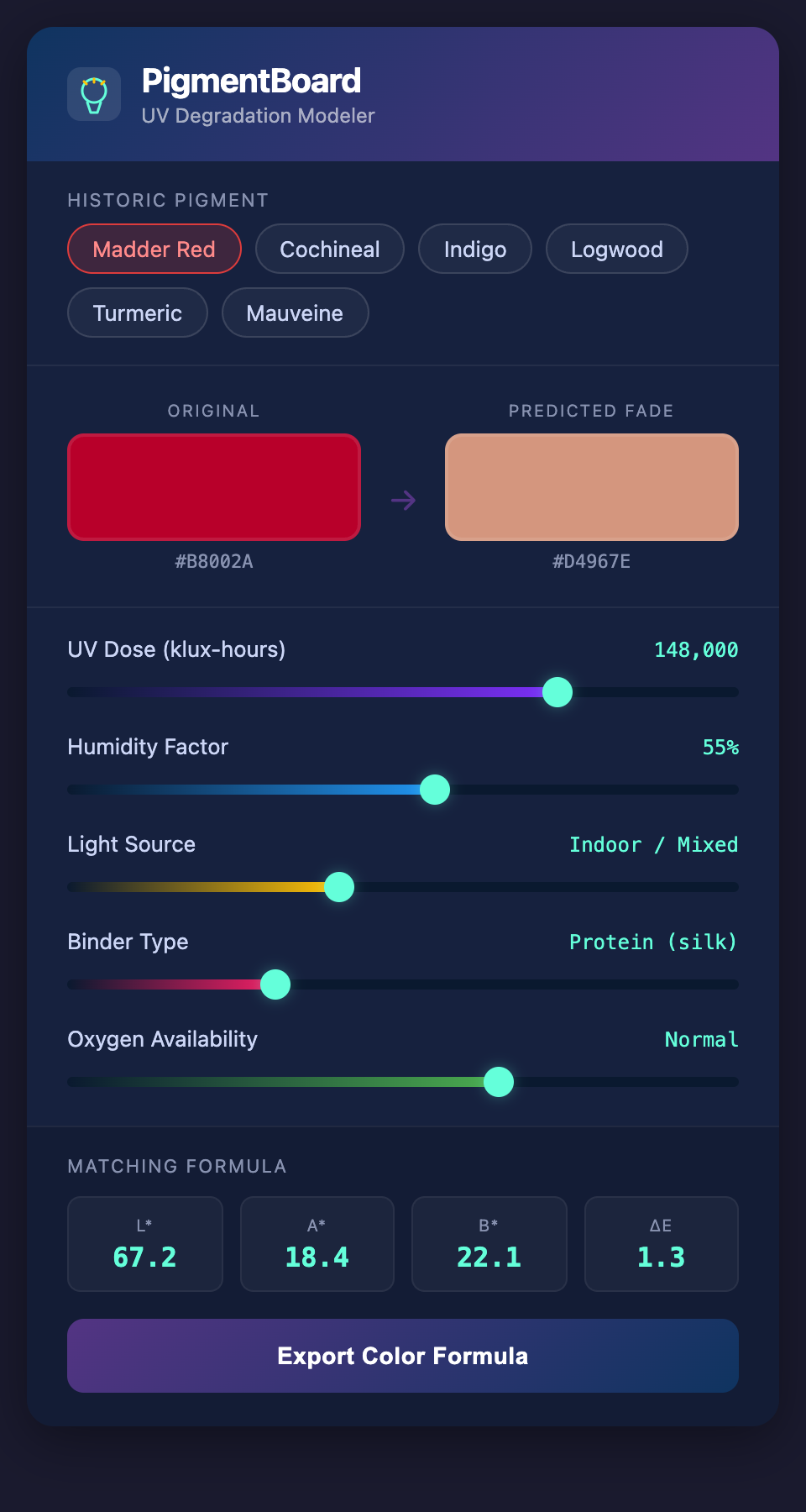
What if you could start with a known pigment's spectral properties, apply mathematically modeled UV degradation curves, and arrive at the target faded color before touching any physical paint?
This is the principle behind degradation modeling tools. By treating UV exposure as a quantifiable input — measured in klux-hours or total UV dose — and applying known photochemical decay curves for specific pigments, you can predict the resulting color with high accuracy.
The key variables in a UV degradation model include:
- Total UV dose (cumulative exposure over time)
- Spectral distribution of the light source (sunlight vs. gallery lighting vs. fluorescent)
- Pigment type and its specific photodegradation pathway
- Binder type (oil, gum, protein — each modifies the rate)
- Atmospheric conditions (humidity and oxygen availability accelerate UV damage)
When you can control these variables independently — sliding each one up or down like a fader on a mixing board — you gain precise control over the predicted output color.
Practical Application: Matching a Faded 1870s Sampler
Consider a common scenario: an 1870s embroidered sampler where the red silk threads have faded from crimson to pale salmon. The conservator needs to in-paint a damaged section to match the surrounding faded threads.
Using a degradation model, the process becomes:
- Identify the likely original dye (cochineal or madder, based on the era and fiber type)
- Set the UV dose slider to approximately 150 years of moderate indoor exposure
- Adjust the humidity factor for the textile's known storage history
- Read the output — a specific color formula that matches the predicted degradation state
- Fine-tune by comparing the digital output to the physical sample under the same lighting conditions
This reduces a half-day of trial and error to roughly 20 minutes of informed adjustment.
What This Means for Your Conservation Lab
UV degradation is predictable. The photochemistry is well understood. The decay curves for major historic pigments have been published in conservation science literature for decades. The missing piece has been a practical tool that lets conservators apply this science without needing a chemistry degree.
Ready to stop guessing and start matching with scientific precision? Join the PigmentBoard waitlist and be the first to bring degradation modeling into your conservation lab.