How to Assess Textile Aging Uniformity for Authentication
Uniformity Is Suspicious
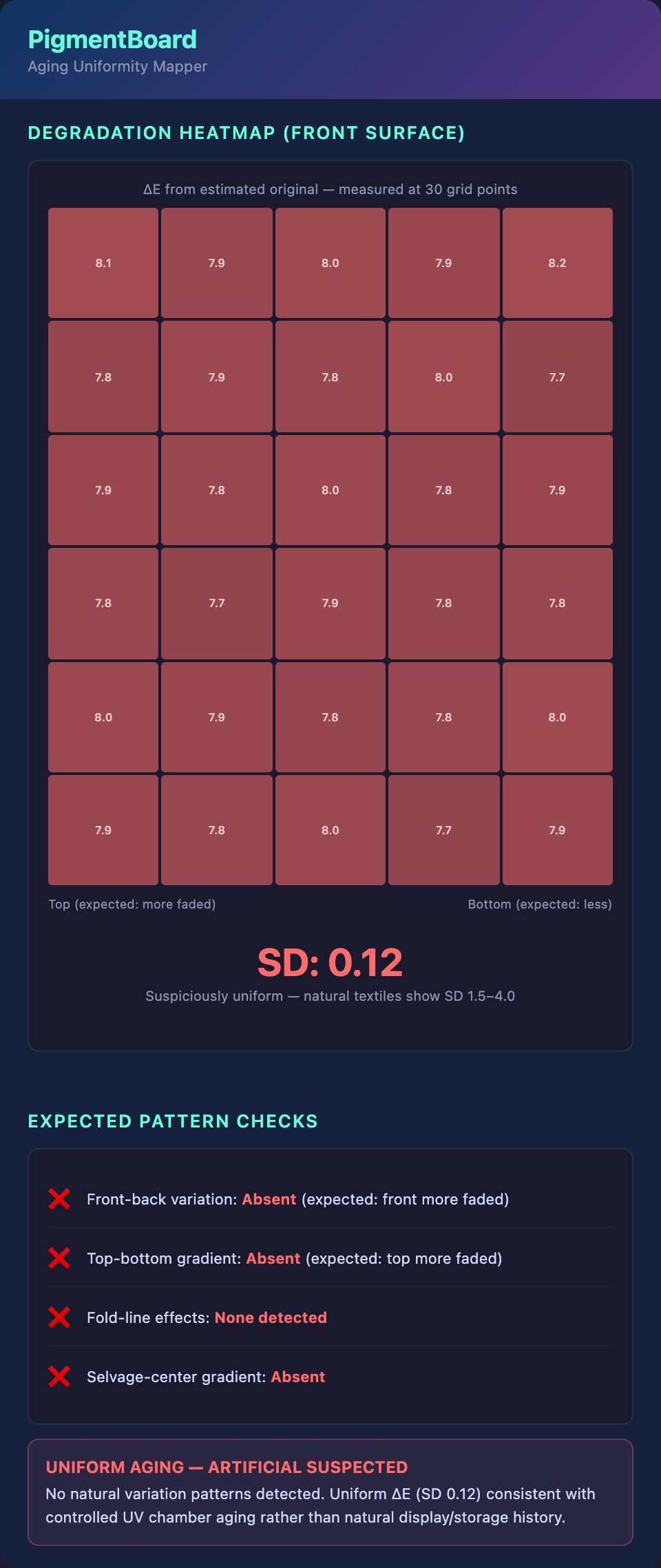
A textile that has been naturally displayed, stored, and handled for decades shows predictable patterns of non-uniform aging. The display side fades more than the reverse. The top fades more than the bottom. Fold lines show accelerated aging. Contact areas with mounting materials show different effects.
When a textile shows suspiciously uniform aging — the same degree of fading everywhere, the same surface condition on both sides — it suggests controlled artificial aging (uniform UV in a chamber) rather than natural aging.
Expected Patterns of Variation
Front-back variation. A displayed textile's front (facing the room) receives more light than the back (facing the wall). The front should be more faded.
Top-bottom gradient. Hanging textiles receive more light at the top (closer to ceiling-mounted windows and lights). A gradual fade gradient from top to bottom is expected.
Fold-line effects. Textiles stored folded show accelerated aging at fold lines due to mechanical stress, concentrated atmospheric exposure, and sometimes moisture accumulation.
Selvage-to-center gradient. Textiles displayed in frames may show more fading at the center (exposed) than at the edges (under the frame).
Contact effects. Areas in contact with other materials (mounting boards, other textiles, storage boxes) show effects from those materials — acid migration, off-gassing, mechanical pressure.
Mapping the Variation
Create a degradation map of the textile:
- Measure color at a grid of points across the surface
- Measure both front and back
- Measure at fold lines and edges
- Note any contact effects
Plot these measurements spatially. The resulting pattern should be consistent with the claimed display and storage history.
Using Variation as Evidence
Consistent variation: The pattern matches what would be expected from the claimed history. Supports authenticity.
No variation: Suspiciously uniform. Suggests controlled artificial aging.
Wrong variation pattern: The pattern is inconsistent with the claimed history. Either the history is wrong or the aging is artificial.
Too-perfect gradients: Some forgers attempt to create directional fading. But artificially created gradients tend to be smoother and more regular than natural ones.
Ready to analyze aging uniformity patterns with degradation modeling? Join the PigmentBoard waitlist.