Authentication Challenges With Post-1856 Synthetic Dye Textiles
The Wild West of Dye Chemistry
The period from 1856 to approximately 1900 saw an explosion of new synthetic dyes — hundreds of compounds introduced within a few decades, many poorly understood, many with terrible light-fastness, and many used only briefly before being replaced by better alternatives.
For authentication specialists, this era presents unique challenges: the dyes degrade dramatically, the degradation patterns are often specific to individual compounds, and the range of original colors was far broader than in any previous period.
Why This Era Is Difficult
Rapid dye turnover. A specific synthetic dye might have been commercially available for only 5-10 years before being superseded. Identifying the exact compound narrows the dating, but the compound may be poorly documented.
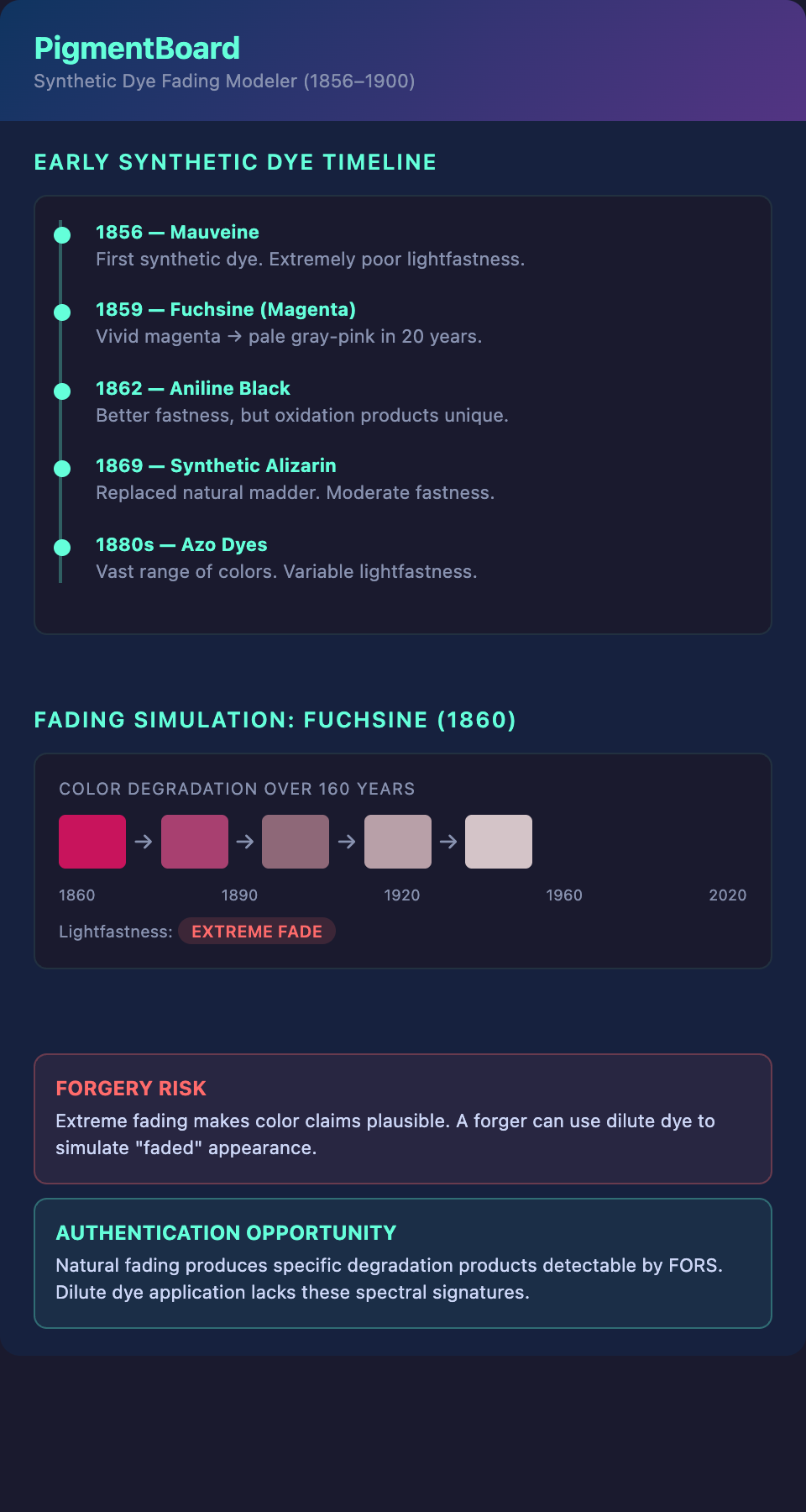
Dramatic fading. Many early synthetics have extremely poor light-fastness. A vivid magenta from 1860 might be pale gray-pink by 1880. The degree of color loss can make dye identification from the faded state alone very difficult.
Unexpected degradation products. Unlike natural dyes (whose degradation pathways are well characterized), many early synthetic dyes degrade to products that are poorly studied. The authentication specialist may encounter spectral signatures not in any reference database.
Manufacturer variation. The same dye name from different manufacturers could be different compounds or different purities, producing different degradation profiles.
Authentication Strategies for This Era
Focus on what survives. Even severely faded dyes retain some spectral signature. FORS can often identify the dye class even when the color is barely visible.
Use protected areas. Seam allowances, fold interiors, and areas under linings retain more dye. These areas are critical for identification.
Cross-reference with mordant data. Early synthetic dyes used specific mordanting systems. XRF identification of mordant metals can narrow the dye identification even when the dye itself is heavily degraded.
Consult specialized references. The conservation science literature includes studies of specific early synthetic dyes and their degradation products. Helmut Schweppe's "Handbuch der Naturfarbstoffe" and similar references document both natural and early synthetic dyes.
Model the extreme fading. A degradation model calibrated for early synthetic dyes must account for their dramatically higher fading rates. Using a natural-dye model for an early synthetic will produce wildly inaccurate predictions.
Forgery Risks in This Era
The dramatic fading of early synthetic dyes creates both a forgery risk and an authentication opportunity:
Risk: A forger can claim that a textile's current pale, ambiguous color is the result of extreme fading from a vivid original. This is plausible because early synthetics really do fade that much.
Opportunity: The specific fading pathway of each synthetic dye is distinctive. A forger who simply uses dilute dye to achieve a "faded" look has not produced the correct spectral signature for naturally faded dye. The degradation products are absent, and the residual spectral curve does not match the natural fading pattern.
Ready to model the extreme fading patterns of early synthetic dyes? Join the PigmentBoard waitlist.