Authentication of Repaired or Restored Antique Textiles
The Restoration Complication
Most textiles that survive long enough to need authentication have been repaired at least once. These repairs introduce non-original materials — newer fibers, different dyes, different construction — that must be identified and separated from the original material before the original can be assessed.
Identifying Repairs
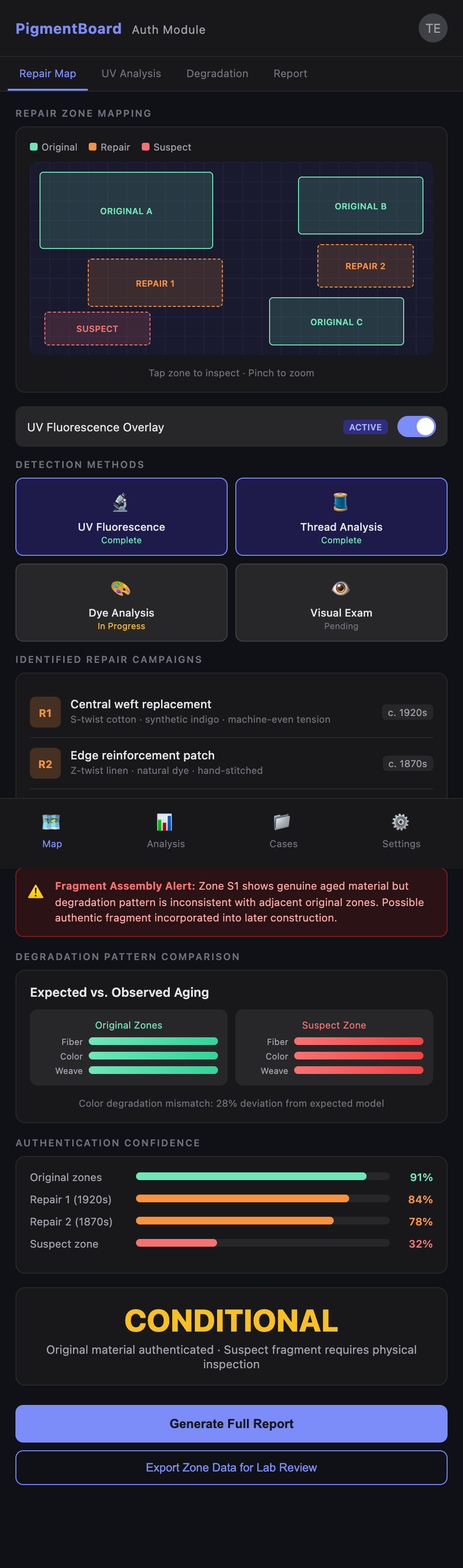
Visual examination: Different fiber sheen, different weave tension, different surface character. Repairs may match the original closely or may be obviously different.
UV fluorescence: The most powerful detection tool. Repairs using different materials almost always fluoresce differently from the original.
Thread analysis under magnification: Different twist direction, different fiber type, different diameter, different ply construction.
Dye analysis: Repair dyes may be from a different era or tradition than the original.
How Repairs Affect Authentication
Positive contribution: The repairs themselves can provide authentication evidence:
- A repair made with materials consistent with a specific era suggests the textile existed before that era
- Multiple repair campaigns suggest a long history of use and maintenance
- The repair technique may be characteristic of a specific tradition
Negative contribution: Repairs complicate the assessment:
- If a significant area has been replaced, is there enough original material for meaningful analysis?
- Repairs may have altered the original (cleaning, over-dyeing, structural changes)
- Later materials may bleed into or migrate toward original materials
Assessment Strategy
- Map all repairs using UV fluorescence, magnification, and visual examination
- Separate original from repair in your analysis — measure and analyze only identified original material
- Assess the repair independently — what materials, what era, what technique?
- Use repair evidence — the repair campaign history supports or challenges the claimed overall age
- Acknowledge limitations — state clearly which areas are original and which are repaired, and note if insufficient original material limits the analysis
Forgery Using Authentic Fragments
A sophisticated forgery technique involves incorporating genuine antique fragments into a larger new construction. The genuine fragments pass analysis while the majority of the textile is modern. Detection requires:
- Examining the entire textile, not just selected areas
- Checking for consistency between areas (all should show the same degradation pattern)
- Examining joins between areas for evidence of later assembly
- Looking for anachronistic construction techniques in the overall assembly
Want to model expected degradation for original material and compare it to surrounding areas? Join the PigmentBoard waitlist.