How Climate Change May Affect Future Textile Degradation Patterns
A Changing Baseline
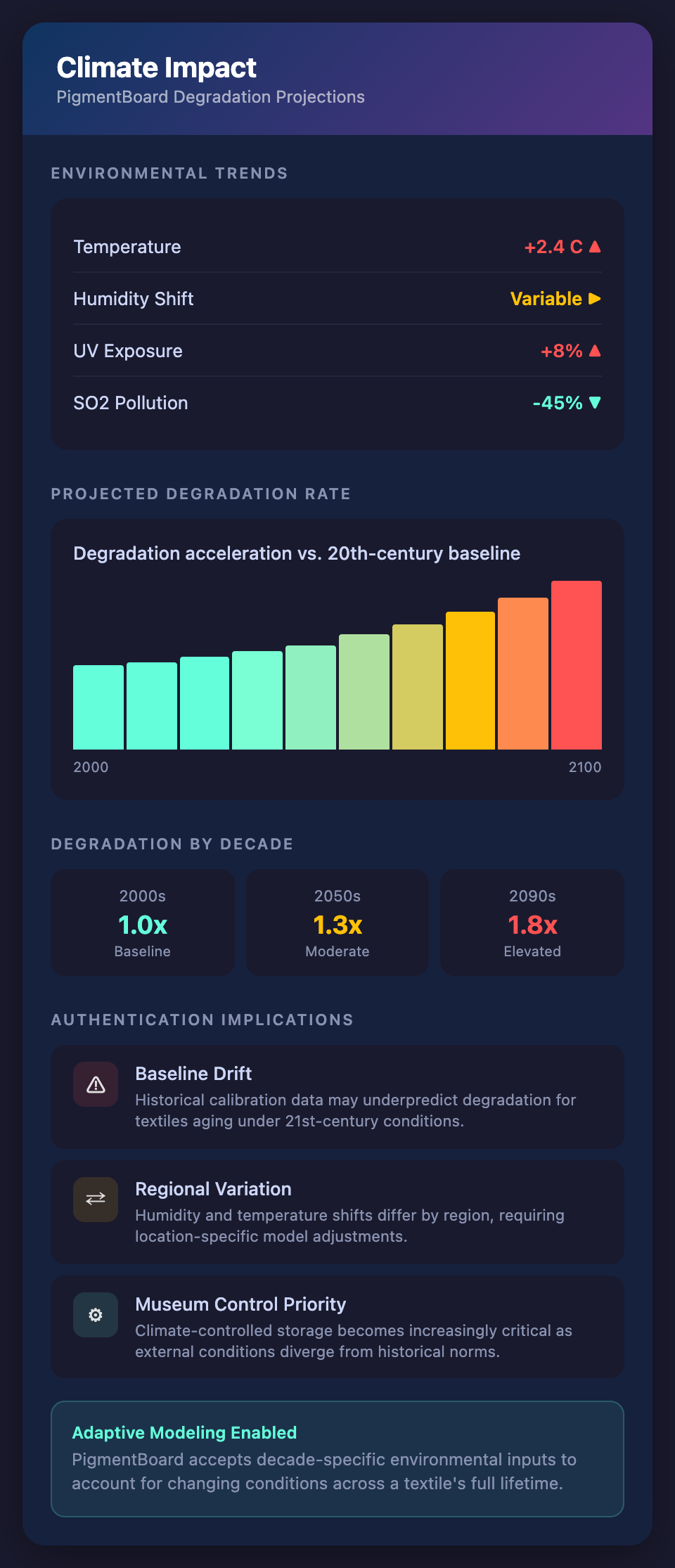
Degradation models are calibrated against textiles that aged under 19th and 20th-century environmental conditions. But 21st-century conditions are changing:
- Temperatures are rising — Accelerating all chemical degradation rates
- Humidity patterns are shifting — Some regions becoming wetter, others drier
- UV exposure may increase — Ozone depletion (now partially recovering) and reduced atmospheric particulates in some regions increase surface UV
- Air pollution patterns are changing — Industrial SO2 declining in developed countries while other pollutants change
Implications for Degradation Modeling
Models may need temporal adjustment. A textile that aged under 19th-century conditions and continues to age under 21st-century conditions is experiencing a changing degradation rate. Models that assume constant conditions will become less accurate.
Regional predictions will shift. A textile currently stored in a location that is becoming warmer and more humid will degrade faster than historical baselines predict.
Museum environmental control becomes more critical. As external conditions change, the value of climate-controlled storage increases — and the penalty for control failures increases.
Implications for Authentication
Future textiles will age differently. A textile made today and naturally aged for 100 years will show a different degradation profile than a textile made in 1900 and naturally aged for 100 years, because the environmental conditions during those two centuries differ.
Historical calibration may need updating. As climate change progresses, the degradation baselines established from pre-2000 textiles may become less representative of newly aging textiles.
This is a long-term concern, not an immediate crisis. But forward-thinking authentication specialists should be aware that the environmental constants underlying their models are changing.
Adaptive Modeling
The degradation model's multi-factor structure inherently accommodates changing conditions — if the inputs are updated. By inputting decade-specific environmental data (available from climate records), the model can account for changing conditions over the textile's lifetime.
Want a degradation model that accounts for changing environmental conditions? Join the PigmentBoard waitlist.