Degradation Modeling for Insurance Valuation of Antique Textiles
Condition Drives Value
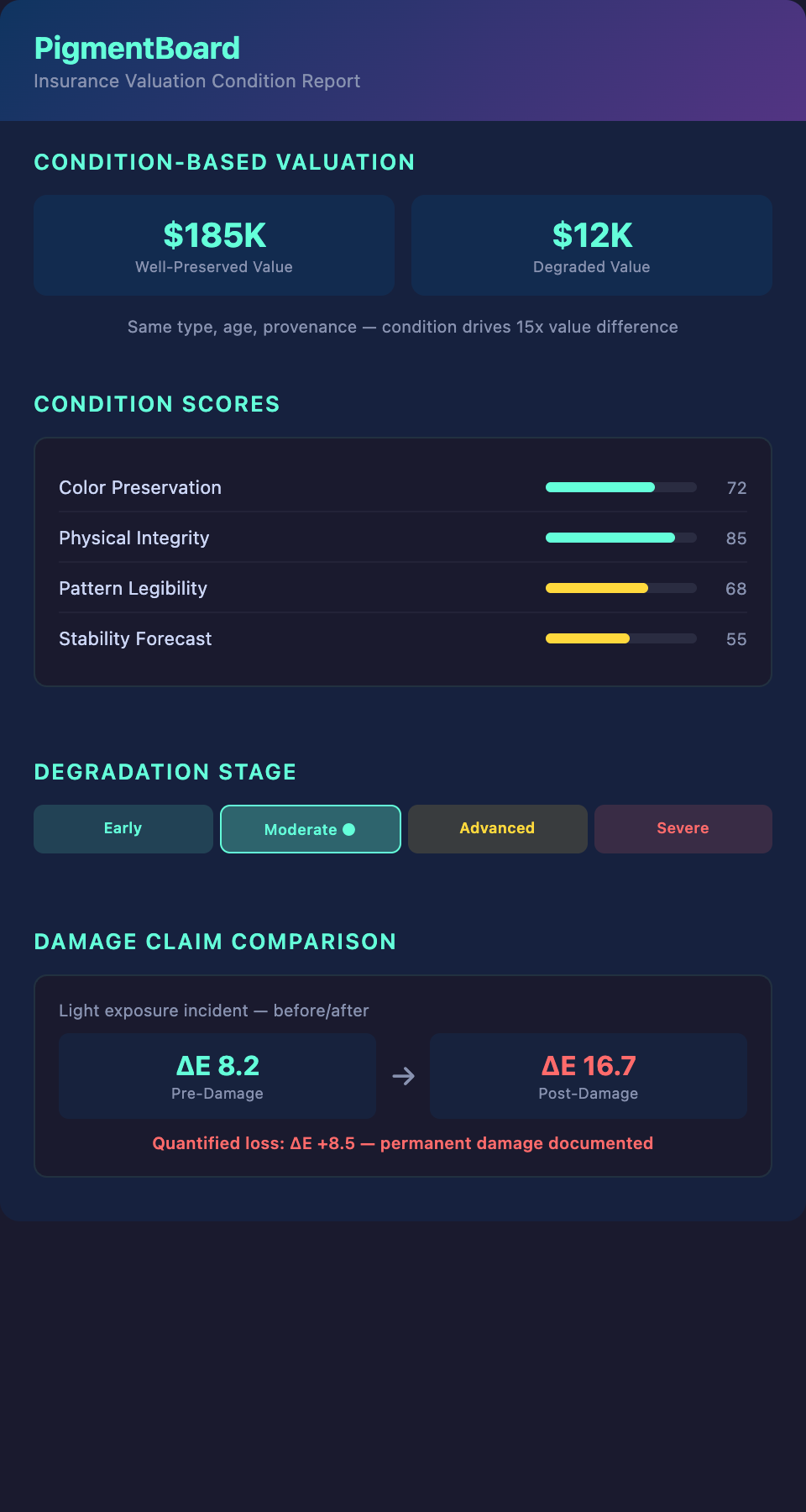
Two textiles of identical type, age, and provenance can differ enormously in value based solely on condition. A well-preserved example may be worth 10-50 times more than a heavily degraded one. This makes degradation assessment a direct input to valuation.
How Degradation Affects Value
Color preservation: Textiles that retain vivid, readable colors are more valuable than those where the colors have faded to near-invisibility.
Physical integrity: Textiles with intact fibers are more valuable than those with losses, holes, and fragile areas.
Pattern legibility: Printed or woven patterns that remain clearly visible are more valuable than those where degradation has obscured the design.
Restoration extent: Heavily restored textiles are generally less valuable than those in good original condition with minimal restoration.
Quantifying Condition
Degradation modeling provides quantified condition metrics:
- Color preservation score: Measured as the ΔE between estimated original color and current color. Lower ΔE = better preserved.
- Degradation stage: Classification of the textile's position on the degradation timeline (early, moderate, advanced, severe).
- Stability assessment: Prediction of how quickly the textile will continue to degrade under specified conditions. A textile that is actively degrading is worth less than one that has stabilized.
Supporting Appraisals
For insurance purposes, the degradation assessment should:
- Quantify current condition with objective measurements
- Compare to reference examples of the same type at various condition levels
- Estimate future condition under the stated storage/display conditions
- Provide documentation suitable for insurance files and potential claims
Claims Support
If a textile is damaged (by flood, fire, light exposure, mishandling):
- Pre-damage condition documented with measurements provides the baseline
- Post-damage condition measured with the same methods
- The difference quantifies the damage
- The degradation model can predict the permanent effect of the damaging event
This quantified before-and-after comparison is far more defensible in a claims dispute than subjective condition descriptions.
Want to provide quantified degradation assessments for insurance and valuation purposes? Join the PigmentBoard waitlist.