Using Degradation Models to Estimate True Age of Undated Textiles
Reverse Engineering Age
When a textile arrives with no provenance documentation, traditional authentication has limited tools for estimating age. Construction analysis constrains the earliest possible date. Dye identification constrains the era. But the specific age — was this made in 1820 or 1860? — is difficult to determine from these alone.
Degradation modeling adds a powerful tool: given the identified dyes and an assumed set of environmental conditions, the model can estimate how many years of aging would produce the observed degradation level.
The Method
- Identify the dyes and mordants using non-destructive analysis
- Assess the fiber condition to establish an independent age constraint
- Measure the current degradation level (color, spectral data)
- Assume environmental conditions based on the most likely context for this type of textile
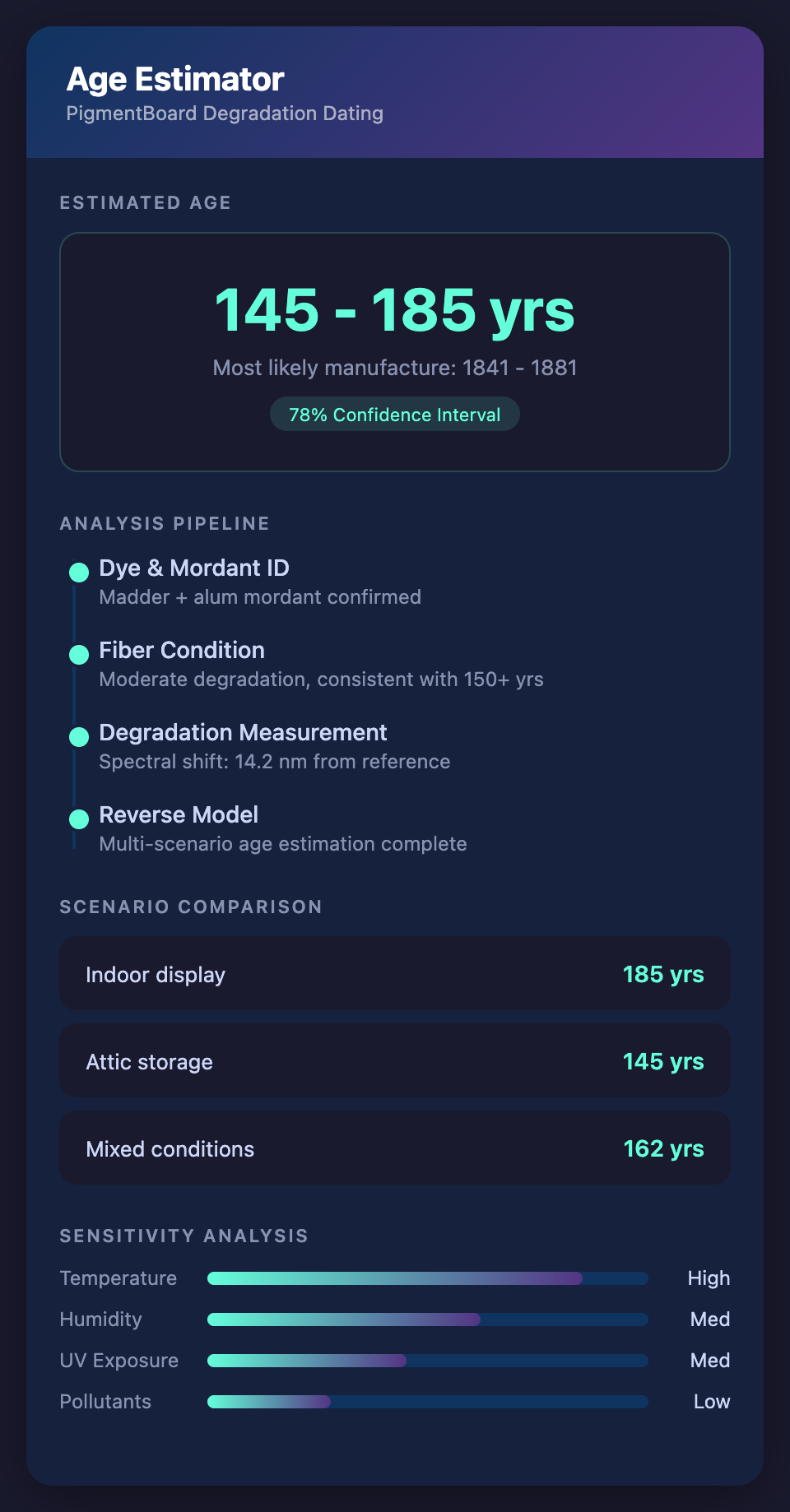
- Run the model backward — at what age does the predicted degradation match the measured degradation?
Uncertainty and Sensitivity
The estimate is only as good as the assumed environmental conditions. Different assumptions produce different age estimates:
- Assuming indoor display: X years
- Assuming attic storage: Y years
- Assuming a combination: Z years
Running the model with multiple plausible scenarios produces a range of age estimates rather than a single number. This range is the honest answer: "Based on the degradation analysis, this textile is most likely between A and B years old, assuming conditions within the plausible range for this type."
Calibration Against Known-Age Examples
The accuracy of degradation dating improves with calibration:
- Measure known-age textiles of the same type
- Compare the model's predictions to the known ages
- Adjust the model if systematic biases are found
- Use the calibrated model for undated textiles
Combining With Other Dating Methods
Degradation dating is most useful in combination with other methods:
- Radiocarbon dating provides an independent age estimate (for textiles old enough — typically pre-1650)
- Dye chronology provides hard date boundaries
- Construction analysis provides earliest-possible dates
- Style analysis provides era constraints
Degradation dating adds another independent estimate that can narrow the range established by other methods.
Limitations
- Environmental assumptions introduce significant uncertainty
- Different parts of the textile may have experienced different conditions
- Previous treatments (cleaning, restoration) may have altered the degradation state
- The model is most accurate within the range calibrated by known-age references
Despite these limitations, degradation dating provides useful estimates that complement other methods — especially for the 1700-1900 period where radiocarbon dating is less precise.
Ready to estimate textile age through degradation modeling? Join the PigmentBoard waitlist.