Detecting Anachronistic Dyes in Claimed Antique Textiles
The Timeline Is Non-Negotiable
The history of dye chemistry provides absolute chronological markers. A dye that was not invented before a specific date cannot appear in a textile made before that date. This is not a matter of expert opinion — it is a matter of chemical fact.
Key Chronological Markers
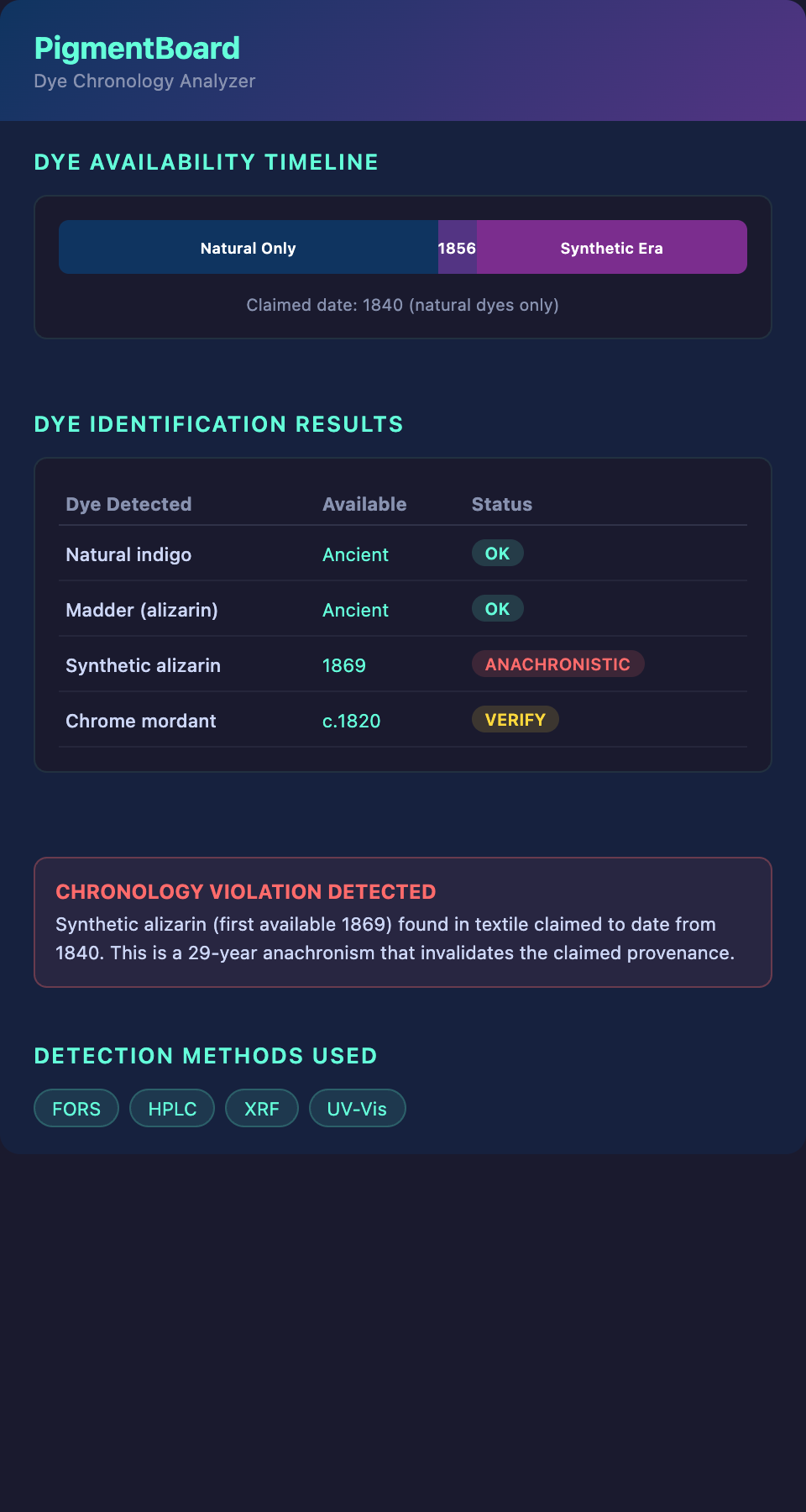
Before 1856: Natural dyes only. Any synthetic dye in a pre-1856 textile is anachronistic. Period.
1856: Mauveine (Perkin's mauve). The first synthetic dye. Distinctive spectral signature.
1858: Fuchsine/Magenta. Distinctive bright pink-red with specific spectral characteristics.
1862: Aniline blue. Triphenylmethane dye with specific spectral signature.
1868: Synthetic alizarin. Identical molecule to natural alizarin but manufactured synthetically. Cannot be distinguished from natural alizarin by FORS alone — but associated impurities may differ.
1876: Methyl violet. Distinctive spectral signature.
1880: Congo red. First direct dye (no mordant needed). Distinctive chemistry.
1884: Synthetic indigo. Identical molecule to natural indigo. Like synthetic alizarin, the molecule is the same but manufacturing impurities may differ.
1897: Synthetic indigo becomes commercially dominant.
Detection Methods
FORS (Fiber Optic Reflectance Spectroscopy): Identifies dye classes and often specific dyes. Can distinguish between natural and synthetic dye classes (e.g., natural madder vs. synthetic aniline red) based on spectral differences.
HPLC (High Performance Liquid Chromatography): Requires a tiny fiber sample but provides definitive molecular identification. Can distinguish natural from synthetic alizarin by detecting manufacturing impurities. The gold standard for dye identification.
XRF (X-Ray Fluorescence): Identifies mordant metals. Certain mordant combinations are era-specific (e.g., chrome mordants were not used on textiles before the early 19th century).
UV-Vis spectrophotometry of extracted dye: If a fiber sample is available, the dye can be extracted and its absorption spectrum measured with high precision.
How Forgers Get Caught
Using available dyes. A forger making a "17th-century" tapestry may use natural dyes for historical accuracy but inadvertently include one synthetic (perhaps a synthetic indigo substituted for natural indigo because it is easier to source). One anachronistic dye invalidates the entire piece.
Using dyes from the wrong tradition. A forger making a "Central Asian" textile may use dyes from a European tradition that were not available in Central Asia at the claimed date.
Overlooking mordant chronology. Even with correct dyes, using a mordant that was not available in the claimed era (e.g., potassium dichromate before its use in textile dyeing) creates an anachronism.
The Role of Degradation Modeling
Degradation modeling extends anachronism detection beyond simple dye identification:
If the dye is correct but the aging is wrong, the model detects the discrepancy. A textile with the right dye for its claimed era but the wrong degradation state for its claimed age is suspicious.
If the dye is correct and the aging is correct for a different age, the model can estimate the true age. A textile showing 50 years of natural aging on a dye available since 1880 is probably from around 1975, not 1880.
If the aging pattern suggests accelerated artificial aging, the model flags the spectral signatures of artificial vs. natural degradation.
Building a Dye Chronology Database
Every authentication specialist should maintain a reference database linking:
- Dye name and chemical identity
- Date of first commercial availability
- Geographic availability (some dyes were regionally available before global distribution)
- Spectral reference data
- Known degradation behavior
This database, combined with degradation modeling, provides a powerful, evidence-based authentication system.
Ready to combine dye chronology with degradation modeling for definitive authentication? Join the PigmentBoard waitlist.