Detecting Re-Dyed or Over-Dyed Antique Textiles
The Re-Dyeing Problem
Re-dyeing (applying new dye to an aged textile to refresh its color) is a common practice that ranges from innocent (restoration) to deceptive (enhancing a textile's appearance for sale while representing it as original).
How to Detect Re-Dyeing
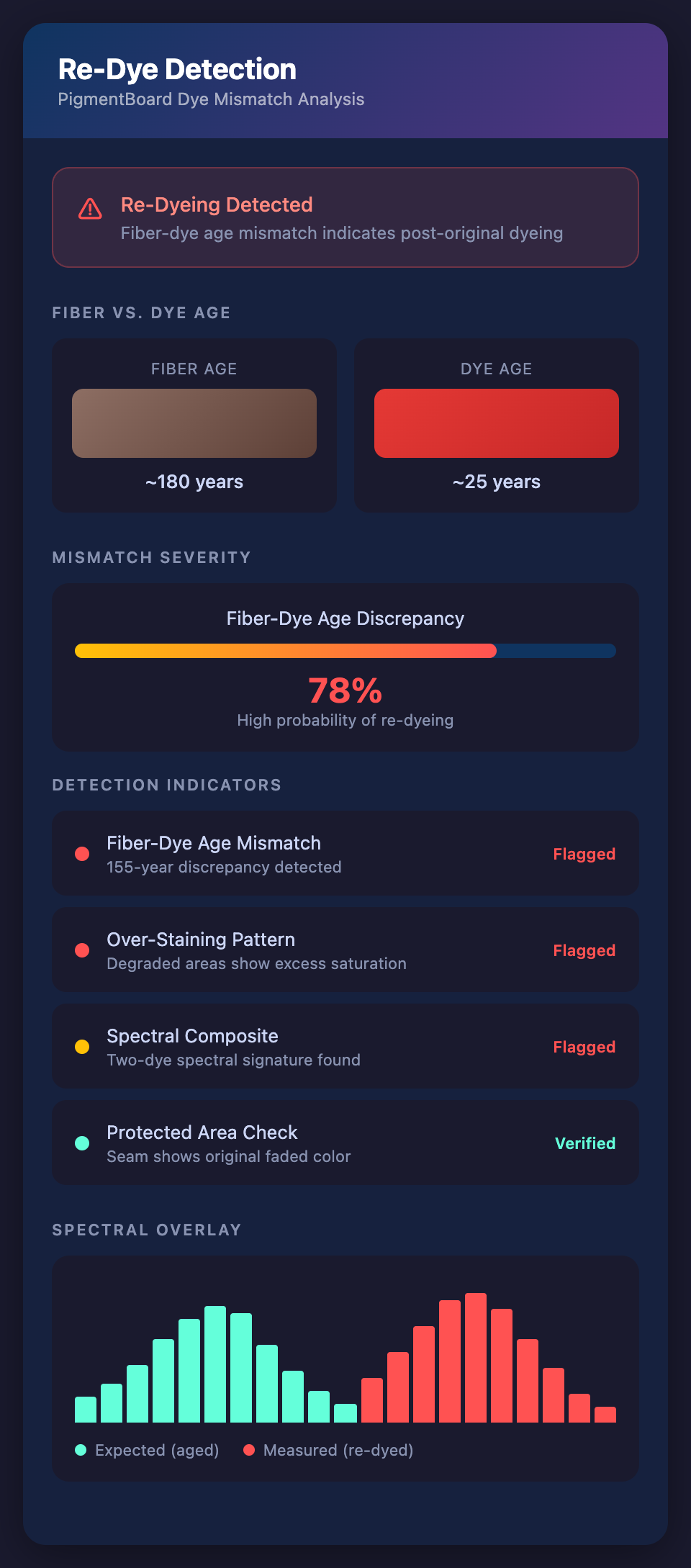
Fiber-dye age mismatch. If fiber analysis indicates significant aging but the dye shows minimal degradation, the dye is younger than the fiber. This is the primary indicator.
Over-staining of degraded areas. Re-dyeing applies new dye over a degraded surface. The new dye may accumulate more heavily in degraded, porous areas, creating a paradoxical pattern: areas that should be most faded appear most saturated.
Spectral anomalies. The spectral curve of a re-dyed area shows contributions from both the residual original dye and the new dye. This composite curve may not match any single dye's natural degradation state.
Protected area comparison. Areas that were protected during re-dyeing (seam allowances, folded-under edges) may retain the original faded color, providing a comparison to the re-dyed exposed areas.
UV fluorescence. New dye on old fabric may fluoresce differently from dye that has been in the fabric for its full life.
Types of Re-Dyeing
Full immersion re-dyeing. The entire textile is immersed in a new dye bath. This produces the most uniform result but also the most detectable — the fiber-dye age mismatch is present everywhere.
Selective re-dyeing. Only faded areas are re-dyed to match less-faded areas. This is harder to detect because the target is the textile's own less-faded color.
Over-dyeing to change color. A faded textile is dyed a different color to create a "new" textile. This is the most deceptive — the over-dye may obscure the original dye identity.
Authentication Implications
A re-dyed textile is not necessarily a forgery — it may be a genuine antique that has been refreshed. But the re-dyeing must be disclosed because:
- It affects the textile's condition assessment (the colors are not original)
- It affects the textile's value (original color is more valuable than refreshed color)
- It complicates degradation analysis (the degradation profile has been altered)
Want to model expected dye degradation and detect mismatches that indicate re-dyeing? Join the PigmentBoard waitlist.