Ethical Responsibilities of Textile Authentication Specialists
The Weight of the Opinion
A textile authentication opinion can:
- Validate a purchase worth hundreds of thousands of dollars
- Invalidate a claimed heirloom, destroying family narratives
- Provide evidence in fraud prosecutions
- Support or deny insurance claims
- Affect museum collection integrity
This power carries proportional ethical responsibility.
Core Ethical Principles
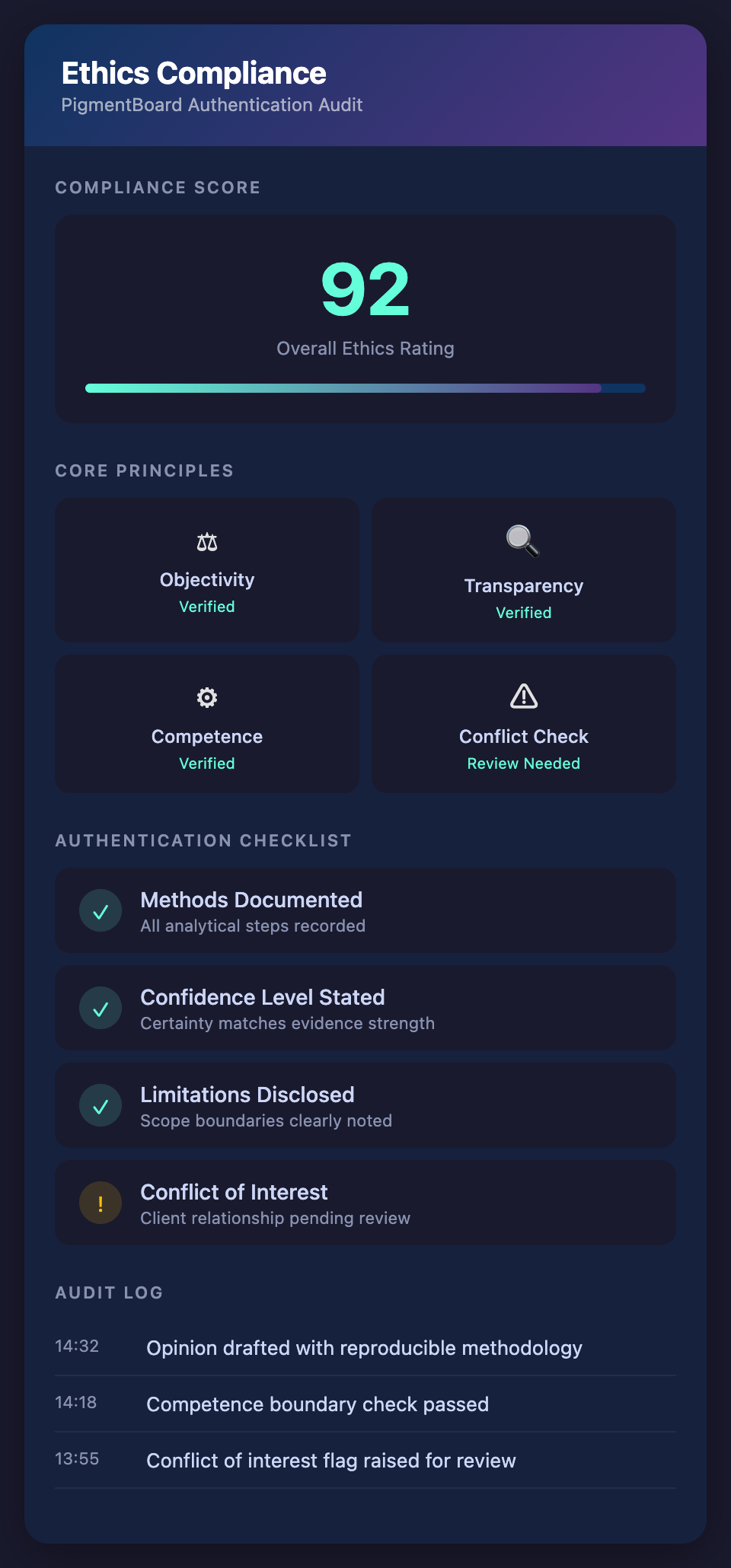
1. Objectivity. Your opinion must be based on evidence, not on who is paying you. If the textile is genuine, say so. If it is not, say so. If you cannot tell, say that. Financial pressure from clients, dealers, or institutions must not influence your conclusion.
2. Transparency. Disclose your methods, your data, your reasoning, and your limitations. An opinion without visible methodology is not a professional opinion — it is a guess.
3. Competence boundaries. Only opine on textile types, eras, and traditions within your expertise. If a case falls outside your knowledge, refer to a specialist. An honest "I am not qualified to assess this" is more ethical than an uninformed opinion.
4. Conflict of interest disclosure. If you have any relationship (financial, professional, personal) with any party to the transaction, disclose it. If the conflict is material, recuse yourself.
5. Appropriate certainty. State your conclusion at the confidence level the evidence supports. "Consistent with the claimed date" is different from "definitely genuine." "Inconsistent with the claimed date" is different from "definitely a forgery."
6. Reversibility. Be willing to revise your opinion if new evidence emerges. An authentication opinion is a conclusion based on available evidence, not an immutable declaration.
The Role of Technology
Degradation modeling and instrumental analysis do not replace ethical judgment — they support it by:
- Providing objective, reproducible data that reduces (but does not eliminate) subjective bias
- Creating transparent methodology that can be independently verified
- Generating quantified results that can be precisely communicated
- Documenting the basis for the opinion in a form that outlasts the expert's career
When You Are Wrong
Authentication errors are inevitable over a long career. When you discover that a previous opinion was incorrect:
- Acknowledge the error promptly
- Understand why the error occurred (new evidence? methodological limitation? actual mistake?)
- Communicate the correction to affected parties
- Improve your methods to reduce the chance of similar errors
The measure of an ethical authentication specialist is not perfection — it is honesty, transparency, and willingness to correct errors.
Want tools that support transparent, documented, reproducible authentication? Join the PigmentBoard waitlist.