Why Forgers Struggle to Replicate Multi-Factor Degradation
The Complexity Barrier
Forgery is fundamentally a replication problem: make something new look old. For textiles, this means replicating the effects of aging on fibers, dyes, and structure. Simple aging effects can be replicated. Complex, multi-factor aging cannot — and this is the authentication specialist's advantage.
Why Single-Factor Aging Is Detectable
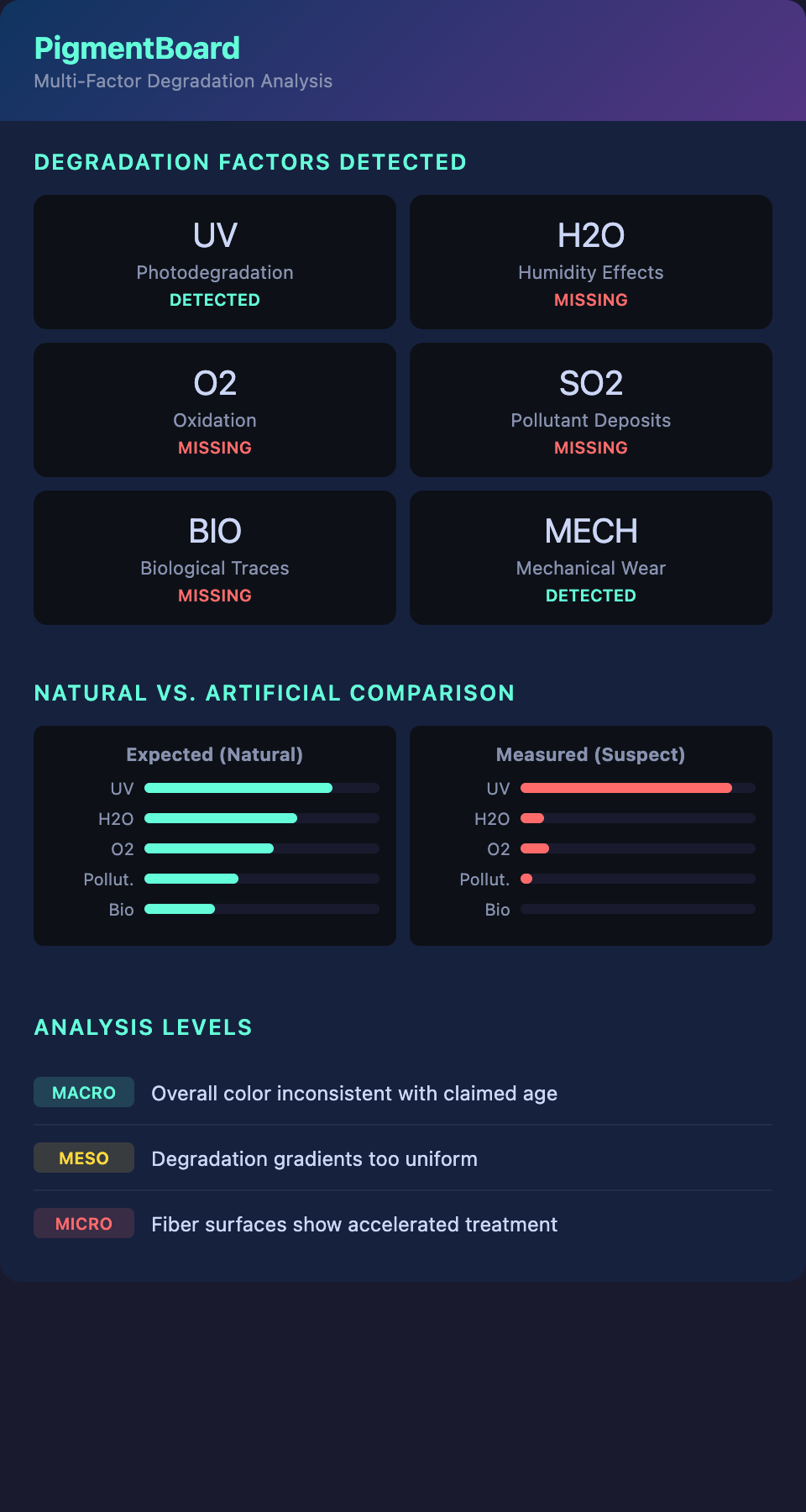
A forger who ages a textile under a UV lamp produces UV fading. It may look convincing. But the textile lacks:
- The humidity-UV synergy that accelerates fading in ways UV alone does not
- The oxidation products that accumulate independently of UV
- The atmospheric pollutant deposits that shift color in specific directions
- The biological traces (mold, insect frass) that accumulate over decades of storage
- The mechanical wear patterns from handling, display, and storage
Each missing factor is a signal that the aging is artificial.
Why Multi-Factor Artificial Aging Still Falls Short
A more sophisticated forger might combine UV exposure with humidity cycling, chemical oxidation treatment, and physical distressing. This multi-step process produces a more convincing result. But it still differs from natural aging because:
1. The factors do not interact the same way. In natural aging, UV and humidity act simultaneously and synergistically. The chemical reactions that occur when both factors are present differ from the sum of their individual effects. Applying them sequentially (UV first, then humidity, or vice versa) produces different degradation products than applying them simultaneously over decades.
2. The time factor cannot be compressed without consequences. Accelerated aging (higher UV intensity, higher temperature, more aggressive chemicals) changes the reaction kinetics. Higher temperatures favor different reaction pathways than lower temperatures. The ratio of competing degradation pathways shifts. The resulting degradation products are measurably different.
3. The spatial distribution is wrong. Natural aging produces gradients — the front of a displayed textile fades more than the back, the top more than the bottom, folds protect differently from flat areas. These gradients are three-dimensional and reflect the textile's specific display and storage history. Artificial aging, even with masking and selective treatment, produces gradients that are simpler and more regular than natural ones.
4. Micro-scale evidence accumulates naturally. Under high magnification, naturally aged fibers show decades of accumulated evidence — oxidation products on individual fiber surfaces, mineral deposits from environmental exposure, biological traces. Artificially aged fibers show aggressive chemical treatment on the surface without the accumulated micro-scale evidence of decades.
The Authentication Specialist's Toolkit
To exploit the multi-factor detection advantage:
Macro-level analysis: Does the overall color and condition match the claimed age? Are the degradation patterns consistent with the claimed display/storage history?
Meso-level analysis: Are the degradation gradients consistent with a specific display orientation? Are fold-line effects present where expected? Is the back different from the front?
Micro-level analysis (under magnification): Do individual fibers show natural vs. accelerated aging? Are biological traces present? Is surface oxidation consistent with decades of exposure?
Spectral analysis: Do the spectral curves match predicted natural aging or do they show signatures of artificial aging?
Multi-factor modeling: Does the overall degradation fingerprint match a natural multi-factor model or a sequential single-factor process?
The Arms Race
As authentication methods improve, forgers will adapt. The response is not to rely on any single detection method but to use the convergence of multiple methods. A sophisticated forger might defeat one test but is unlikely to defeat them all simultaneously.
Degradation modeling contributes by providing a quantitative, multi-factor prediction that serves as one strong line of evidence among several.
Want to model multi-factor degradation for authentication? Join the PigmentBoard waitlist.