How Humidity History Affects Authentication of Claimed Provenance
Humidity Leaves Its Own Signature
As discussed in conservation contexts, humidity drives specific degradation pathways that differ from UV fading. For authentication, these humidity-specific signatures provide an independent check on provenance claims.
Humidity-Specific Degradation Indicators
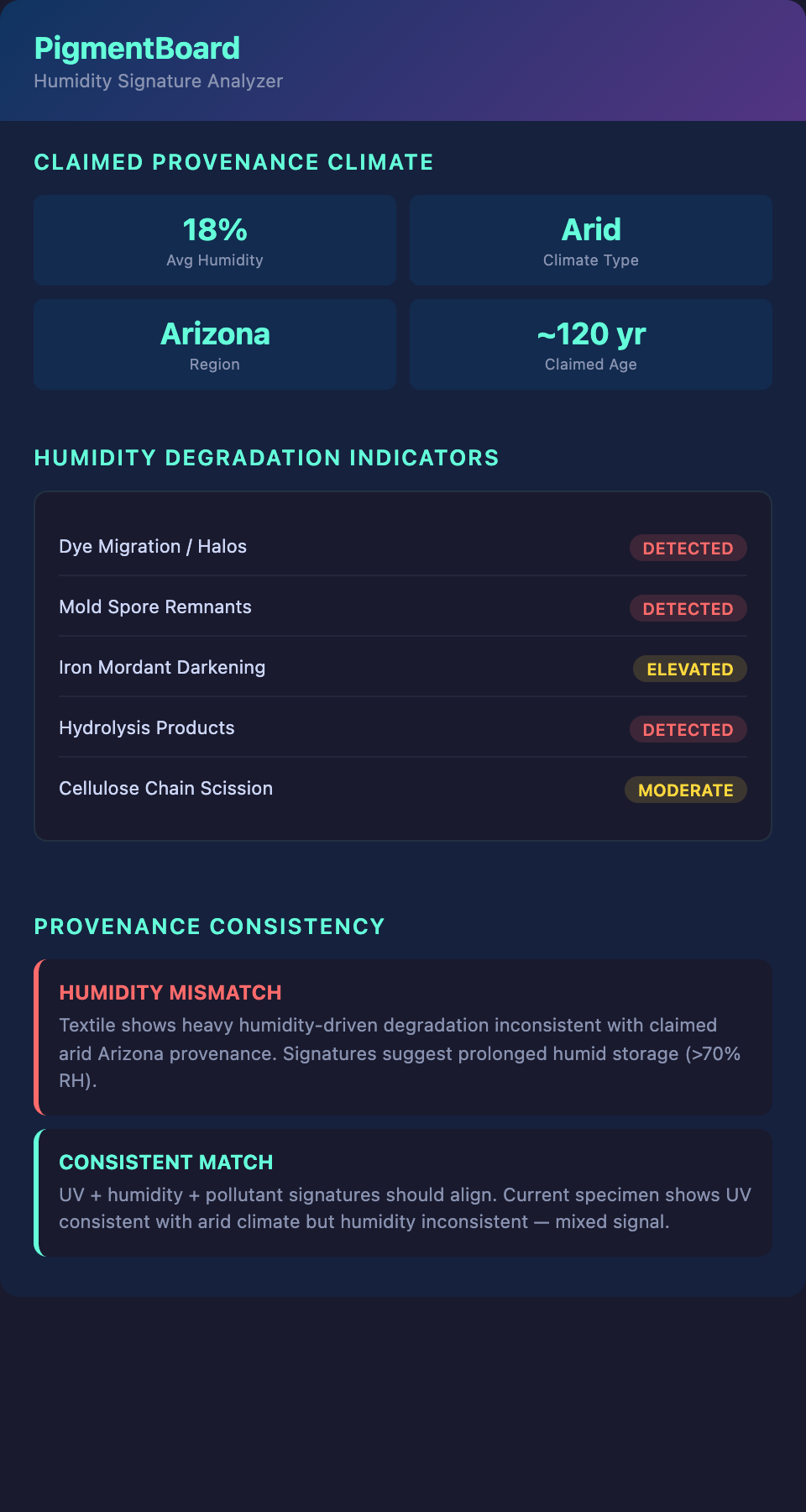
Dye migration patterns. High-humidity exposure causes soluble dyes to migrate through the textile, creating characteristic halos, bleeding, and color redistribution. These patterns do not occur in dry conditions.
Mold traces. Textiles from humid environments often carry traces of mold — even if no active mold is visible, spore remnants and mycelial fragments may be detectable under magnification.
Iron mordant behavior. Iron-mordanted areas in humid conditions show more aggressive darkening and fiber degradation than in dry conditions. The degree of iron damage is a humidity indicator.
Hydrolysis products. Humidity-driven hydrolysis produces specific molecular fragments that differ from UV-driven degradation products. These can be detected spectroscopically.
Fiber condition. Cellulose fibers (cotton, linen) in humid conditions show characteristic hydrolysis degradation. Protein fibers (silk, wool) show different humidity-related damage patterns.
Authentication Application
Scenario 1: A textile is claimed to have been stored in a climate-controlled museum since 1950. The textile shows significant humidity-driven degradation (dye migration, mold traces). This is inconsistent with climate-controlled storage and suggests a different storage history.
Scenario 2: A textile is claimed to be from Central Asia (dry climate). It shows heavy humidity effects. Either it was stored in a humid environment at some point (which the provenance does not mention), or the provenance is incorrect.
Scenario 3: A textile is claimed to be from Southeast Asia (humid tropical climate). It shows the expected heavy humidity signatures. This is consistent with the claimed provenance.
Combining Humidity With Other Factors
Humidity analysis is most powerful when combined with other degradation factors:
- UV + humidity signatures should be consistent with the same provenance
- Pollutant + humidity signatures should reflect the same geographic/temporal context
- Biological traces should be consistent with the humidity level indicated by the dye degradation
Inconsistencies between factors (e.g., high UV fading but no humidity effects, when the claimed location should produce both) are red flags.
Want to model humidity-specific degradation for authentication? Join the PigmentBoard waitlist.