The Legal Weight of Degradation Analysis in Art Fraud Cases
Science in the Courtroom
Textile forgery cases increasingly involve substantial sums — a single contested textile can be worth hundreds of thousands of dollars. Courts require expert evidence that meets specific standards of reliability and relevance.
Legal Standards for Scientific Evidence
Daubert standard (US federal courts): The expert's methodology must be:
- Testable and tested
- Subject to peer review
- Have a known error rate
- Based on standards
- Generally accepted in the relevant field
Frye standard (some US state courts): The methodology must be generally accepted in the relevant scientific community.
Similar standards exist internationally.
How Degradation Analysis Meets Legal Standards
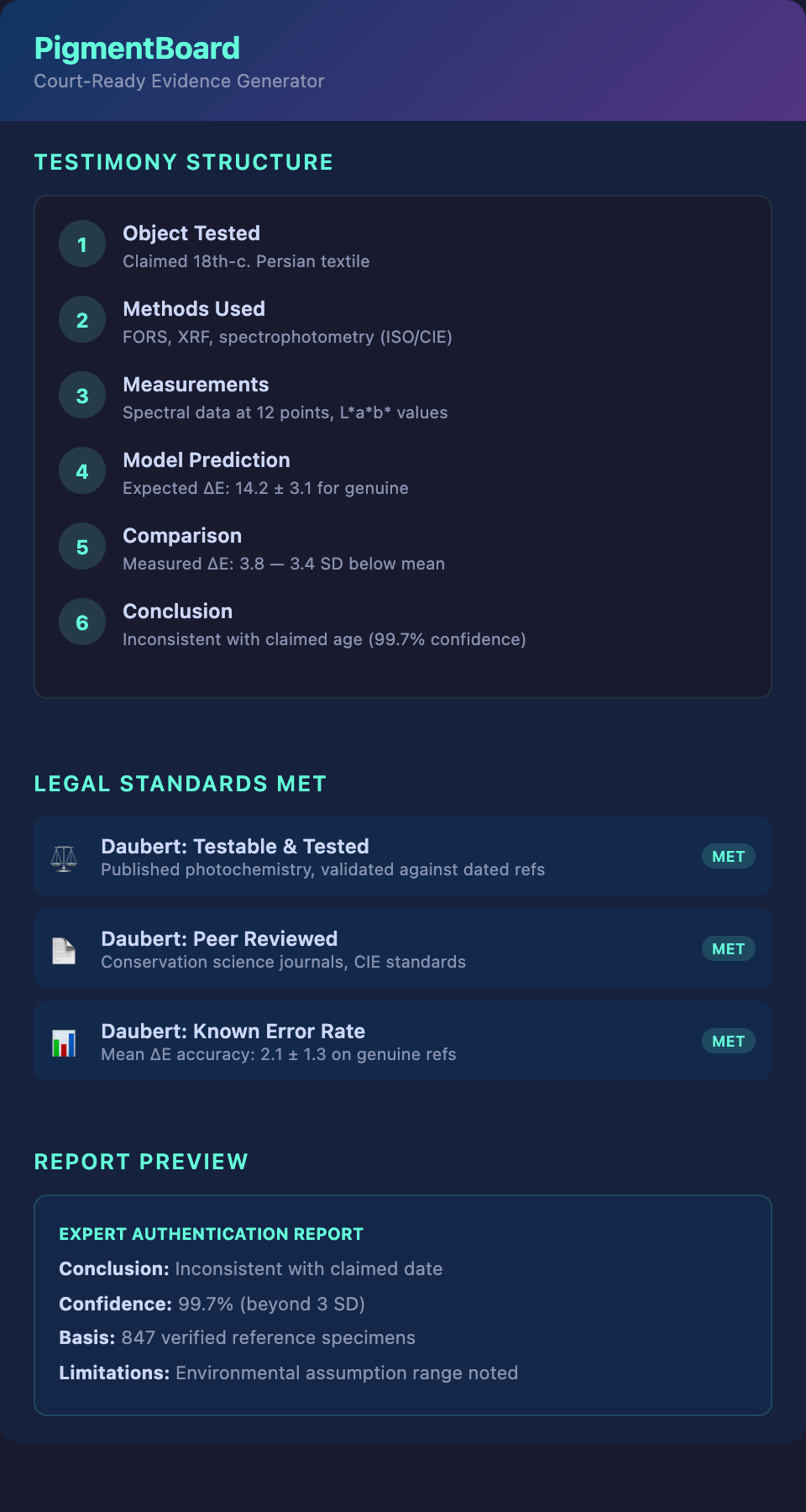
Testable and tested: Degradation modeling is based on published photochemistry, validated against dated reference textiles, and produces predictions that can be independently verified.
Peer reviewed: The underlying degradation science (photodegradation rates, oxidation mechanisms, mordant chemistry) is extensively published in peer-reviewed conservation science journals.
Known error rate: When calibrated against a reference database, the model's prediction accuracy can be quantified (e.g., "the model predicts degraded color with a mean ΔE of 2.1 ± 1.3 for genuine textiles of this type").
Standards-based: Spectrophotometric measurements use ISO/CIE standards. Analytical methods (FORS, XRF, HPLC) follow established protocols.
Generally accepted: Degradation science is a recognized specialty within conservation science, itself a well-established field.
Presenting Evidence Effectively
Structure your testimony around the scientific method:
- Here is what we tested (the textile)
- Here is how we tested it (methods, instruments, standards)
- Here is what we found (measurements, data)
- Here is what the science predicts for a genuine textile (model output)
- Here is the comparison (agreement or discrepancy, quantified)
- Here is the conclusion (consistent or inconsistent, with stated confidence)
Anticipate cross-examination:
- "Could any other explanation account for the discrepancy?" (Always acknowledge alternative explanations while explaining why they are less probable)
- "How accurate is the model?" (Present the model's calibrated accuracy against known reference textiles)
- "Is this method widely used?" (Reference published literature, use at other institutions, professional standards)
Documentation for Legal Use
Reports intended for legal proceedings should:
- Clearly state the expert's qualifications
- Describe methods in reproducible detail
- Present raw data (not just conclusions)
- Quantify all comparisons
- State the confidence level and its basis
- Acknowledge limitations
- Be signed and dated
Want to generate court-ready degradation analysis for authentication cases? Join the PigmentBoard waitlist.