How Pigment Aging Models Detect Textile Forgeries
The Forger's Problem
Textile forgery has become increasingly sophisticated. Modern forgers can:
- Source antique fibers and fabrics from scraps and fragments
- Reproduce historical weave structures and patterns
- Apply natural dyes using historical recipes
- Artificially age the fabric with tea, sunlight, and physical distressing
What they struggle to replicate is the specific, multi-factor degradation fingerprint that genuine aging produces. A textile that has spent 150 years in a specific environment has been shaped by UV, oxidation, humidity, atmospheric pollutants, and biological agents acting simultaneously and synergistically. Each factor affects the pigments through specific chemical pathways that produce specific degradation products.
Artificial aging typically applies one or two factors (usually UV and general aging/staining) and produces a superficially convincing but chemically incorrect result.
How Degradation Modeling Exposes Fakes
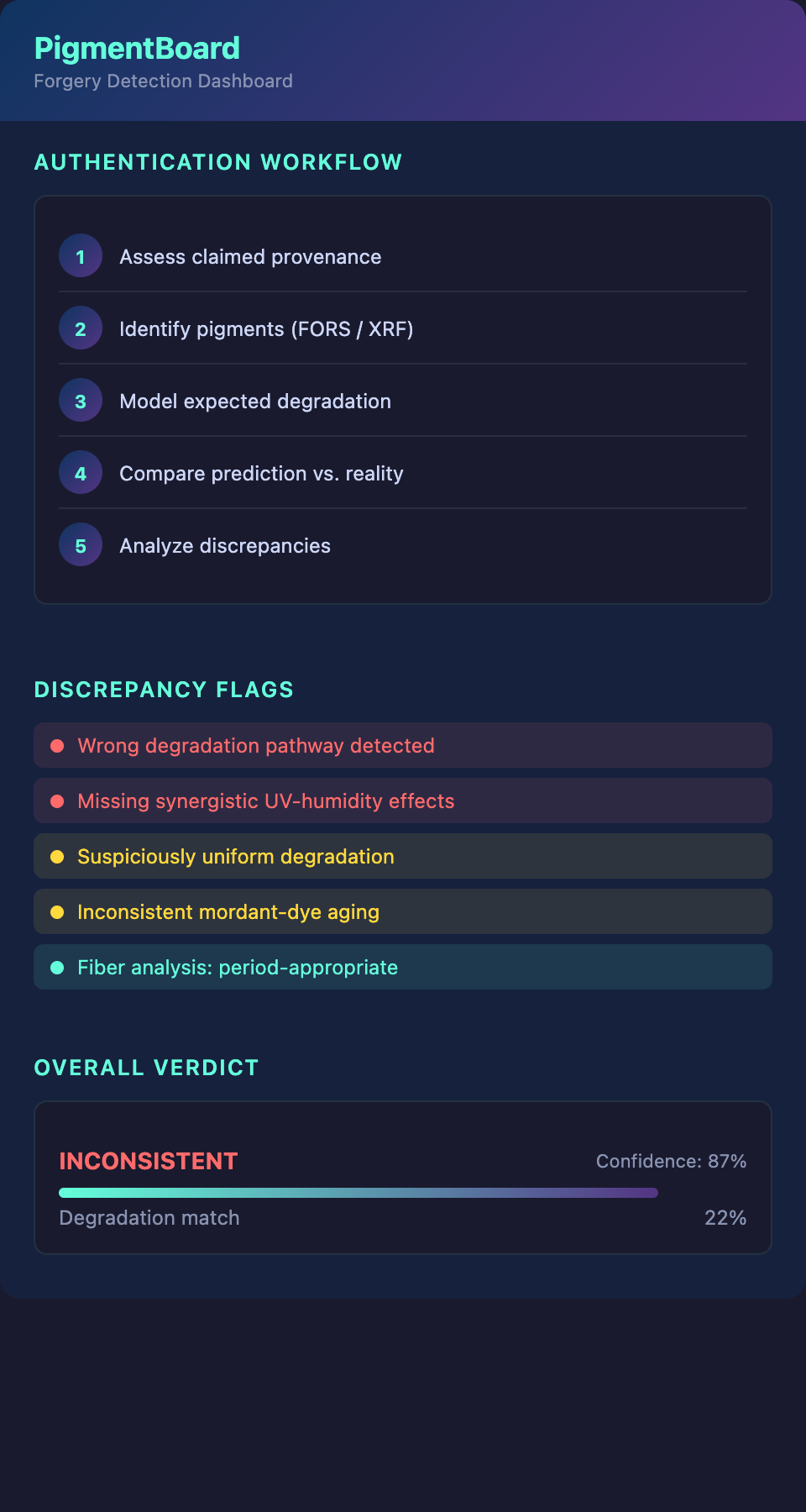
The authentication workflow using degradation modeling:
Step 1: Assess the claimed provenance. The textile is said to be from a specific era, region, and context. These claims imply a specific degradation history — how much UV, what humidity range, what atmospheric conditions, what temperature range.
Step 2: Identify the pigments present. Using FORS, XRF, and other non-destructive analysis, identify the dyes and mordants used.
Step 3: Model the expected degradation. Input the identified pigments and the claimed provenance conditions into the degradation model. The model predicts what the pigments should look like after the claimed duration of aging under the claimed conditions.
Step 4: Compare prediction to reality. Measure the actual color of the textile and compare it to the model's prediction.
Step 5: Analyze discrepancies. If the actual color matches the prediction, the claimed provenance is consistent with the physical evidence. If the actual color does not match, something is wrong — either the provenance is inaccurate or the pigments have been manipulated.
Types of Discrepancies That Flag Forgeries
Wrong degradation pathway. A textile claimed to be 19th-century indigo but showing a color shift consistent with chemical discharge (bleach) rather than photodegradation. The endpoint color might be similar, but the spectral signature differs.
Missing synergistic effects. A textile showing UV fading but no humidity-UV synergy, suggesting it was aged under a UV lamp in a dry environment rather than in a real-world setting where humidity and UV act together.
Uniform degradation. Natural aging is never perfectly uniform. Folds, display orientation, contact with other materials, and environmental gradients create variation. Artificially aged textiles often show suspiciously even degradation.
Wrong dye for the era. The pigment analysis reveals a dye that was not available in the claimed era — a synthetic dye in a textile claimed to be pre-1856, or a specific synthetic variant that was not commercially available until after the claimed date.
Inconsistent mordant-dye aging. The dye shows one aging pattern while the mordant shows another, suggesting they were applied separately rather than as a historical dye-mordant system.
The Limitations of Subjective Assessment
Traditional textile authentication relies heavily on expert visual assessment — trained eyes that have seen thousands of genuine textiles and can spot anomalies. This expertise is real and valuable, but it has inherent limitations:
- Subjectivity — Two experts may disagree
- Non-transferable — Cannot be documented in a way that another expert can independently verify
- Legally vulnerable — In court, subjective opinion is weaker than reproducible scientific analysis
- Susceptible to high-quality fakes — As forgeries improve, the visual differences between genuine and fake shrink below the threshold of visual detection
Degradation modeling supplements expert judgment with reproducible, parameterized analysis. The model's prediction and the comparison methodology can be documented, shared, and independently verified — strengthening the authentication conclusion.
Building Authentication Confidence
No single test definitively proves or disproves authenticity. Authentication confidence comes from the convergence of multiple lines of evidence:
- Fiber analysis (correct era? correct processing method?)
- Dye identification (correct for the era and region?)
- Weave structure analysis (correct for the tradition?)
- Degradation pattern analysis (consistent with claimed provenance?)
- Provenance documentation (paper trail)
Degradation modeling adds a powerful, quantitative line of evidence to this convergence. When the degradation pattern matches the model's prediction for the claimed provenance, it corroborates the other evidence. When it does not match, it raises a red flag that demands explanation.
Ready to add quantitative degradation modeling to your authentication toolkit? Join the PigmentBoard waitlist.