How Production Technique Analysis Complements Degradation Authentication
Construction Tells Its Own Story
Independent of dye and degradation analysis, the physical construction of a textile carries era-specific information. Spinning methods, weaving techniques, finishing processes, and printing technologies all changed over time, leaving detectable evidence.
Era-Specific Technical Markers
Spinning:
- Hand-spun yarn (pre-industrial): irregular diameter, Z or S twist varying within the yarn
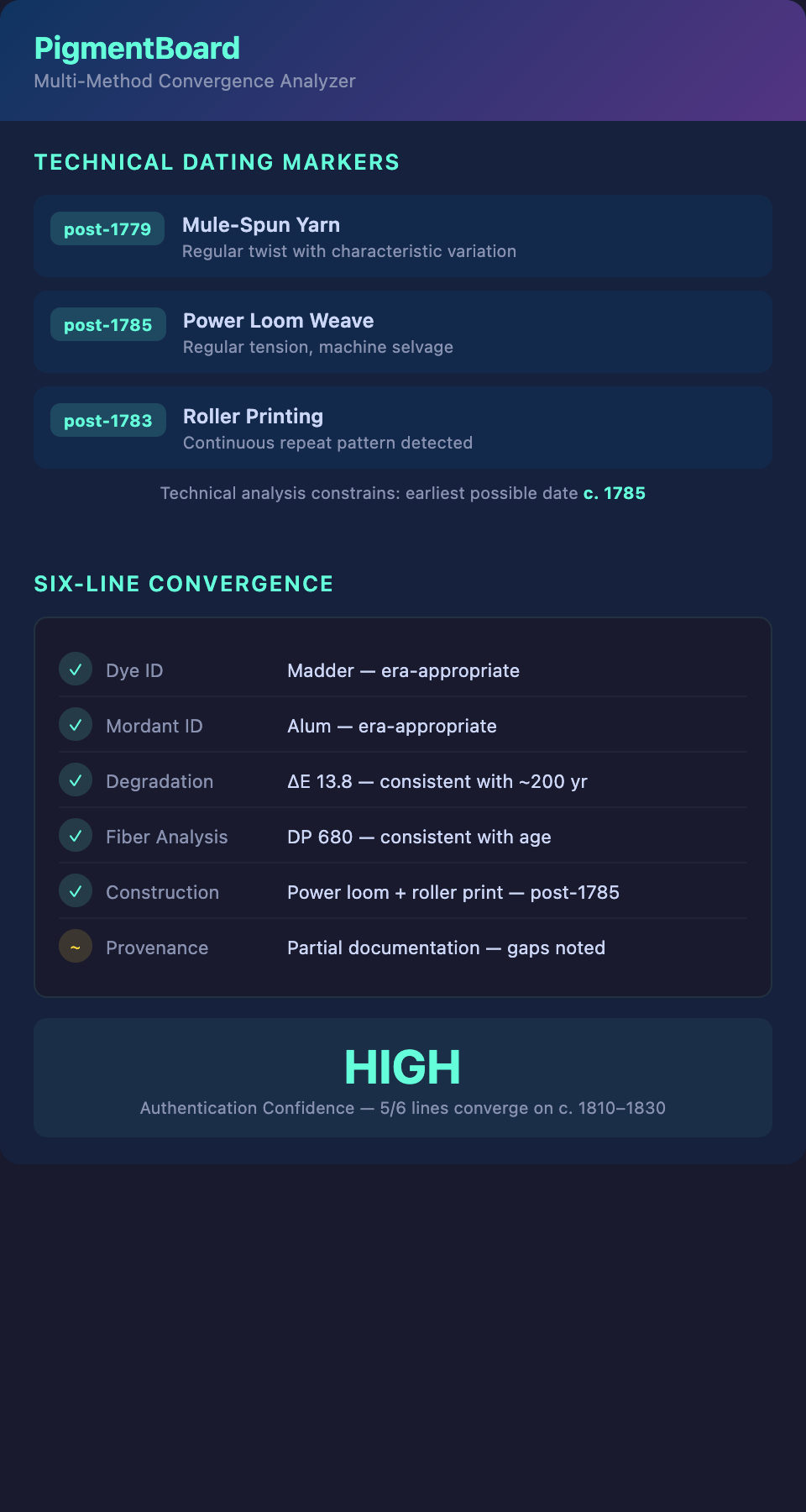
- Mule-spun (post-1779): more regular but with characteristic twist variation
- Ring-spun (post-1828): very regular, consistent twist
- The spinning method visible under magnification immediately constrains the earliest possible date
Weaving:
- Hand-loom: characteristic selvage construction, weft tension variations
- Power loom (post-1785): more regular tension, different selvage type
- Jacquard (post-1801): specific pattern repeat characteristics
Finishing:
- Calendering, napping, and other finishing processes leave specific surface evidence
- Chemical finishes (sizing, stiffening) are era-specific
Printing:
- Block printing: characteristic irregular registration, pressure variations
- Plate printing: specific image quality characteristics
- Roller printing (post-1783): continuous repeat, specific registration characteristics
- Screen printing (post-1907): mesh pattern may be visible under magnification
How Technical Analysis Supports Degradation Authentication
Agreement strengthens confidence: If technical analysis dates the construction to the 1840s and degradation analysis is consistent with 180 years of aging, both lines of evidence converge.
Disagreement raises flags: If technical analysis shows ring-spun yarn (earliest possible date: 1828) but degradation analysis suggests only 50 years of aging, the textile cannot be from 1828 — it is either much younger or has been artificially preserved.
Technical analysis constrains the date range. Degradation analysis then tests whether the degradation level is consistent with an age within that range.
The Convergence Approach
The strongest authentication combines:
- Dye identification — Era-appropriate dye?
- Mordant identification — Era-appropriate mordant?
- Degradation analysis — Consistent with claimed age and conditions?
- Fiber analysis — Era-appropriate fiber processing?
- Construction analysis — Era-appropriate techniques?
- Provenance documentation — Paper trail
Each line of evidence is independent. Convergence across all six provides high authentication confidence. Divergence in any one demands explanation.
Want to add quantitative degradation modeling to your multi-method authentication approach? Join the PigmentBoard waitlist.