Using Provenance Data to Predict Expected Pigment Degradation
provenance data predict expected pigment degradation
Provenance as Degradation Input
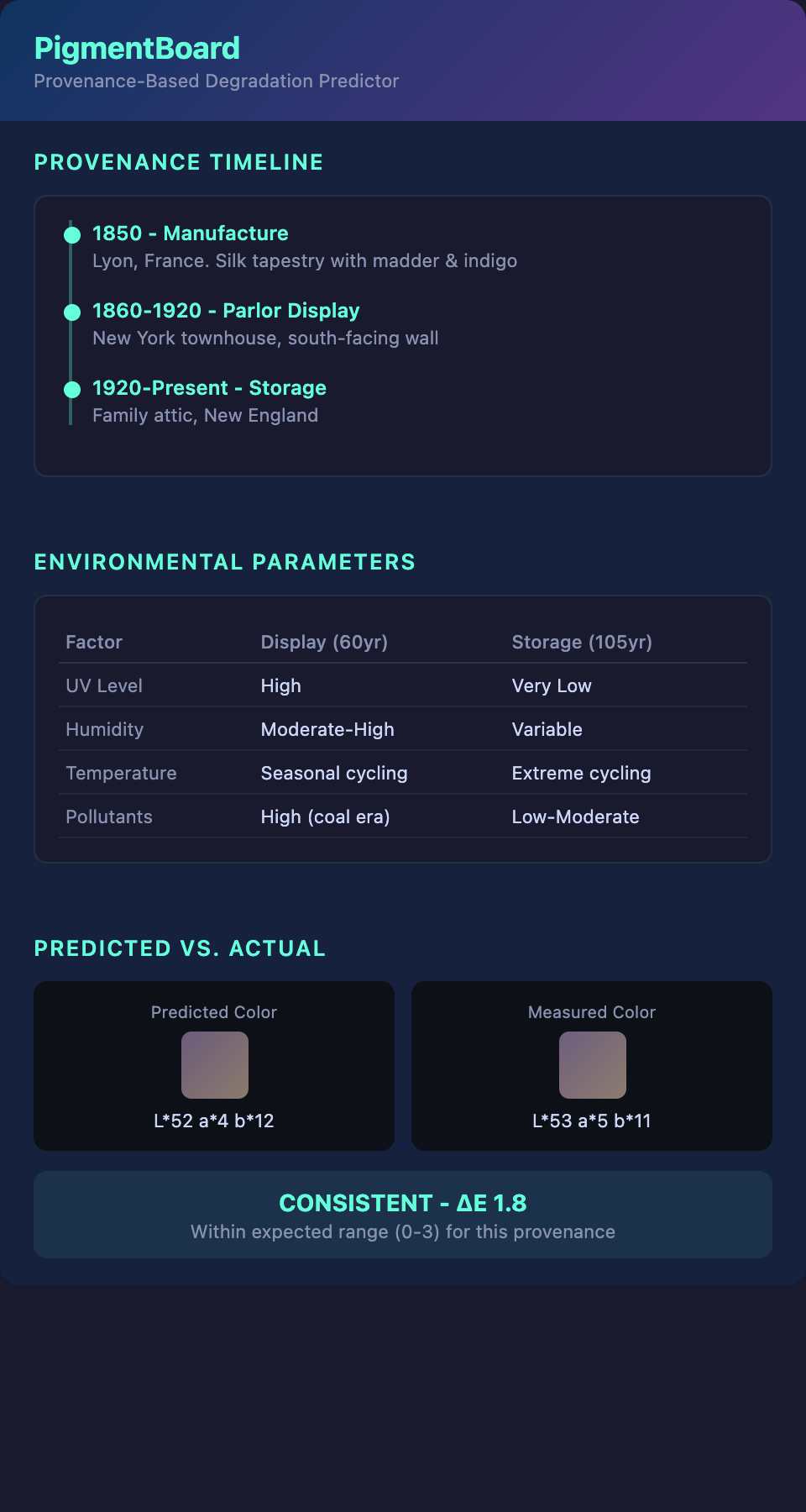
Every provenance claim implies a degradation history. "Made in Lyon, France, circa 1850; displayed in a New York townhouse parlor from 1860-1920; in family storage since 1920" is not just a historical narrative — it is a set of environmental parameters:
- UV exposure: moderate-high (parlor display, probably near windows, for 60 years), then low (storage for 100+ years)
- Humidity: moderate to high (New York climate, no air conditioning until mid-20th century)
- Temperature: seasonal cycling (coal-heated in winter, hot in summer until air conditioning)
- Atmospheric pollutants: high (New York, coal-heated, gas-lit era), decreasing after electrification
- Mechanical handling: moderate (parlor display, occasional cleaning, one major move to storage)
These parameters can be translated directly into degradation model inputs.
Building the Provenance-to-Parameters Translation
Display conditions by context:
| Context | UV Level | Humidity | Pollutants | Notes |
|---|---|---|---|---|
| Parlor, near window | High | Moderate-High | Moderate-High | North light less damaging than south |
| Interior room, no window | Low-Moderate | Moderate | Moderate | Artificial lighting contributes some UV |
| Attic storage | Very Low | Variable (high/low cycling) | Low-Moderate | Temperature extremes accelerate cycling damage |
| Basement storage | Very Low | High | Moderate | Humidity and mold risk |
| Museum display (pre-1980) | Moderate | Moderate | Low-Moderate | Before modern UV filtering |
| Museum display (post-1980) | Low | Controlled | Low | Modern environmental controls |
| Museum storage | Very Low | Controlled | Very Low | Best-case scenario |
Regional climate factors:
| Region | Humidity Character | Temperature Character | Pollutant Character |
|---|---|---|---|
| New England (US) | Seasonal, moderate-high | Four-season cycling | Moderate industrial |
| Southeast US | High year-round | Warm, less cycling | Lower industrial |
| UK | Moderate-high, stable | Mild, less cycling | High industrial (pre-1956) |
| Northern Europe | Lower, seasonal | Cold winters | Moderate |
| Mediterranean | Lower, seasonal dry | Warm summers | Low-moderate |
The Prediction Workflow
- Document the complete provenance claim with all available details
- Translate each period of the provenance into environmental parameters
- Input the parameters into the degradation model for each period
- Combine the predictions (60 years of parlor display + 100 years of storage = cumulative effect)
- Generate the expected current state of the pigments
- Compare to the actual state measured on the textile
- Document the agreement or discrepancy
When Provenance Is Incomplete
Many textiles have gaps in their provenance. The model can still be useful:
- Known bookends: If you know the textile was made in 1850 and was in a specific collection by 1930, you can model the 1850-1930 period under estimated conditions and the 1930-present period under documented conditions.
- Regional estimation: If the general region is known but specific conditions are not, use regional averages.
- Sensitivity analysis: Run the model with different plausible conditions and see how much the prediction varies. If all plausible scenarios predict similar results, the prediction is robust.
The Comparison
The comparison between predicted and actual pigment state can be:
- Qualitative: Does the overall character of aging match? (direction of color shift, type of degradation)
- Semi-quantitative: Is the degree of aging roughly consistent? (heavily faded where the model predicts heavy fading)
- Quantitative: What is the ΔE between predicted and actual? What are the spectral differences?
All three levels provide useful information, with quantitative comparison being the most defensible.
Ready to translate provenance claims into quantitative degradation predictions? Join the PigmentBoard waitlist.