Understanding Crowd Crush Risk at Music Festivals: Lessons from Astroworld and Roskilde
The Physics of Festival Crowd Crush
Crowd crush is not a stampede. This distinction is critical and widely misunderstood — including by media outlets that covered both the Astroworld and Roskilde disasters. A stampede implies panicked people running over each other. A crowd crush is a fluid-dynamics event in which the density of a standing crowd exceeds the threshold at which individuals lose the ability to control their own movement, and the resulting compressive forces cause asphyxiation, cardiac arrest, or trampling of those who fall.
The foundational research comes from Professor G. Keith Still of Manchester Metropolitan University, whose crowd-science work established that a standing crowd becomes dangerously compressed at densities above approximately 6 persons per square meter. At that density, individuals can no longer raise their arms or expand their chests to breathe. At 8 to 9 persons per square meter, compressive forces can reach 4,500 newtons — enough to bend steel barriers (Still, G. Keith — Introduction to Crowd Science, CRC Press).
At the Astroworld Festival in Houston on November 5, 2021, a crowd surge during Travis Scott's headline set compressed approximately 50,000 attendees toward the stage. Ten people died and hundreds were injured. The subsequent investigation by Harris County found that crowd density in the front-of-stage area exceeded survivable thresholds, that festival medical staff were overwhelmed, and that communication breakdowns delayed the decision to stop the performance (Harris County Institute of Forensic Sciences — Astroworld Investigation). A congressional investigation by the U.S. House Committee on Oversight and Reform documented systemic failures in crowd-management planning, including inadequate crowd-density monitoring and a security plan that relied on visual observation rather than quantitative measurement (U.S. House Committee on Oversight and Reform — Astroworld Investigation).
At the Roskilde Festival in Denmark on June 30, 2000, a crush during Pearl Jam's set killed nine people. The Danish police investigation found that a crowd surge from the rear compressed fans against a stage barrier that offered no escape route. The subsequent safety reforms, which became a model for European festival regulation, required front-of-stage barrier redesigns, crowd-density monitoring, and mandatory stop-show protocols (Roskilde Festival Safety Report / Danish National Police).
Both incidents share a common pattern: the crowd reached lethal density gradually, over a period of minutes, while security personnel on the ground lacked the tools to measure what was happening quantitatively. By the time the situation was visually obvious, it was already too late.
How Spatial Tension Mapping Detects Pre-Crush Conditions
The value of spatial tension mapping in a crowd-crush context is not that it prevents bad behavior. Crowd crush victims are not behaving badly. They are trapped in a fluid-dynamics event that no individual can control. The value is that the system detects the precursor conditions — rising density, compressive flow patterns, loss of individual mobility — minutes before the crowd reaches the lethal threshold.
The detection model works in layers.
Density gradient monitoring. The system does not just measure average density across a zone. It tracks the density gradient — the rate at which density is changing and the direction of the change. A zone at 4 persons per square meter with a stable gradient is yellow. The same zone at 4 persons per square meter with a rising gradient of 0.5 persons per square meter per minute is orange — because the model projects it will reach 6 persons per square meter within four minutes if the trend continues.
Flow-velocity analysis. In a healthy crowd, individuals at the front of a stage area have some lateral mobility. They can shift sideways, step back, and create micro-adjustments that redistribute pressure. As density increases, flow velocity drops toward zero. A zone where average individual movement speed falls below 0.2 meters per second is exhibiting the early signs of crowd lock — the condition in which people cannot move at all and are held in place by the bodies around them. This is the critical pre-crush indicator.
Pressure-wave detection. Before a full crush, the crowd often exhibits oscillating compression waves — the crowd surges forward, then rebounds slightly, then surges again. These waves are visible in overhead camera footage as rhythmic density oscillations. The system detects these patterns and flags them as high-priority crush precursors.
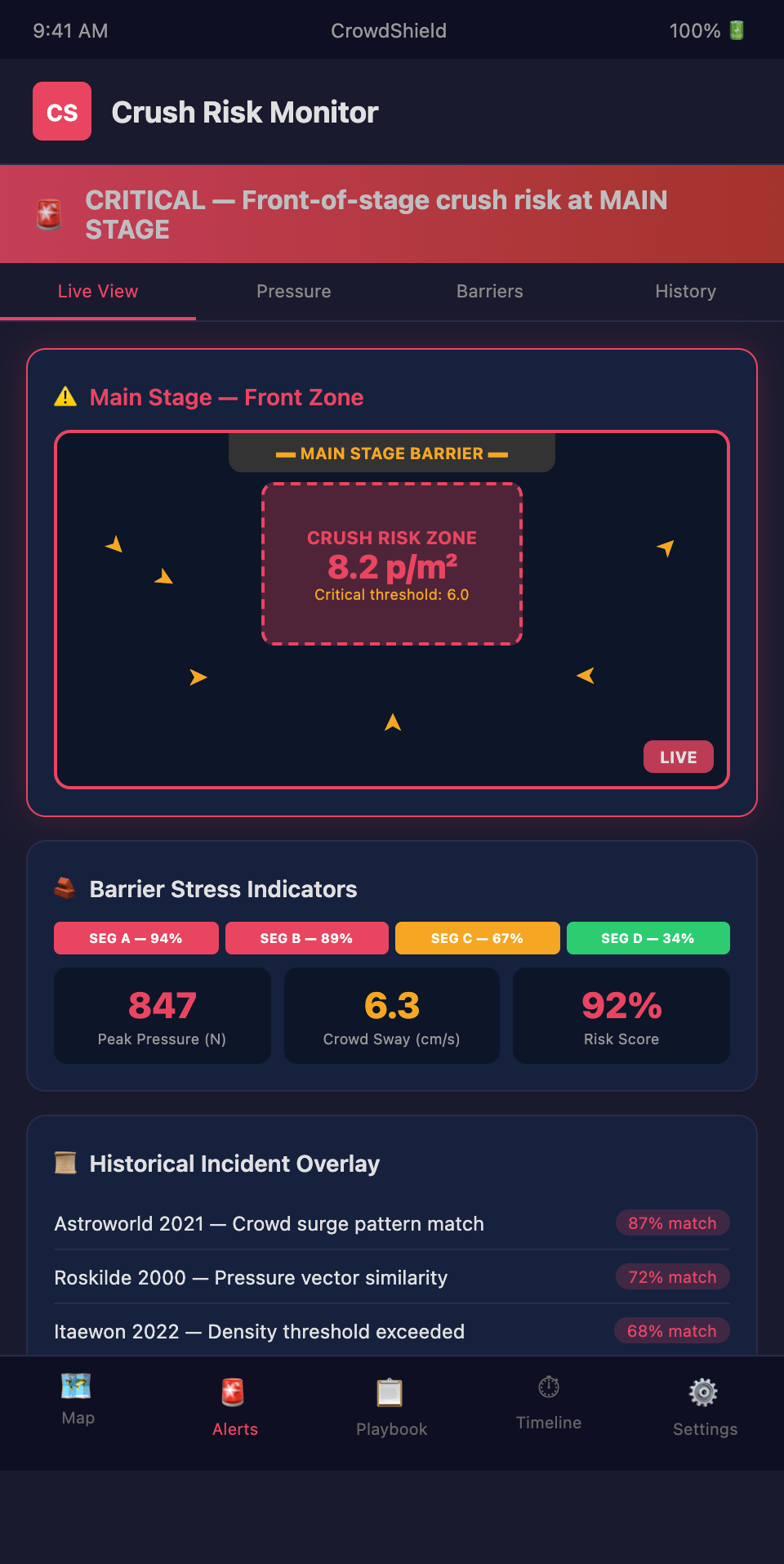
When the system detects pre-crush conditions, the choose-your-own-adventure prompt escalates rapidly. Unlike a tension-mapping alert for a potential altercation — where the first prompt might suggest deploying a hospitality ambassador — a crush-risk alert skips directly to high-priority interventions:
"Main Stage Front Zone — CRUSH RISK. Density 5.4/sqm, gradient rising. Flow velocity 0.15 m/s. Compression waves detected. Recommended actions: (A) Initiate stop-show protocol — request artist pause performance and direct crowd to step back. (B) Open emergency escape lanes at stage-left and stage-right barriers. (C) Deploy crowd-push team to rear of zone to halt inward flow. (D) Activate all options simultaneously."
The Astroworld congressional report specifically identified the absence of a stop-show protocol as a critical failure. A spatial monitoring system with predefined crush-risk thresholds and automated escalation prompts directly addresses this gap.
Advanced Tactics: Designing for Crush Prevention
Beyond real-time monitoring, the lessons from Astroworld and Roskilde point to structural and operational measures that spatial data should inform before the event begins.
Front-of-stage barrier geometry. The Roskilde reforms required festivals to replace straight-line stage barriers with chevron or thrust-stage configurations that break the crowd into segments and provide lateral escape routes. Spatial modeling can simulate crowd-flow behavior against different barrier geometries before the event, allowing planners to optimize barrier placement for the specific stage dimensions and expected crowd size. Research published in Safety Science demonstrated that angled barrier configurations reduced peak crowd pressure by 20 to 35 percent compared to flat barriers in simulation models (Helbing, D., Johansson, A., & Al-Abideen, H.Z. — "Dynamics of crowd disasters: An empirical study," Physical Review E, 2007).
Density caps with automated enforcement. Rather than relying on visual estimates of "how full the pit looks," a spatial system can enforce hard density caps by zone. When a zone reaches its maximum safe density, the system triggers automated messaging to stewards at access points to close entry — and provides the data to justify that decision to frustrated fans and supervisors.
Historical incident correlation. By analyzing density, flow, and compression data from previous events, the system identifies the specific conditions that preceded past incidents and calibrates its alert thresholds accordingly. This converts institutional memory — which is often lost when security contractors change between festival editions — into persistent, data-driven models.
Stop-show protocol automation. One of the most significant findings from the Astroworld investigation was the ambiguity around who had the authority to stop the show and under what conditions. A spatial monitoring system removes this ambiguity by defining quantitative thresholds. When density exceeds a predefined level, when flow velocity drops below a predefined floor, or when compression-wave patterns match a predefined signature, the system automatically triggers the stop-show protocol — notifying the production manager, the artist's stage manager, and the security incident commander simultaneously. The decision to stop a performance costing millions of dollars is extraordinarily difficult for a human to make in real time. A system that surfaces the data and initiates the protocol reduces the psychological barriers to making the right call.
Crowd-facing communication systems. Beyond the security team's internal decision support, the system can interface with public-address systems and festival app push notifications to deliver direct crowd-communication messages. During the early stages of a developing crush scenario, a message instructing the crowd to stop pushing forward and take two steps back — delivered by the artist, the PA system, and the attendees' phones simultaneously — can interrupt the compression cycle before it reaches the lethal threshold. Research on crowd communication during emergencies by Drury and colleagues at the University of Sussex found that direct, specific instructions delivered through trusted channels produce faster and more uniform behavioral responses than generic warnings (Drury, J. et al. — "Cooperation versus competition in a mass emergency evacuation," Journal of Applied Social Psychology, 2009).
For a broader exploration of how crowd density thresholds apply across different venue types, see Understanding Crowd Density Thresholds and Aggression Risk in Venues.
For more on how barrier design interacts with crowd safety at festivals, see Barrier Systems and Crowd Control Infrastructure at Music Festivals.
For a look at how similar crush dynamics manifest in the compressed spaces of nightclubs and late-night venues, see Understanding Crowd Density Thresholds and Aggression Risk in Venues.
Protect Your Festival Attendees with CrowdShield
The lessons from Astroworld and Roskilde are clear: crowd crush follows predictable physics, produces detectable precursor signals, and can be interrupted if security teams have the right data at the right time. CrowdShield is building the spatial monitoring and decision-support system that turns crowd science into real-time operational intelligence. If you run a music festival and want to ensure your team can detect crush risk before it becomes a crisis, join the CrowdShield waitlist today.