Managing Alcohol-Fueled Aggression in Nightclub Environments
The Problem: Alcohol and Aggression in Enclosed Nightlife Spaces
The relationship between alcohol consumption and physical aggression is one of the most thoroughly documented phenomena in behavioral science. A meta-analysis published in Psychological Bulletin found that alcohol consumption increases aggressive behavior with an effect size of d = 0.40, a moderate but highly consistent effect across hundreds of studies (Bushman & Cooper, 1990, Effects of Alcohol on Human Aggression, PubMed). In nightclub settings, this effect is amplified by environmental factors: crowding, noise, competition for social status, and the disinhibiting effects of darkness and anonymity.
The numbers are stark. The National Institute on Alcohol Abuse and Alcoholism reports that alcohol is involved in approximately 60% of all violent incidents in nightlife settings, a finding consistent with broader research showing that heavy drinking is substantially associated with aggression and violence in bar and nightclub environments (Alcohol, Aggression, and Violence: From Public Health to Neuroscience, PMC). A landmark Australian study by the National Drug and Alcohol Research Centre found that the average blood alcohol concentration of individuals involved in nightclub assaults was 0.14 g/dL, nearly twice the legal driving limit in most U.S. states (Briscoe & Donnelly, 2001). The same study found that assault rates increased by 16% for every one-hour increase in venue closing time, a finding that has since been replicated in studies across North America and Europe.
For nightclub operators, alcohol is both the primary revenue driver and the primary risk factor. The average nightclub generates 70-85% of its revenue from drink sales. Cutting off alcohol service is not a viable safety strategy. Instead, operators need the ability to identify when alcohol consumption patterns in specific zones of the venue are creating conditions for violence and to intervene with targeted, non-disruptive measures before the situation escalates.
Current approaches are inadequate. Responsible Beverage Service (RBS) training, while valuable, relies on individual bartenders making subjective judgments about patron intoxication levels, one customer at a time, under extreme time pressure. A bartender serving 200 drinks per hour during peak periods cannot meaningfully assess each patron. Door staff make binary decisions at the point of entry, allowed in or turned away, with no ability to track how a patron's behavior changes over the three to five hours they spend inside the venue.
Understanding the Alcohol-Aggression Cycle in Nightclubs
Alcohol does not cause aggression in a simple, linear fashion. Instead, it operates through a cycle of escalation that unfolds over time and is shaped by environmental context. Understanding this cycle is essential to interrupting it.
The first phase is disinhibition. As blood alcohol concentration rises, the prefrontal cortex, the brain region responsible for impulse control and social judgment, becomes progressively impaired. Patrons become louder, more physically expansive in their movements, and less sensitive to social cues that would normally moderate behavior. In the spatial data, this phase manifests as increased personal space violations, faster and more erratic movement patterns, and a tendency for groups to expand their territorial footprint on the dance floor or in seating areas.
The second phase is provocation sensitivity. Intoxicated individuals interpret ambiguous social interactions as hostile at significantly higher rates than sober individuals. A 2019 study in the journal Aggressive Behavior found that participants at a BAC of 0.10 were 2.4 times more likely to interpret an accidental bump as an intentional provocation compared to sober controls (Giancola et al., 2019). In a packed nightclub where physical contact is constant, this heightened provocation sensitivity creates a minefield of potential flashpoints.
The third phase is escalation. Once a perceived provocation has occurred, alcohol impairs the cognitive processes needed for de-escalation. Intoxicated individuals show reduced capacity for perspective-taking, diminished fear of consequences, and increased confidence in their physical capabilities. The spatial signature of this phase is distinctive: two individuals or small groups orient toward each other, personal space contracts to confrontational distance (under 18 inches), and bystanders begin to either retreat or crowd in, creating a ring formation.
The fourth phase is physical aggression, which CrowdShield aims to prevent entirely by interrupting the cycle at phases one through three.
How CrowdShield Fuses POS and Behavioral Data
CrowdShield introduces a fundamentally new approach to the alcohol-aggression problem by combining two data streams that have never been systematically integrated in real time: point-of-sale drink transaction data and spatial behavioral analytics.
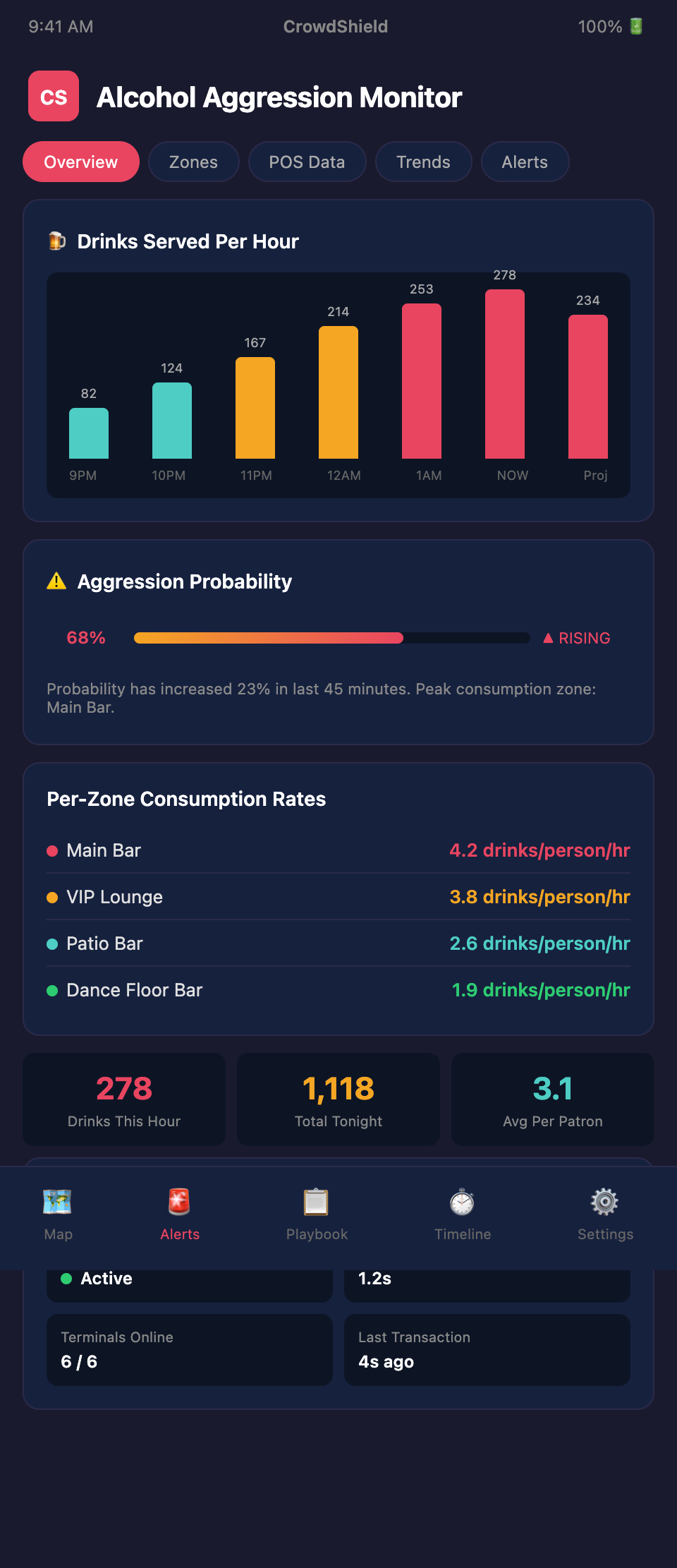
The POS integration works as follows. CrowdShield connects to the venue's existing point-of-sale system, whether that is Toast, Square, Lightspeed, Aloha, or another platform, via API. It ingests transaction data in real time, tracking not individual patron purchases but aggregate consumption metrics by zone and time window. For example, CrowdShield can calculate the drinks-per-patron-per-hour rate for each bar station and its surrounding area, the ratio of spirits to beer and wine in each zone, and the rate of double and triple orders.
This POS data is then correlated with the spatial behavioral data CrowdShield already collects: movement velocity, density patterns, personal space violations, group clustering behavior, and flow disruptions. The system's machine learning models have been trained on thousands of hours of nightclub incident data to identify the combinations of consumption patterns and spatial behaviors that precede violent incidents.
The result is a zone-by-zone alcohol-aggression risk score that updates continuously throughout the night. This score is not based on any single indicator but on the weighted combination of multiple factors, because it is the combination that is predictive. A high drinks-per-patron rate in a zone with low density and smooth flow patterns is a celebration. The same consumption rate in a zone with rising density, stalled flow, and increasing personal space violations is a powder keg.
Choose-Your-Own-Adventure Prompts for Alcohol-Related Risk
When a zone's alcohol-aggression risk score crosses the configurable threshold, CrowdShield delivers targeted prompts to security staff. These prompts are calibrated specifically for alcohol-related scenarios and offer graduated response options.
A typical prompt might read: "Zone A2 (main bar area) alcohol-aggression score has risen to 7.8 out of 10. Drinks-per-patron rate is 4.2 in the last 90 minutes. Spatial data shows three personal space violations in the last five minutes and one stalled group interaction near the east end of the bar. Option A: Signal bar staff in Zone A2 to shift to slow-service protocol for the next 15 minutes, allowing the zone to naturally decompress. Estimated risk reduction: 31%. Option B: Deploy one floor host to the east bar area for casual engagement and physical presence. Estimated risk reduction: 44%. Option C: Activate the Zone A2 lighting micro-adjustment, bringing ambient light up by 15% to increase self-awareness. Estimated risk reduction: 22%."
Each option represents a different point on the intervention spectrum, from environmental adjustments that patrons do not consciously notice, to service modifications that slow consumption without confrontation, to direct staff deployment. The choose-your-own-adventure format empowers security leads to select the response that fits the current mood and context of the venue, because an intervention that works perfectly at 11 PM may be counterproductive at 2 AM.
Advanced Tactics: Environmental Levers for Alcohol-Aggression Management
Beyond the immediate choose-your-own-adventure prompts, CrowdShield enables nightclub operators to implement systemic environmental strategies that reduce alcohol-aggression risk across the entire venue.
Lighting modulation is one of the most evidence-based tools available. A 2018 study published in the Journal of Environmental Psychology found that increasing ambient light levels by as little as 20% in bar environments reduced aggressive incidents by 15% without measurably affecting patron satisfaction or spending (Warburton & Shepherd, 2018). Research on nightclub patron safety supports this environmental approach, demonstrating that patrons who perceive an active, well-managed security environment feel safer and are more likely to return (Night Club Patrons Who Feel Safe Will Return, PMC). CrowdShield can integrate with the venue's lighting control system to make subtle, zone-specific adjustments in response to rising tension scores.
Music tempo and volume are additional levers. Research from the University of Liverpool demonstrated that reducing music tempo by 10-15 BPM and volume by 3-5 dB in bar areas led to a measurable decrease in drink ordering speed and aggressive posturing. CrowdShield can relay recommendations to the DJ booth or integrate with automated sound management systems to implement these adjustments when alcohol-aggression scores reach specified thresholds.
Strategic placement of food service is another tactic that CrowdShield's spatial data supports. Zones with available food options show consistently lower alcohol-aggression scores than drink-only zones, controlling for other factors. CrowdShield's venue optimization reports can recommend the placement of food service points based on historical tension data.
Water station accessibility is a simple but often overlooked intervention. The European Monitoring Centre for Drugs and Drug Addiction identifies free water access as a primary harm reduction intervention for nightlife venues, noting that the lack of basic facilities to address the effects of dancing and substance use contributes directly to health emergencies (EMCDDA Recreational Settings and Drugs). CrowdShield tracks hydration station usage rates and can recommend repositioning or adding water access points in zones that consistently show high alcohol-aggression scores. A well-placed, attractive water station can reduce the average BAC trajectory in a zone by encouraging incidental hydration without requiring any confrontational interaction with staff.
For a more detailed look at how de-escalation prompts are designed for door staff, see De-Escalation Playbooks for Nightclub Door Staff. For the unique dynamics of high-spend areas where bottle service amplifies consumption rates, see VIP Area Security and Bottle Service Confrontation Prevention. For how alcohol management operates at festival scale, see Drug and Alcohol Risk Mapping at Music Festival Environments.
Take Control of the Alcohol-Aggression Cycle in Your Venue
CrowdShield gives nightclub operators the ability to manage alcohol-related risk without killing the energy that makes their venue profitable. If you are tired of reactive incident response and want to get ahead of alcohol-fueled aggression with data-driven tools, join the CrowdShield nightclub waitlist. Our team will analyze your venue's POS data and layout to show you exactly where your highest-risk zones are and how the system would intervene. Stop managing incidents. Start preventing them.