Coordinating Safety Protocols During Phase Transitions
Why Phase Transitions Are Safety Critical Moments
Demolition injuries don't occur randomly throughout projects—they cluster at specific moments when operations change. Phase transitions rank among the highest-risk periods: when crews from different trades overlap, when equipment is repositioned, when temporary bracing is modified, or when access routes shift. Understanding why these moments are dangerous is essential to protecting your teams.
During normal demolition phases, crews work within established zones with known hazards, predictable equipment placement, and established safety routines. When you transition from one phase to the next, you're simultaneously:
-
Introducing new hazard sources (new equipment entering the site)
-
Removing controls for old hazards (removing temporary bracing before permanent structure supports loads)
-
Changing site layout and access routes
-
Rotating or adding new crew members unfamiliar with current site conditions
-
Modifying utility locations and energy isolation procedures
The confusion and reorganization inherent in phase transitions creates windows where hazards aren't properly controlled. A demolition manager who plans phase transitions with the same rigor as the demolition work itself catches these gaps before they cause incidents.
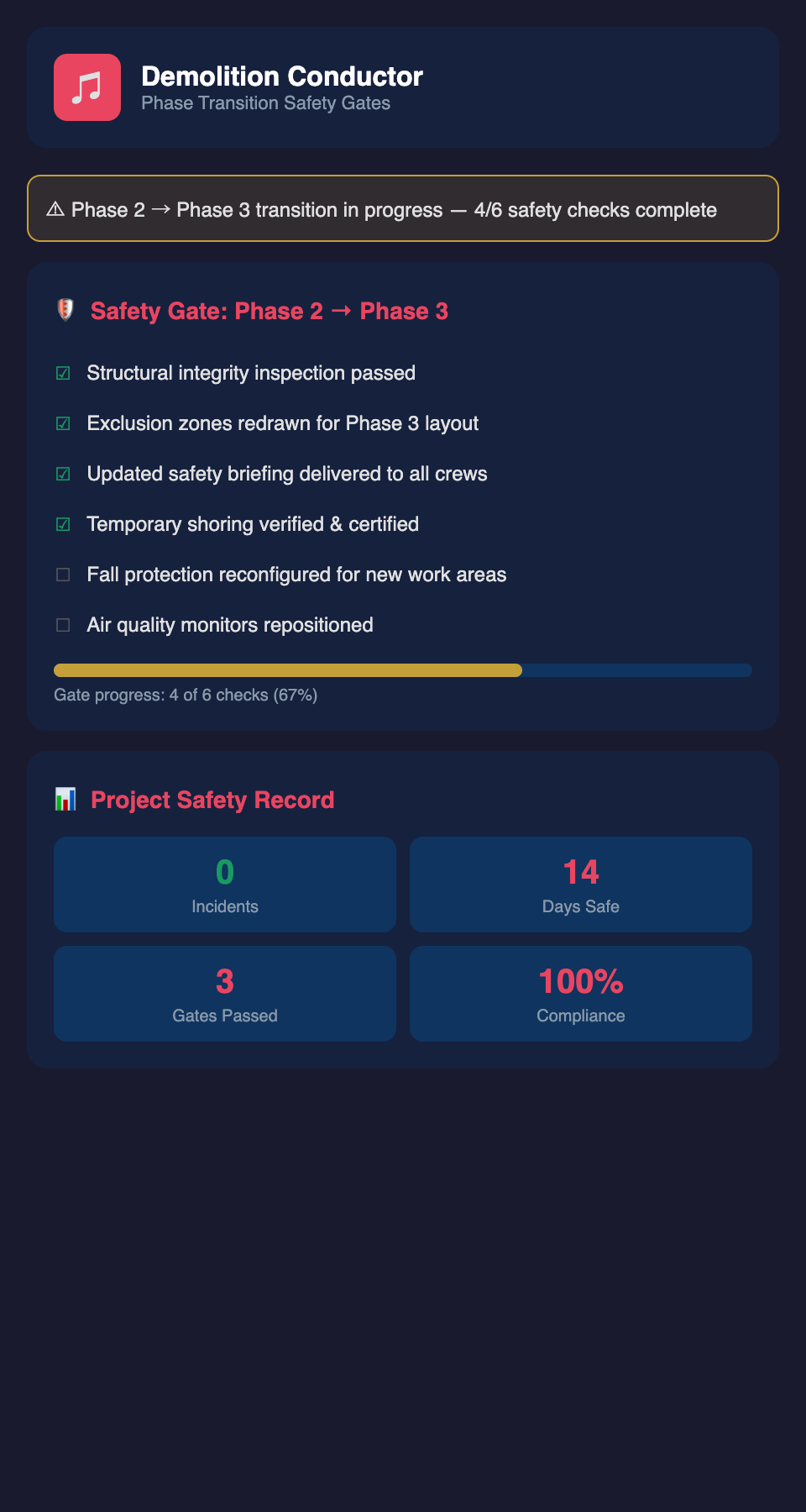
Establishing Phase Transition Protocols
Every phase transition needs a detailed protocol separate from the demolition sequence itself. This protocol answers specific questions before the transition begins:
Three to Four Weeks Before Transition
-
Identify all equipment changes: what's leaving, what's arriving, when
-
Schedule all equipment positioning and verify access routes can accommodate it
-
Review new hazards introduced by new equipment
-
Identify crew changes and schedule site induction for new personnel
-
Verify utility changes required and schedule isolation work
One to Two Weeks Before Transition
-
Conduct a site walk-through specifically focused on phase transition impacts
-
Verify temporary bracing or shoring will remain in place throughout transition period
-
Establish new exclusion zones and communicate changes to all crews
-
Test temporary power systems that will support new equipment
-
Brief all supervisors on new hazards specific to the transition
Final Days Before Transition
-
Complete all demolition work in the current phase up to the defined stopping point
-
Install or verify all temporary bracing required for the new phase
-
Position new equipment but don't energize or activate it yet
-
Create a transition checklist for the supervisor to verify all conditions are met
-
Hold a pre-transition safety meeting with all crews
Transition Day
-
Conduct a final hazard walk-through at the start of the shift
-
Activate new equipment only after verification that all positioning is complete and safe
-
Maintain overlap of previous crews and new crews for 2-4 hours to verify handoff is smooth
-
Supervisors remain on-site throughout the transition to monitor unexpected issues
-
Document the transition completion and any deviations from the plan
Managing Temporary Bracing Through Transitions
Temporary bracing and shoring is often the critical control that prevents structural failure during demolition phases. Many incidents occur when temporary bracing is modified incorrectly or when load-bearing capacity is compromised during the transition to new bracing systems.
Your phase transition protocol must address:
-
Load verification: Before removing any temporary bracing, verify that permanent structure will support loads, not just theoretically but with visual confirmation and documentation
-
Sequential removal only: Never remove multiple bracing points simultaneously. Remove one, verify no movement, monitor for several shifts, then remove the next
-
Load redistribution: When transitioning from temporary to permanent support, understand exactly how loads will redistribute and verify the structure behaves as predicted
-
Environmental factors: Temperature changes, vibration from nearby work, and equipment weight can all affect how structures behave during bracing transitions. Monitor conditions closely during these phases
-
Documentation requirement: Every bracing installation and removal must be documented with photos and structural engineer sign-off
A common error is scheduling bracing removal on the same day as equipment relocation or new crew introduction. These should be separated by at least one shift, preferably longer. You want to stabilize the structure before introducing other changes that increase the risk of unexpected behavior.
Utility Isolation Sequencing During Transitions
Phase transitions often require significant utility modifications: rerouting, temporary system activation, and permanent infrastructure shutdown. The sequence matters immensely for safety.
The correct sequence for utility transitions is:
-
Install temporary utility infrastructure (temporary electrical panels, rerouted water lines, emergency lighting)
-
Load test temporary systems under full operational conditions
-
Verify performance and safety of temporary systems
-
Only then begin isolation of permanent infrastructure
-
Verify permanent infrastructure is fully isolated and all energy sources are locked out
-
Confirm all affected zones have full utility service from temporary systems before crews resume work
The error that creates safety incidents is proceeding too quickly through this sequence. You install temporary systems, do a quick visual check, then immediately shut down permanent systems. If the temporary system has a hidden flaw—insufficient capacity, an incorrect connection, a failed component—you've created a catastrophic situation where occupants lose critical utilities suddenly.
Build at least 24 hours of full operational testing into your timeline between temporary system activation and permanent system shutdown.
Personnel Transitions and Site Induction
Phase transitions typically mean new crew members entering the site or familiar crew members moving to new zones. Every new person to a work area needs proper hazard awareness, not just generic induction.
For each phase transition:
-
Conduct phase-specific induction covering: new hazards specific to this phase, equipment in use, temporary bracing and why it's critical, utility locations and isolation status, access restrictions, and emergency procedures
-
Pair new personnel with experienced site workers for the first shift of the transition
-
Have supervisors conduct specific briefings on the new phase's hazards, not rely on general induction from project start
-
Verify understanding by asking specific questions about hazards, not just presenting information
-
Document all inductions with date, content covered, and attendees
Phase transitions are where site leadership is most visible. The project manager and safety supervisor should both be on-site during major transitions, not managing remotely. This visibility catches gaps in communication and prevents the operational drift that causes incidents.
Monitoring and Adjustment During Transitions
Even the best-planned phase transitions sometimes encounter unexpected conditions. Your protocol should include a monitoring and adjustment process:
-
Mandatory supervisor site presence for the first 8 hours of new phases
-
Shift overlap where crews from the previous phase hand off to new crews with supervisor present
-
Hazard spotchecks by the safety officer at the start and end of the first week of each phase
-
Deviation protocol: if conditions don't match the transition plan, work stops in that area until resolved
-
Communication updates to all crews when deviations require plan changes
Documentation is your accountability record and learning tool. When you transition phases without incident, that's success worth replicating. When you encounter unexpected conditions, documenting what happened and how you resolved it builds organizational knowledge that improves the next project.
Phase transitions aren't just administrative scheduling points—they're critical moments where your coordination and planning either prevent incidents or allow them to develop. The project manager who treats them with this seriousness protects crews and maintains schedule momentum.
Join our waitlist to access tools that help you choreograph phase transitions with safety and precision.