Critical Path Analysis for Demolition Projects
Why Critical Path Analysis Matters in Demolition
Complex demolition projects involve hundreds of interdependent tasks. Remove the structural wall before the columns are shored, and you create a collapse hazard. Isolate utilities without establishing temporary systems, and you lose critical services. Start the next phase before the previous phase's debris is removed, and you have material accumulation blocking access. Understanding which tasks actually control the overall project schedule—and which have flexibility—is the difference between finishing on time and accumulating delays.
Critical path analysis (CPA) is a systematic approach to identifying schedule-driving tasks, quantifying schedule flexibility, and understanding the true impact of delays. While CPA is most commonly associated with complex commercial construction, it applies equally to demolition projects and often reveals surprising insights about what actually controls your schedule.
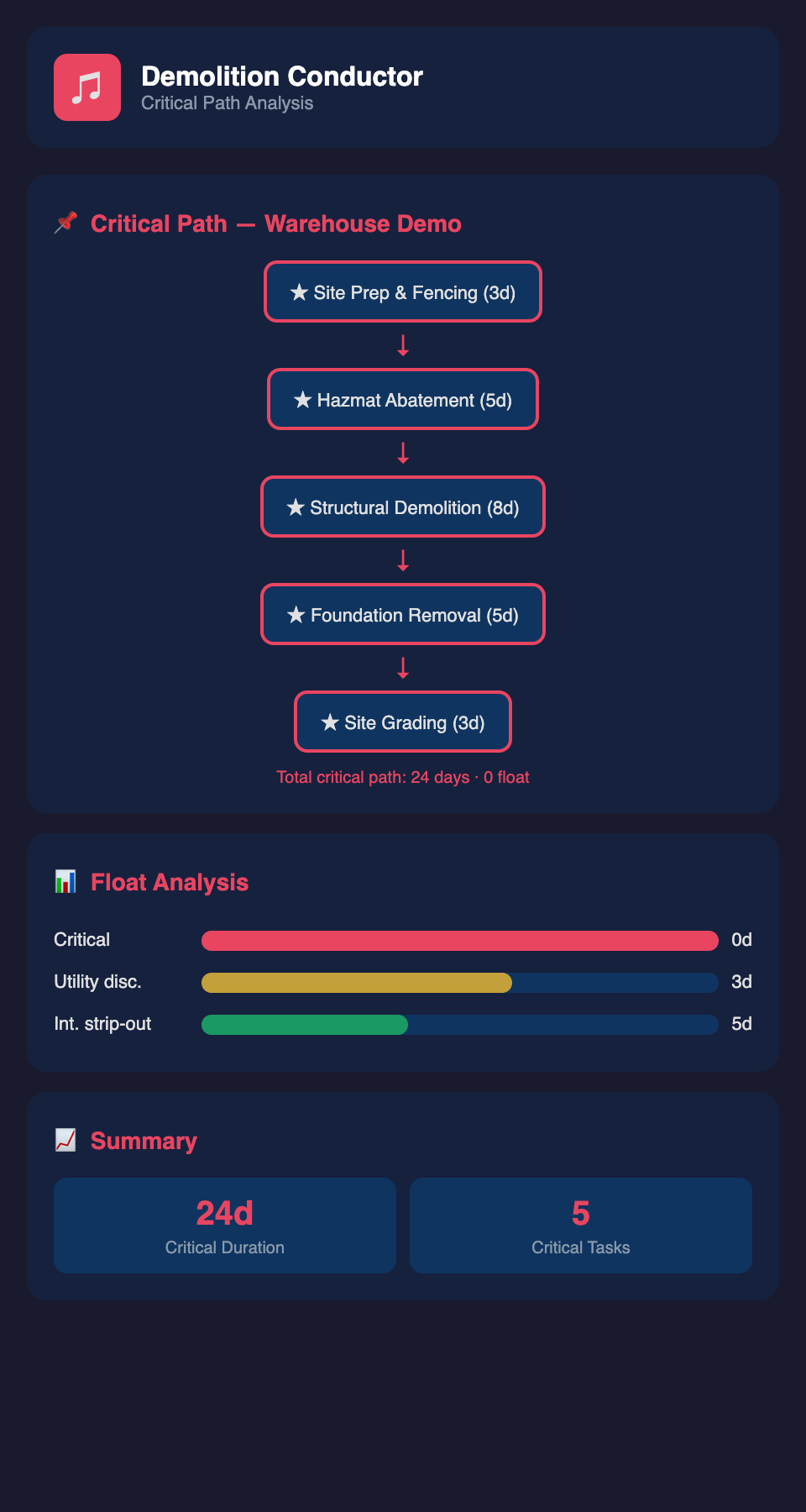
Building Your Demolition Network Diagram
Critical path analysis begins with a network diagram—a visual representation of all project tasks and their dependencies. Rather than a linear timeline, a network diagram shows which tasks must complete before others can begin and which tasks can occur simultaneously.
For a demolition project, your network typically looks like:
-
Phase 1 Interior Demolition: Remove drywall, flooring, and non-structural elements. This has flexible dependencies—most interior removal tasks can proceed in parallel.
-
Phase 1 Utility Isolation: Disconnect utilities from the zones to be demolished. This has specific dependencies—utilities must be isolated before structural demolition begins in that zone.
-
Phase 1 Structural Demolition: Remove load-bearing walls, structural elements, and supporting columns. This has strict dependencies—some structural elements can't be removed until others are removed first to maintain temporary stability.
-
Phase 1 Debris Removal: Haul away all material from the demolished zone. This has dependencies with subsequent phases—phase 2 can't begin until phase 1 debris is cleared.
-
Phase 2 Setup: Install temporary bracing and utilities for the next phase. This must complete before phase 2 demolition begins.
-
Phase 2 Interior Demolition, Phase 2 Utilities, Phase 2 Structural Demolition, etc.
Create the network by identifying every task, estimating its duration, and mapping dependencies. A project with 10 demolition zones and multiple task types within each zone easily contains 50-100 distinct tasks.
Calculating the Critical Path
Once you've created your network, critical path analysis calculates which sequence of tasks determines your overall project duration. This is the critical path—if any task on the critical path is delayed, the overall project is delayed.
Tasks off the critical path have schedule flexibility (called "float" or "slack"). You can delay these tasks within their float window without affecting the overall project duration.
For example:
-
Task A (Interior Demo Zone 1): Duration 5 days, Critical Path
-
Task B (Utility Isolation Zone 1): Duration 3 days, Critical Path
-
Task C (Debris Removal Zone 1): Duration 4 days, Float of 1 day
-
Task D (Interior Demo Zone 2): Duration 6 days, Critical Path
Tasks A, B, and D are critical—delays in any of them delay the overall project. Task C can be delayed up to 1 day without affecting the project, because its dependent tasks don't start until Task A and B complete anyway.
This insight is valuable: focusing extra resources or attention on Task C doesn't improve the overall schedule. But focusing on Task D—which has no float—directly accelerates the project.
The critical path isn't a single set of tasks; it typically represents multiple chains that interact. A single delay in one critical path chain might create a new critical path downstream. As you complete tasks, different paths become critical.
Identifying Schedule Risk
Critical path analysis reveals which tasks are schedule risks. A critical path task with a duration estimate that has high uncertainty creates high schedule risk. An 8-day task on the critical path where you're 80% confident it takes between 6-10 days creates 2 days of schedule risk. An 8-day task where you're confident it takes 7-9 days creates minimal schedule risk.
For high-risk critical path tasks, identify contingency:
-
What additional resources could accelerate this task?
-
What dependencies could be resequenced to provide more float?
-
What external factors could delay this task and what's your mitigation?
For example, "Structural Demolition Zone 1" is critical and has high uncertainty because actual structural configuration might vary from drawings. Plan for this risk by:
-
Scheduling a 1-day contingency specifically for discovering unexpected structural conditions
-
Identifying alternative demolition methods that work if primary method is slower than expected
-
Establishing priority for equipment access if equipment needs to be shared with another critical task
Optimizing the Critical Path
Once you've identified the critical path, you can optimize the overall project by shortening the critical path. Several strategies work:
Parallel phasing: Instead of strictly sequential phases (complete Zone 1 entirely before starting Zone 2), can you overlap phases? Start interior demolition in Zone 2 while debris removal from Zone 1 is still ongoing? Overlapping reduces total duration but increases complexity and coordination requirements.
Resource acceleration: Can you reduce critical path task duration by adding resources? Interior demolition might complete 20% faster with an additional crew. Debris removal might accelerate with additional haul trucks. Calculate the cost-benefit of acceleration before implementing.
Dependency resequencing: Are there dependencies that are assumed but not truly required? Sometimes you can resequence tasks to reduce critical path duration. For example, can utility isolation in Zone 2 begin before structural demolition in Zone 1 completes? If yes, this shortens the overall path.
Alternative methods: Different demolition methods have different durations. Mechanical demolition might take 6 days; selective demolition might take 10 days but preserve materials for salvage. If the project critical path could benefit from the faster method, and the salvage value doesn't justify the slower method, switch methods.
Contingency integration: Are you carrying contingency separately from the critical path, or is contingency integrated into task durations? If you're carrying 15% contingency on top of an already-estimated critical path, you're over-buffering. Integrate contingency into the high-risk tasks on the critical path.
Using Critical Path Analysis for Resource Planning
Critical path analysis reveals how your resources should be allocated. Resources allocated to non-critical tasks with substantial float don't improve the overall schedule. Resources allocated to critical path tasks with no float directly accelerate the project.
For labor planning:
-
Assign your most experienced and productive crews to critical path tasks
-
For non-critical tasks with float, you can use apprentices, less experienced crews, or part-time resources
-
As you complete critical path tasks and new paths become critical, shift resources accordingly
For equipment planning:
-
Schedule critical equipment (specialized crane, cutting equipment) for critical path tasks
-
Schedule standard equipment for non-critical tasks
-
If critical path requires equipment that's not available on your timeline, implement contingency or alternative methods immediately
For contractor selection:
-
For critical path trades (structural demolition, hazmat removal), prioritize contractor capability and reputation
-
For non-critical trades, prioritize cost
Monitoring Critical Path During Execution
The critical path you calculate during planning is a prediction based on estimated task durations. During execution, actual performance might differ. Your planned critical path might not be the actual critical path once work begins.
Implement ongoing critical path monitoring:
-
Weekly progress tracking: Update task completion estimates based on actual performance. A task planned for 5 days that's 3 days complete and 60% done is on track. A task planned for 5 days that's 4 days complete and only 60% done is behind and will take 6-7 days total.
-
Recalculate critical path weekly: With updated duration estimates, recalculate which path is critical. If your planned critical path is now complete but another path is behind, you have a new critical path.
-
Reallocate resources: When the critical path changes, reallocate resources to the new critical path. This maintains schedule acceleration throughout the project.
-
Stakeholder communication: Update stakeholders when the critical path changes. It's better to communicate mid-project that a different task is now driving the schedule than to discover at project end that delays accumulated in an unexpected area.
Common Critical Path Analysis Mistakes
Overestimating task durations: Conservative duration estimates create excessive contingency. Use your historical data and actual conditions to estimate realistically, not conservatively.
Oversimplifying dependencies: Some project managers create overly simple networks (10-15 tasks) to avoid complexity. This misses interdependencies that actually constrain the schedule. Build sufficient detail to capture actual constraints.
Ignoring resource constraints: A network diagram assumes resources are unlimited. In reality, you might have only one crane, requiring sequential use rather than parallel. A resource-constrained schedule might be longer than the purely logical critical path.
Setting contingency separately: If you calculate a critical path assuming no delays, then add contingency on top, you've created a timeline that's longer than realistic. Integrate contingency into the high-risk tasks.
Not updating during execution: The most common failure is calculating critical path during planning and never updating it during execution. Critical path is a planning tool that's most valuable during execution when it guides daily resource allocation.
Critical path analysis removes guesswork from schedule management. You know which tasks truly control your schedule, where to focus attention, and how delays in specific tasks affect your overall timeline. This precision is what separates projects that finish on schedule from projects that accumulate delays without visibility to why.
Join our waitlist to access tools that automate critical path analysis for complex demolition projects, enabling dynamic schedule optimization throughout the project lifecycle.