Integrating Waste Management into Demolition Schedules
The Hidden Schedule Impact of Poor Waste Management
Most project managers underestimate how significantly waste management affects demolition schedules. You've planned to demolish the interior of a building in 4 weeks and haul away 2,000 cubic yards of material. But waste management failures turn this into a 6-week project: inadequate haul trucks force material to accumulate on-site, blocking further demolition. Disposal facilities don't accept certain material types, requiring rerouting to secondary facilities. Segregation requirements weren't communicated to crews, forcing you to separate mixed waste after demolition.
Waste management isn't an afterthought to the demolition plan—it's an integral part that must be designed into the schedule.
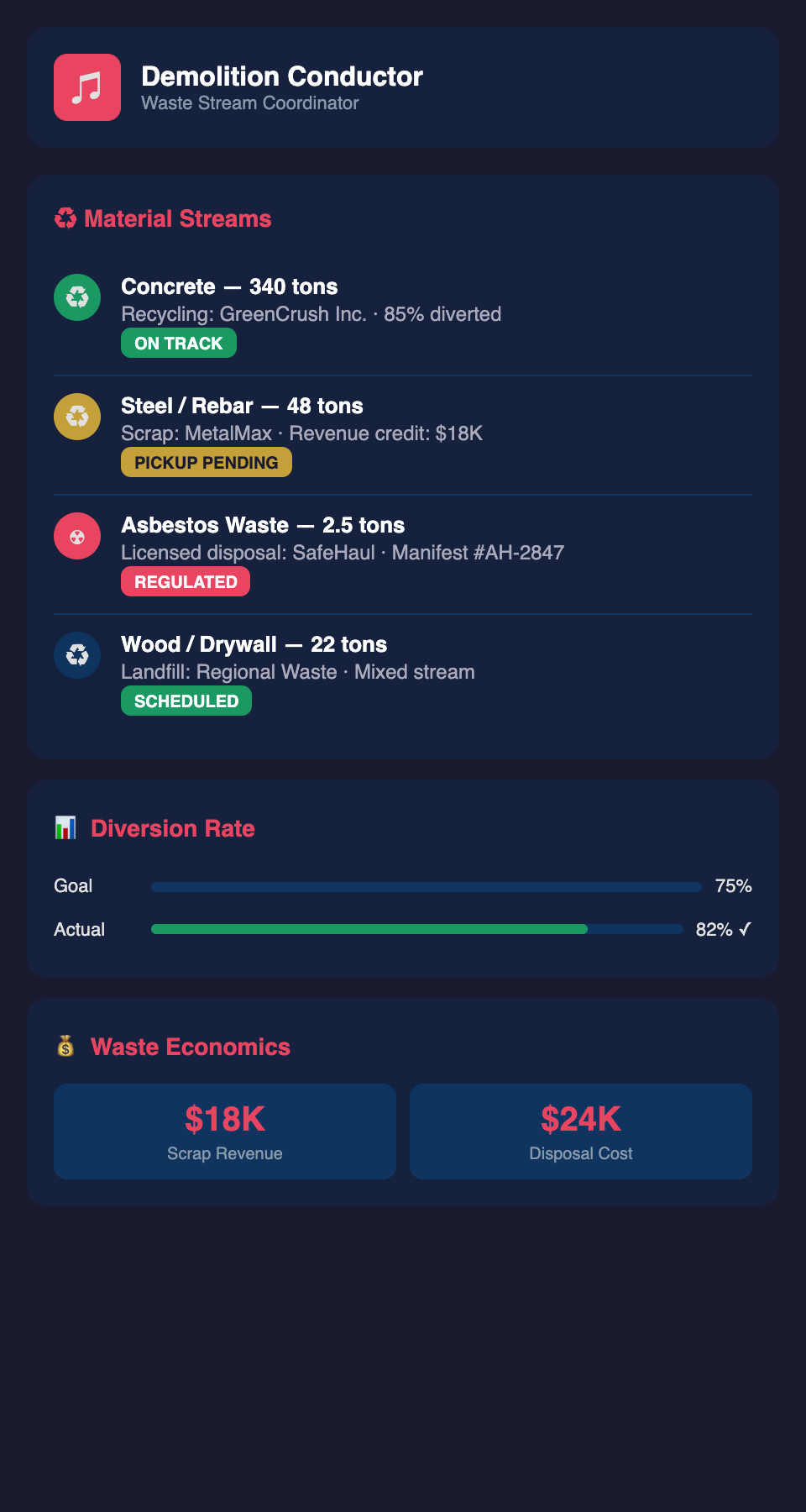
Characterizing Material Volume and Types
Before you can plan waste disposal, you need to know exactly what you're removing. Most projects estimate volume based on building dimensions—a rough calculation of square footage times story height. This approach has accuracy problems.
Conduct a material characterization study:
On-site material survey: Walk the building and document what's actually there. A building listed as "standard drywall walls" might actually have plaster walls, tile, and concrete structural elements. A roof listed as "standard asphalt shingles" might have multiple layers of built-up roofing or metal decking underneath. An interior listed as "typical commercial finishes" might have specialized materials specific to the previous tenant.
Material volume estimation by location: Don't estimate overall volume. Estimate volume by floor and location. The ground floor might be 30% concrete and 40% mixed material. The upper floors might be 20% drywall, 30% steel, 50% mixed material. This detailed breakdown lets you plan disposal by location.
Hazardous material identification: Document any hazardous materials that require special handling. Asbestos, lead paint, PCBs, and underground storage tanks require specialized contractors and disposal facilities. These materials often aren't visible—they require testing to identify.
Recyclable material potential: Note materials with recycling value. Structural steel, metals, and wood might have market value. Concrete can be crushed and reused. Some contractors bid on demolition at lower rates if they can salvage high-value materials. Understanding your material value informs contractor selection.
The time invested in material characterization—typically 2-3 days of site investigation—prevents expensive surprises during demolition.
Designing the Waste Removal Sequence
Material doesn't disappear just because you've demolished it. You need a plan for moving it from the building to disposal facilities. The volume and type of material, combined with available haul routes and disposal facility capacity, determines how quickly you can remove material.
For each phase of demolition, design the removal sequence:
Haul capacity planning: If you're removing 500 cubic yards per week, you need truck capacity to remove 500 cubic yards per week. A typical haul truck carries 12-15 cubic yards. You need 35-40 truck loads per week. If trucks are available only 5 days per week, you need 7-8 truck loads per day. If your site has one access point and traffic management requires spacing trucks one every 15 minutes, you can accommodate roughly 30-35 trucks per day maximum. This actually works—but if traffic management can only accommodate one truck every 20 minutes, you've exceeded capacity.
Calculate haul capacity early and verify it matches removal volume. If it doesn't, you'll accumulate material on-site, blocking further demolition.
Disposal facility coordination: Not all material goes to the same disposal facility. Concrete goes to crushing facilities. Metal goes to recycling centers. Hazardous materials go to specialized facilities. Inert materials might go to local landfills. Mixed waste typically goes to regional transfer stations.
Contact disposal facilities before demolition begins. Verify:
-
They accept the material types you're removing
-
They have capacity during your project timeline
-
Their hours of operation work with your haul schedule
-
Any material segregation requirements they impose
-
What documentation they require
-
What testing or characterization they need before accepting material
A disposal facility that's currently full but expects capacity in 4 weeks might work perfectly—your phase 1 material goes to a secondary facility while you wait for primary facility capacity. But this requires planning; discovering it mid-demolition creates crises.
Material staging and segregation: Before you demolish, establish where material will be staged on-site and how it will be segregated. If you're removing concrete, steel, and mixed waste separately, you need distinct staging areas. If you're removing hazardous material, it requires a designated secure area.
Well-designed staging prevents material mixing, reduces loading time, and accelerates haul times because crews know exactly where material goes.
Contracting for Waste Management
How you contract for waste removal affects both cost and reliability. There are several approaches, each with tradeoffs:
Full-service demolition contractor: The demolition contractor handles both demolition and waste removal. Advantage: single point of responsibility, integrated planning. Disadvantage: demolition contractors typically subcontract waste management at minimal margins, so quality varies.
Separate waste management contractor: You hire the demolition contractor for demolition and a waste management contractor for material removal. Advantage: specialized expertise, potential cost savings. Disadvantage: coordination requirements increase, disputes about delays often occur.
Haul contractor plus multiple disposal facilities: You hire a haul contractor to remove material from site and coordinate with multiple disposal facilities. Advantage: flexibility to respond to disposal facility capacity changes. Disadvantage: complexity in contractor management.
Regardless of structure, the contract must clearly define:
-
Material removal targets (volume per week)
-
Consequences for failing to meet targets (you have material accumulating on-site)
-
Material segregation requirements
-
Disposal facility coordination responsibilities
-
Hazardous material handling procedures
-
Cost structure (fixed cost, variable cost, material revenue sharing)
Environmental and Regulatory Compliance
Waste management in demolition projects often involves regulatory compliance beyond simple haul logistics. Environmental permits, waste tracking, and material documentation are frequently requirements.
Address these in your waste management plan:
Environmental permits: Some demolition projects require environmental permits for waste removal, dust control, or stormwater management. Identify permit requirements early and ensure permits are obtained before work begins. Include compliance monitoring in your schedule.
Waste manifests and documentation: Hazardous materials typically require waste manifests documenting origin, transport, and disposal. Track this documentation throughout the project.
Material certifications: Some demolition projects require certification that material was disposed of in accordance with contract terms. Establish procedures for verification and documentation.
Sustainability requirements: If the project has sustainability targets (recycling a percentage of material, minimizing landfill waste), establish metrics and track compliance throughout demolition.
Planning for regulatory compliance early prevents last-minute complications that disrupt schedules.
Preventing Material Accumulation on-Site
The most common waste management failure is material accumulating on-site faster than it can be removed. This creates a cascading set of problems: ongoing demolition is blocked, the site becomes a safety hazard, and equipment costs mount because nothing is being accomplished while waiting for material removal.
Prevent accumulation through:
-
Daily volume tracking: Track how much material is removed each day and compare to removal capacity. If removal is falling behind, add additional haul trucks or extend haul hours immediately.
-
Real-time facility capacity communication: If your primary disposal facility nears capacity, shift material to secondary facilities before the primary facility reaches maximum. Don't wait until the facility closes and discover you have nowhere to put material.
-
Buffer staging: Maintain 2-3 days of material staging capacity on-site. This buffer absorbs minor variations in haul timing. But if staging reaches maximum and material is still being demolished, stop demolition until removal catches up.
-
Contingency contractors: Identify secondary waste contractors and disposal facilities before you need them. If your primary haul contractor has a breakdown, switch to the contingency contractor immediately rather than waiting for primary to be repaired.
Material accumulation is preventable through discipline and monitoring. Projects that encounter accumulation typically did so due to poor communication or underestimated volumes, not unavoidable circumstances.
The Cost Impact of Integration
Waste management costs are typically 15-25% of total demolition cost. Poorly planned waste management can push this to 30-35%, or higher if material accumulation forces extended schedules.
Well-planned waste management—with accurate volume estimates, coordinated haul contractors, and disposal facility capacity secured—typically costs 10-15% less than average because:
-
You avoid premium pricing for emergency haul contractors
-
You negotiate better disposal facility rates with advance commitment
-
You prevent material accumulation that requires extended on-site management
-
You enable recycling and material recovery that offset costs
The investment in waste management planning pays for itself through cost avoidance and schedule certainty.
Join our waitlist to access planning tools that integrate waste management scheduling with demolition sequencing for better cost and schedule control.