Managing Demolition Sequences in Mixed-Use Projects
Understanding the Challenge of Mixed-Use Demolition
Mixed-use buildings—structures combining residential, commercial, and sometimes industrial spaces—present unique demolition challenges that extend far beyond traditional single-purpose building takedowns. As a construction project manager, you're tasked with orchestrating the removal of these complex structures while accounting for multiple stakeholder concerns, varying occupancy schedules, and interconnected systems that defy simple sequential demolition.
The fundamental problem is that mixed-use buildings rarely allow for straightforward top-to-bottom dismantling. Each section may have different hazardous materials, load-bearing requirements, and adjacent operations that must continue during certain phases. A residential wing might require extended notice periods for tenant relocation, while the commercial ground floor needs to remain operational through a specific date. The basement might contain infrastructure serving both sections.
Traditional demolition planning often fails in these scenarios because it treats the building as a monolithic structure. What you actually need is a choreographed sequence that respects the building's functional compartments while maintaining safety integrity throughout.
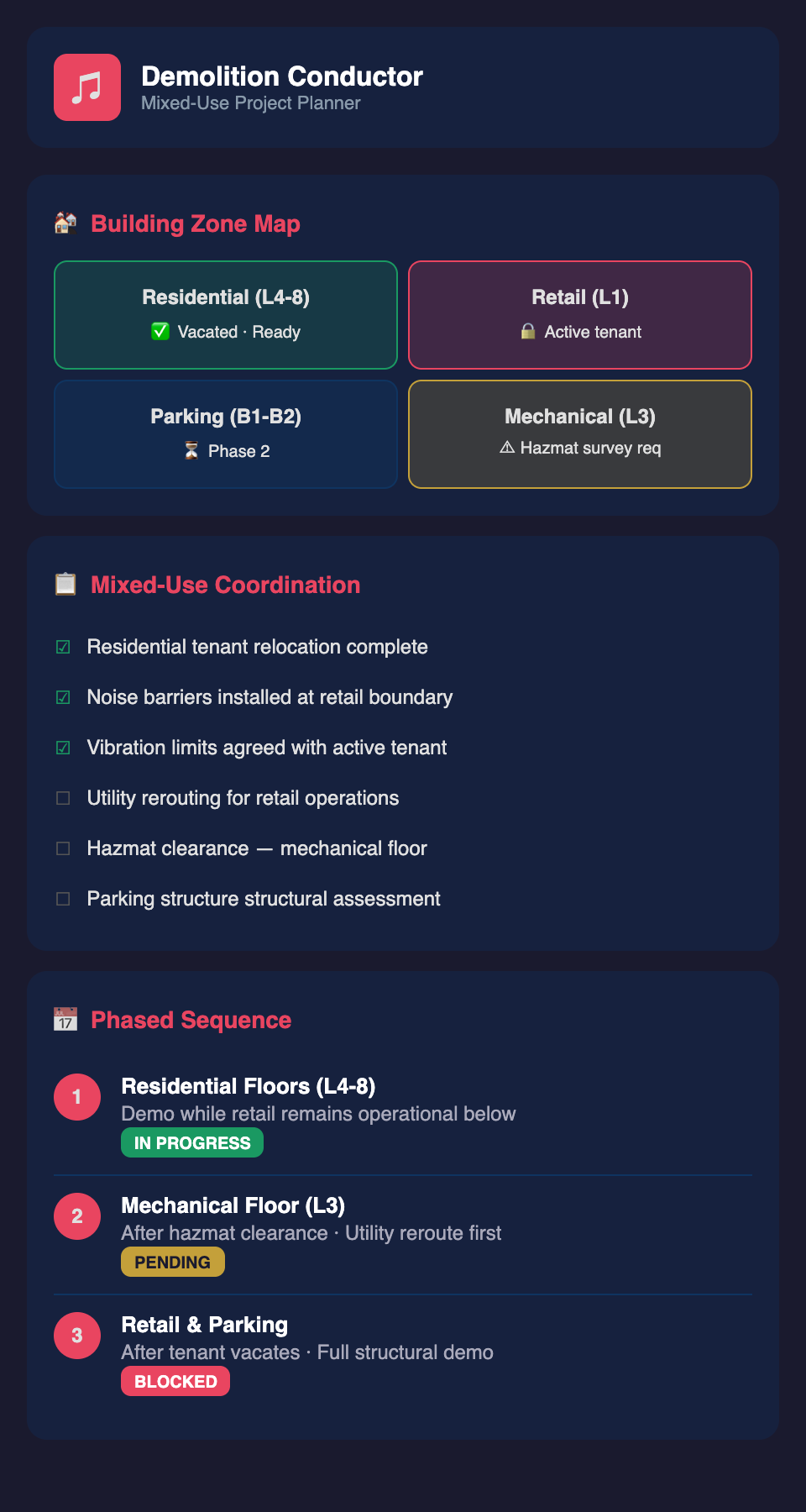
Establishing Functional Zones and Dependency Maps
The first step in managing mixed-use demolition is identifying discrete functional zones within the building. These aren't arbitrary divisions—they're based on the actual systems, occupancy types, and operational requirements.
Begin by mapping:
-
Occupancy types and their lease termination dates
-
Mechanical systems that serve specific zones (HVAC, electrical, plumbing)
-
Load-bearing walls and how structural removal in one zone affects adjacent spaces
-
Fire suppression systems and safety infrastructure
-
Access points required for ongoing operations
-
Utility connections and which zones depend on which infrastructure
For example, in a residential-over-retail mixed-use building, the commercial space below can't simply lose all its utilities to facilitate residential demolition above. Your sequence must preserve retail operations through a specific phase, maintain egress routes, and handle utility isolation in phases that don't create dangerous conditions.
Create a dependency matrix showing which zones can be demolished simultaneously, which must wait for others to complete, and which require parallel operational support. This becomes your critical path for the entire project.
Phasing Occupancy Removal Strategically
One of the most underestimated factors in mixed-use demolition is the timeline for clearing occupants. You can't demolish a building section with tenants still present, and the notice periods vary dramatically:
-
Commercial tenants typically require 30-90 days notice and negotiate end-of-lease timing
-
Residential tenants may have legal protections requiring 60-180 days notice in many jurisdictions
-
Month-to-month tenants complicate planning because they can leave on short notice or need multiple notice cycles
-
Businesses may negotiate phased closure to maintain operations temporarily in other zones
Rather than waiting for all occupants to leave simultaneously, orchestrate a sequence that empties zones in the order your demolition plan requires. This might mean accelerating residential clearance in the wing you'll demolish first, while maintaining commercial tenancy in an adjacent section that will be cleared later.
Build into your schedule:
-
Individual move-out management and verification
-
Lease termination phases staged 2-4 months before demolition of that section begins
-
Alternative space agreements for businesses needing temporary relocation within the building during transitions
-
Security and weatherproofing procedures as sections empty before demolition
Managing Interdependent Building Systems
Mixed-use buildings typically have integrated mechanical, electrical, and plumbing systems that serve multiple zones. Demolishing one section without properly isolating utilities creates safety hazards and operational disruptions.
Develop a detailed utilities sequence that:
-
Identifies all connections between zones
-
Establishes temporary utility networks for zones remaining operational (temporary electrical panels, rerouted HVAC, emergency water supplies)
-
Tests temporary systems under full load before isolating permanent infrastructure
-
Implements isolation in stages that never leave any occupied zone without critical utilities
-
Maintains redundancy for life-safety systems (fire suppression, emergency lighting, evacuation routes)
A frequent mistake is isolating utilities simultaneously across too many zones. You'll create situations where you've cut the main water supply but haven't yet completed the temporary water line, leaving active occupants without service. Your sequencing must ensure the temporary system is verified operational before the permanent system is shut down.
Coordinating with Structural Load Transfer
The structural integrity of remaining sections depends on careful demolition sequencing. In mixed-use buildings, the structure often works as an integrated system where removing one section affects load paths in adjacent areas.
Work with your structural engineer to establish:
-
Sequence-dependent load bearing: Which walls can only be removed after others, because they temporarily support adjacent sections
-
Temporary bracing requirements: Where temporary shoring must support floors or walls during demolition of supporting elements
-
Monitoring protocols: Visual inspection points and tolerances to verify the structure is behaving as predicted during demolition
-
Contingency plans: What you'll do if unexpected structural behavior emerges—you need these decisions made before you encounter the problem
Document the sequence explicitly, with photos of reference points for monitoring. Any structural concerns should immediately pause that phase until resolved. The cost of delays from engineering assessment is minimal compared to the cost of structural failure or collapse.
Creating the Master Sequence Document
Your demolition sequence needs formalization as a master document that all trades reference. This should include:
-
Phase calendar showing dates, occupancy status, and which zones are under active demolition
-
System cutoff schedule showing when utilities are isolated, temporary systems activated, and main systems shut down
-
Safety protocols specific to each phase transition
-
Resource allocation showing equipment and crew movement between zones
-
Contingency triggers that automatically escalate decisions if conditions aren't met
This document becomes your daily reference and your accountability record. When the project encounters delays—and it will—you modify the sequence with full visibility to all downstream phases, rather than making ad-hoc changes that cascade into safety issues or schedule conflicts.
Mixed-use demolition isn't more complicated because the building is bigger; it's more complicated because it demands a level of coordination that residential or pure commercial demolition doesn't require. The project manager who choreographs these sequences systematically, with all dependencies visible and all contingencies planned, transforms what could be a chaotic nightmare into a controlled, efficient demolition.
Ready to streamline your demolition coordination? Join our waitlist to discover how visual orchestration tools can transform your mixed-use project planning.