Measuring Success in Coordinated Demolition Project Management
Beyond Traditional Project Metrics
Construction project managers accustomed to measuring success through schedule and budget metrics often miss the full picture of demolition project quality. A project completed on schedule and budget but with significant safety incidents, extensive rework, or damaged relationships with contractors and stakeholders is not truly successful.
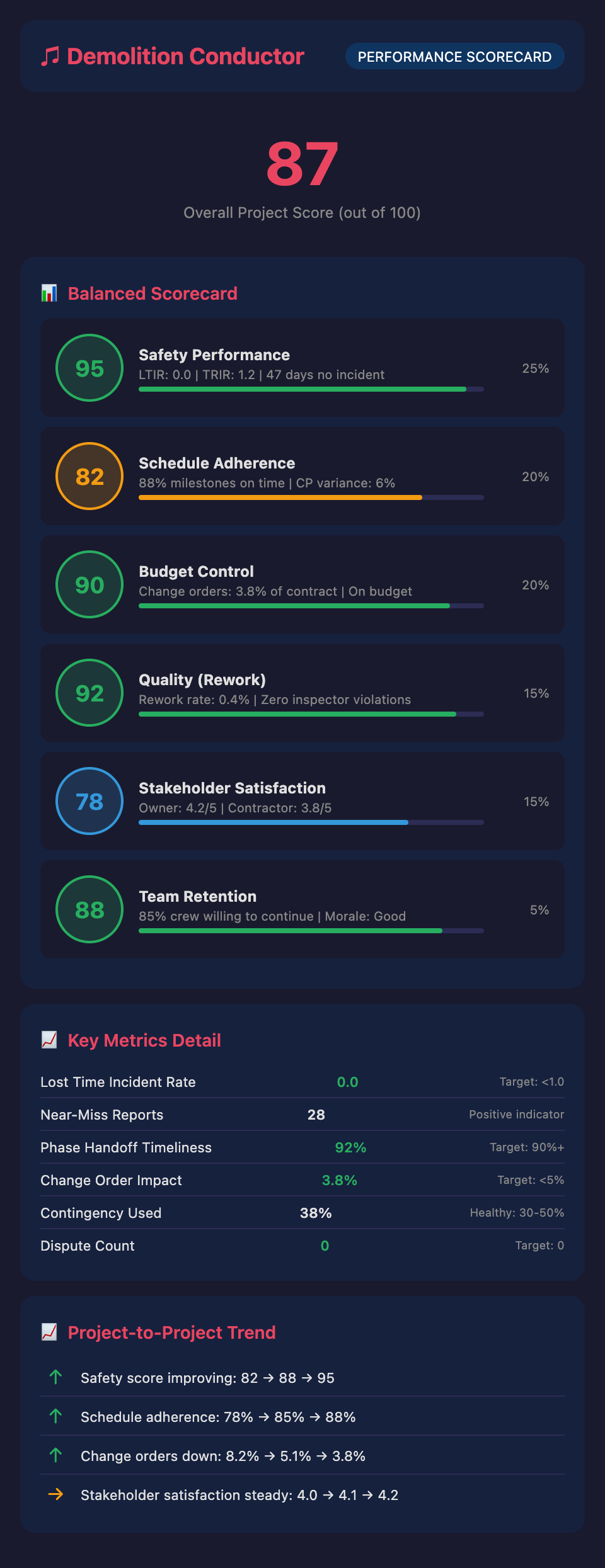
Effective demolition project measurement requires a balanced scorecard including safety, quality, coordination effectiveness, stakeholder satisfaction, and team development—not just schedule and budget.
Safety Performance as Primary Metric
Safety should be the primary metric for demolition project success:
Lost Time Incident Rate (LTIR)
-
Measure: Number of incidents resulting in lost work time per 200,000 hours worked
-
Context: Industry average ranges from 2-5; excellent projects achieve under 1
-
Significance: LTIR directly indicates whether your demolition orchestration prevented the incidents that result from poor coordination
Total Recordable Incident Rate (TRIR)
-
Measure: All recordable incidents (including non-lost-time injuries) per 200,000 hours
-
Context: Industry average 5-8; excellent projects achieve under 3
-
Significance: TRIR includes near-misses and minor incidents that indicate safety culture
Near Miss Reporting
-
Measure: Number of near-misses reported and resolved per project
-
Context: Projects with active safety reporting typically report 20-30+ near-misses
-
Significance: High near-miss reporting indicates crews actively identifying hazards and management responsiveness to hazard communication
A demolition project with zero safety incidents is successful. A project with good schedule and budget but poor safety performance is a failure regardless of other metrics.
Schedule Performance Beyond Completion Date
Schedule metrics beyond simple on-time completion provide insight into demolition orchestration effectiveness:
Schedule Adherence
-
Measure: Percentage of scheduled milestones completed on or within acceptable variance
-
Target: 90%+ milestone achievement on schedule
-
Significance: Consistent milestone achievement indicates predictable orchestration; frequent delays indicate coordination problems
Critical Path Variance
-
Measure: Variance between planned and actual critical path task duration
-
Target: Less than 5% variance on critical path tasks
-
Significance: Critical path management effectiveness directly correlates with schedule control
Phase Handoff Timeliness
-
Measure: Percentage of contractor phases beginning on or within 2 days of planned start
-
Target: 90%+ on-time phase starts
-
Significance: Handoff timeliness indicates successful coordination between subcontractors
Schedule Change Frequency
-
Measure: Number of formal schedule revisions
-
Context: 1-2 major revisions over project duration is normal; 5+ revisions indicates poor planning or inadequate orchestration
-
Significance: Excessive revisions suggest that initial choreography didn't account for predictable realities
Budget Performance Beyond Final Cost
Budget metrics include:
Change Order Impact
-
Measure: Total change order value as percentage of original contract value
-
Target: Under 5% for well-planned demolition; 10-15% indicates coordination or planning gaps
-
Significance: High change orders suggest field discoveries weren't anticipated or coordination required scope modifications
Contractor Variance
-
Measure: Comparing actual subcontractor cost to contract value
-
Target: Within 5% of contract
-
Significance: Significant contractor overages suggest scope ambiguity or poor contractor management
Contingency Utilization
-
Measure: Percentage of budget contingency actually required
-
Target: 30-50% utilization indicates realistic contingency planning
-
Significance: Using 5% contingency suggests lucky circumstances; using 95% suggests poor risk planning
Coordination Quality Metrics
Metrics specific to demolition orchestration effectiveness:
Contractor Satisfaction
-
Measure: Post-project survey of subcontractors rating coordination, clarity, payment, and management
-
Target: Average rating of 4+ out of 5
-
Significance: Satisfied contractors want to work on future projects and maintain professional relationships; dissatisfied contractors spread negative reputation
Change Order Disputes
-
Measure: Number of change orders resulting in contractor disputes or litigation
-
Target: Zero disputes
-
Significance: Disputes indicate either scope ambiguity or unfair change management
Safety Findings by Inspectors
-
Measure: Number of safety violations identified by municipal or OSHA inspectors
-
Target: Zero violations; any violation indicates safety orchestration gaps
-
Significance: Inspector findings are objective assessments of safety coordination effectiveness
Rework Requirements
-
Measure: Percentage of completed demolition requiring rework or correction
-
Target: Under 1%
-
Significance: High rework indicates quality control gaps or unclear choreography
Stakeholder Satisfaction Metrics
Owner Satisfaction
-
Measure: Post-project survey rating of owner satisfaction with project management, communication, outcomes
-
Target: 4+ out of 5
-
Significance: Owners who are satisfied recommend the team for future projects; dissatisfied owners damage reputation
Neighbor/Community Impact
-
Measure: Formal complaints received about demolition disruptions
-
Target: Zero or minimal complaints proportional to project disruption
-
Significance: High complaints indicate poor stakeholder communication or inadequate disruption mitigation
Inspector Cooperation
-
Measure: Qualitative assessment of inspector responsiveness and cooperation during project
-
Target: Inspectors report adequate documentation and responsiveness to findings
-
Significance: Cooperative regulatory relationships smooth project execution; adversarial relationships create obstacles
Team Development Metrics
Crew Safety Awareness
-
Measure: Safety training completion rates, safety quiz scores, hazard identification suggestions
-
Target: 100% training completion, average quiz scores 85%+
-
Significance: Well-trained, safety-aware crews prevent incidents more effectively
Supervisor Satisfaction
-
Measure: Post-project survey of site supervisors regarding coordination, resources, communication, management support
-
Target: 4+ out of 5
-
Significance: Satisfied supervisors perform better on future projects; experience from this project should improve future execution
Crew Retention
-
Measure: Percentage of crew members willing to work on future projects with the same team
-
Target: 80%+ willing to continue
-
Significance: Willing retention indicates the project was a positive team experience
Balanced Scorecard Approach
Rather than optimizing for any single metric, use a balanced scorecard:
| Category | Primary Metric | Target | Weight |
|----------|---|---|---|
| Safety | Lost Time Incident Rate | Under 1 | 25% |
| Schedule | Critical Path Adherence | 90%+ milestones on time | 20% |
| Budget | Change Order Impact | Under 5% | 20% |
| Quality | Rework Rate | Under 1% | 15% |
| Satisfaction | Owner Rating | 4+/5 | 15% |
| Teamwork | Crew Retention | 80%+ | 5% |
This balanced approach ensures success is multidimensional, not dominated by any single metric.
Benchmarking and Continuous Improvement
Track these metrics across multiple projects to establish baselines and identify improvement trends:
-
Is your LTIR improving project-to-project?
-
Is schedule adherence becoming more consistent?
-
Are change order percentages trending downward?
-
Is contractor satisfaction rating trending upward?
Metrics compared across projects reveal whether your demolition orchestration capabilities are improving or stagnating.
Post-Project Analysis and Lessons
Conduct formal post-project reviews analyzing:
-
What choreography worked well and should be repeated
-
What coordination aspects created problems and need adjustment
-
What surprises occurred and how could planning prevent them in future projects
-
What equipment, processes, or tools made the biggest difference
Document these lessons and reference them when planning future demolition projects.
Transforming Project Performance
Construction project managers who track comprehensive success metrics typically improve performance project-to-project. Metrics create accountability; teams that know their performance is measured focus on improvement. Clear metrics align team effort around what actually matters (safety first, then coordination and quality).
If your demolition projects achieve schedule and budget targets but you sense coordination could be better, or you experience safety concerns, your performance measurement approach may be too narrow. Effective project teams use balanced metrics that drive continuous improvement.
Join our waitlist to access project orchestration tools that facilitate performance measurement by creating visibility into safety, coordination, schedule, and quality metrics. Your team deserves coordination approaches that make performance visible and measurable.