Preventing Schedule Delays in Demolition Phases
The Hidden Cost of Demolition Delays
Schedule delays in demolition projects don't just extend the timeline—they cascade through downstream construction activities, affect lease negotiations, delay occupancy revenue, and multiply costs across crews, equipment rental, and overhead. A two-week demolition delay on a mixed-use project can easily cost $200,000 to $500,000 when you factor in extended equipment rental, crew mobilization schedule changes, and delayed start dates for the next phase.
Yet most demolition delays aren't catastrophic surprises—they're accumulations of small underestimated tasks, unforeseen conditions discovered only during demolition, and inefficient sequencing that could have been prevented with better planning. The construction project manager who systematically eliminates these preventable delays maintains schedule momentum and controls costs.
Identifying Your Project's Delay Risk Factors
Different project types have different delay vulnerabilities. A high-rise residential demolition faces different risks than a single-story industrial facility. Before you can prevent delays, you need to identify your specific vulnerability areas.
Common delay sources include:
Structural discoveries: You plan for 3 weeks to demolish the 5th through 8th floors, but discover that the floor system is actually 2 inches thicker than architectural drawings indicated. Unexpected concrete strength requires different cutting methods. Unforeseen steel reinforcement patterns require additional shoring. These discoveries halt work while solutions are engineered.
Hazardous materials identification: Asbestos, lead paint, PCBs, or other regulated materials aren't identified in the pre-demolition survey. You're 5 days into work when you encounter friable asbestos. Abatement requires specialized contractors, state notifications, and timeline delays of 4-6 weeks minimum.
Utility location ambiguity: You thought you'd isolated all electrical circuits to a section, but there's an unexpected feeder serving an adjacent zone. You can't proceed until you trace and isolate the connection. Gas lines exist in locations not marked on utility maps. HVAC ducting follows non-standard routing.
Environmental surprises: You encounter contaminated soil that requires disposal protocols. Previous uses of the site involved materials that create unexpected hazards. Water intrusion reveals underground structures not documented in original building records.
Equipment performance issues: Your primary excavator breaks down mid-phase. Scheduled crane rental isn't available when you need it because the previous user didn't release it on schedule. Your demolition contractor underestimated material volume and needs additional haul trucks mid-phase.
Regulatory and permit delays: Inspections don't occur on the scheduled date. Adjacent property owners file complaints about noise or dust that require modified work methods. Local authorities require additional monitoring or documentation.
Understanding your specific risk profile lets you focus prevention efforts where they matter most.
Pre-Demolition Investigation That Prevents Delays
The most significant delay prevention happens before demolition begins, during the investigation phase. Many project managers treat pre-demolition investigation as a checkbox exercise—a quick site visit and basic review of existing documents. This is how delays happen.
Invest in thorough pre-demolition investigation:
-
Structural verification: Hire an engineer to examine the actual structure and compare it to drawings. Verify concrete dimensions, steel specifications, and connection details. Don't assume drawings are accurate.
-
Comprehensive hazmat survey: Use specialized contractors to test for asbestos, lead, PCBs, and other regulated materials in all major sections. You're looking to identify hazards before they halt work.
-
Complete utility mapping: Have utilities physically located and marked. Don't rely on existing marks or maps alone. Identify every electrical feeder, gas line, water line, and communication cable, and understand what each serves.
-
Structural system understanding: Walk the building with the structural engineer and discuss how loads are distributed. Understand which walls are load-bearing, which are infill, which elements are critical to stability.
-
Environmental site assessment: If the building or site has industrial history, conduct an environmental assessment to identify potential contamination.
-
Demolition logistics verification: Confirm access routes can accommodate the equipment you plan to use. Verify utility clearances for cranes and tall equipment. Identify site constraints that might affect demolition method selection.
This pre-demolition work typically costs $15,000 to $40,000 depending on project size. It prevents delays worth 10 to 20 times that cost.
Building Contingency Directly into the Schedule
Most project managers build a contingency percentage into the schedule—typically 10-15%—and hope it absorbs delays. This approach fails because it treats contingency as a buffer rather than a plan. The contingency gets consumed by the first unexpected issue, leaving no protection for subsequent problems.
Instead, explicitly schedule time for likely discoveries:
-
Structural cutting rate assumptions: Your rate assumes straightforward reinforced concrete with typical rebar spacing. If you discover heavier reinforcement, you've built 3 days of schedule to adjust your cutting method and pace.
-
Utility discovery buffer: Even with comprehensive pre-demolition mapping, you typically discover secondary utilities or unexpected connections. Schedule 2-3 days per major phase for utility tracing and isolation.
-
Material volume verification: After the first week of demolition in a new zone, verify that the volume of material discovered matches your predictions. If you're removing 20% more material than estimated, that affects disposal timeline and equipment efficiency.
-
Inspection contingency: Schedule 1-2 days after completing critical phases for inspections and any corrective work required.
-
Environmental response buffer: If environmental risk exists, schedule 5 days per phase for potential environmental discovery response.
This contingency approach turns hidden delays into acknowledged time on the schedule, giving you control rather than surprises.
Equipment and Crew Planning That Maintains Momentum
Schedule delays frequently result from equipment and crew misalignment. You've scheduled to begin a phase that requires a specific crane, but the crane is still under contract on the previous phase. You're ready to demolish the second floor but your concrete cutting contractor is fully booked.
Prevent these delays through:
-
Committed resource scheduling: Don't schedule work depending on equipment or crew availability that you haven't confirmed in advance. Long-lead equipment should be reserved months before you need it.
-
Overlap transitions: If you're switching from one demolition method to another or one contractor to another, schedule them to overlap by a few days. This allows knowledge transfer and prevents downtime between transitions.
-
Crew productivity tracking: Monitor actual crew productivity against estimates. If your interior demolition is progressing slower than estimated, you know you need to adjust timing for subsequent phases earlier rather than discovering it during the phase.
-
Backup equipment and contractor relationships: Identify backup equipment rental companies and backup contractor options for critical trades. If your primary option fails, you can move quickly rather than waiting for availability.
Weekly Progress Monitoring That Catches Delays Early
Once demolition begins, catch delays early through structured weekly monitoring:
-
Baseline comparison: Each week, compare actual progress to the baseline plan. This isn't complex—it's a simple question: are we ahead, on schedule, or behind?
-
Root cause identification: When you're behind, identify why before the next week of work begins. Was it a predictable slowdown that requires adjusted expectations? Was it an unexpected discovery that requires plan changes?
-
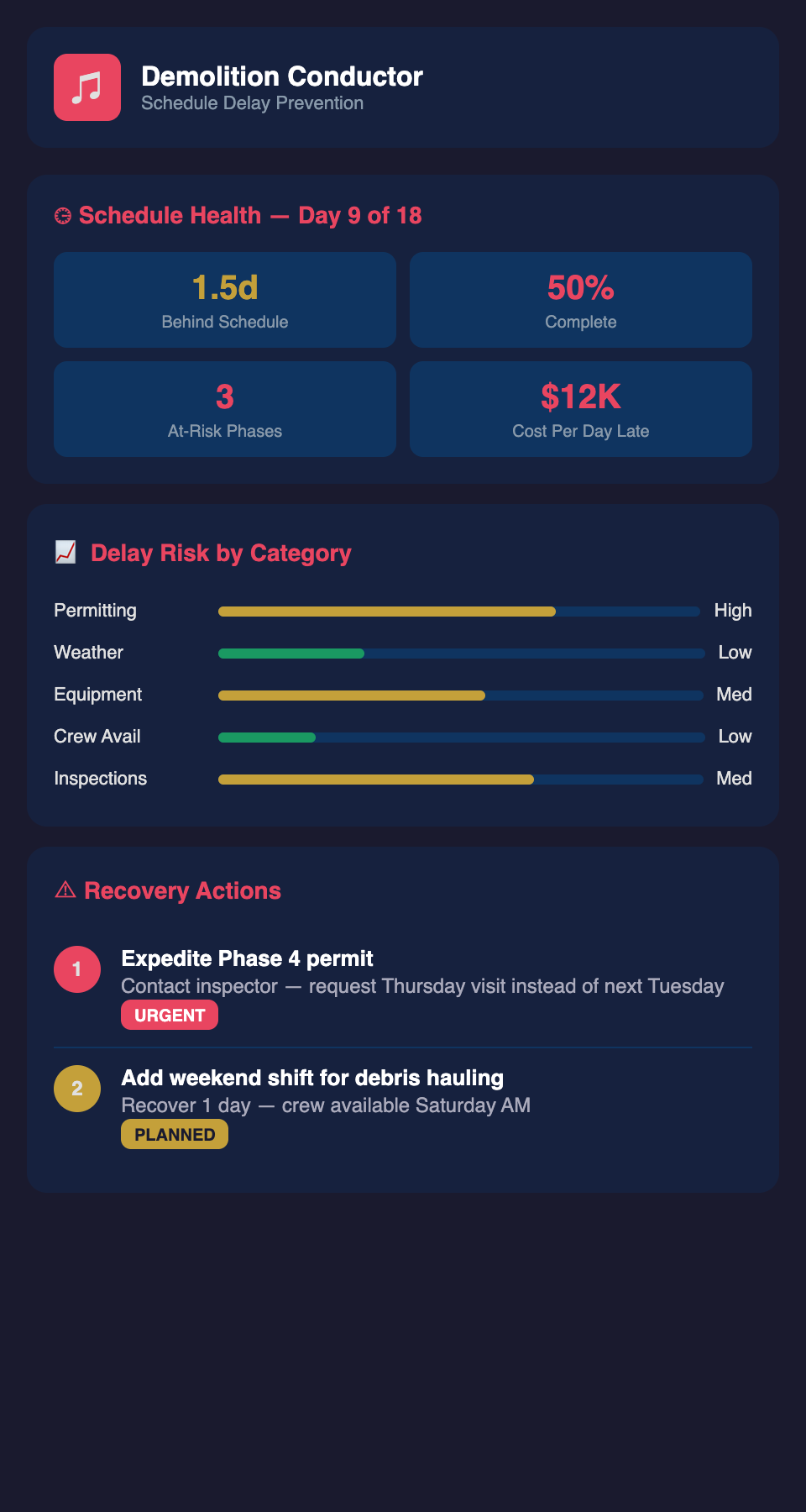
Proactive recovery planning: If you're behind, determine what adjustments will get back on schedule and implement them immediately. Adding crew, extending hours, or modifying the sequence are better than hoping to catch up later.
-
Stakeholder communication: Update all stakeholders weekly on progress status and timeline implications. People respond better to early notice of delays than surprises.
A project manager who prevents schedule delays typically does so through methodical pre-planning, explicit contingency, and weekly monitoring—not through heroic overtime or cutting corners on safety.
Ready to orchestrate your demolition schedule with precision? Join our waitlist to discover how structured planning tools keep projects on time and on budget.