Stakeholder Communication in Demolition Timelines
Why Demolition Communication Is Different From Construction
Many project managers apply construction communication strategies to demolition projects and discover that they're insufficient. In construction, you're building something people understand and value—they want it finished, but they understand the work takes time. In demolition, you're removing something, often creating disruption and uncertainty—stakeholders need clarity on what's happening, why, and how it affects them.
A construction project manager manages stakeholder expectations around value and timeline. A demolition project manager must also manage anxiety about disruption—noise, dust, traffic, uncertainty about the future use of the site, concerns about safety, and questions about waste management and environmental impact.
Effective demolition communication addresses both the technical project status and the stakeholder concerns underlying it.
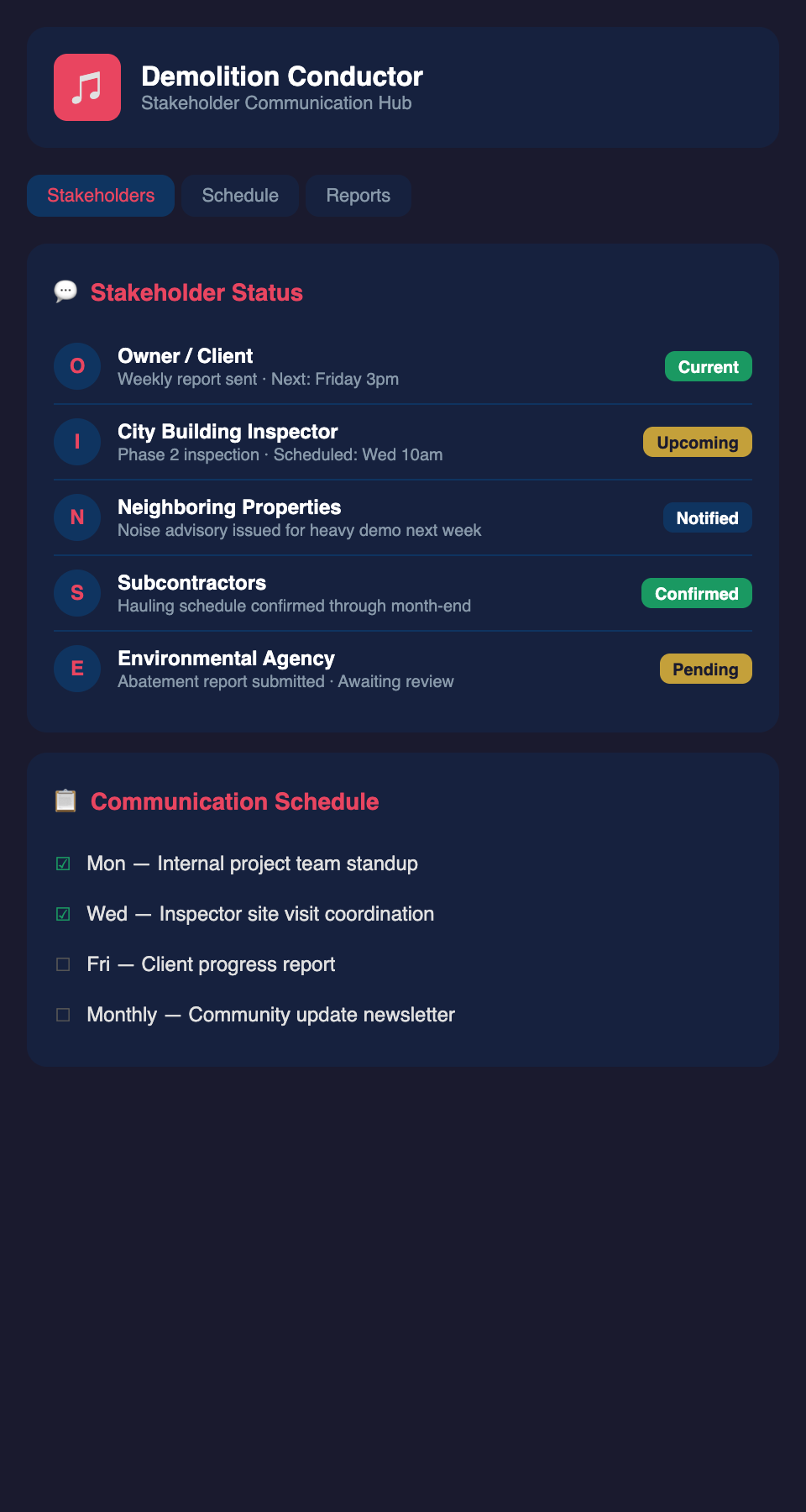
Identifying Your Stakeholder Universe
Before you develop a communication plan, identify all the parties who need project information:
Owner and development stakeholders: They own the site and need to know timeline, cost, and anything affecting the final project. They care about finish date because subsequent development can't begin until demolition completes.
Adjacent property owners: They're experiencing disruption—noise, vibration, dust—and want to know duration and mitigation. They want assurance it's temporary and they'll get resolution.
Municipal authorities and permitting: They've issued demolition permits and want assurance the project complies with conditions. They need notification of any changes from the permitted plan.
Planned tenants or occupants: If the site is intended for future development, planned tenants or anchor businesses want to know timeline and will make occupancy decisions based on your completion date.
Environmental agencies: If the project has environmental oversight or contamination concerns, environmental agencies want progress updates and assurance of compliance.
Affected residents: If the demolition is in a residential area, nearby residents want to know frequency and duration of disruptive activities.
Construction workforce: Your construction crews, subcontractors, and equipment suppliers need regular project updates to coordinate their work.
Different stakeholders need different information at different frequencies. Develop a communication matrix that specifies:
-
Who needs what information
-
How frequently
-
In what format
-
Through what channel
Establishing Baseline Communication Channels
Clear communication channels prevent the cascading failures where information gets misunderstood or interpreted differently by different parties.
Establish formal communication protocols:
Owner/developer: Weekly written status reports covering progress, any deviations from the baseline schedule, upcoming activities, and any issues requiring decision. Monthly in-person meetings with leadership and stakeholders to discuss schedule trajectory and any major issues. Immediate notification for any significant delays or safety incidents.
Municipal authorities: Notify of work start, any changes to the permitted demolition plan, major schedule changes, and substantial completion. Follow the notification requirements specified in your permits—some permits require specific notification procedures.
Adjacent property owners: A letter explaining the demolition project, expected duration, disruptive activities (noise/vibration/dust), your mitigation measures, a point of contact, and a complaints process. Then, weekly or bi-weekly updates during active demolition phases, notification if schedule changes affect adjacency impact, and final notification when work concludes.
Environmental agencies: Follow the reporting requirements in your permits. Most require periodic compliance documentation and final site clearance certification.
Affected residents: Similar to adjacent property owners. For residential demolition projects, a comprehensive initial notification and regular updates maintains confidence and prevents escalation of minor concerns into community opposition.
Workforce: Daily toolbox talks covering the day's plan, safety briefing, and any schedule changes. Weekly more detailed briefings for subcontractors and trade leads.
Building Timeline Realism Into Communication
One of the most common communication failures is providing unrealistic timelines that stakeholders internalize and base decisions on. When you miss the communicated date, stakeholders become frustrated regardless of the actual reason.
Avoid this by building realism into communicated timelines:
Conservative date estimates: Don't communicate your aggressive schedule scenario. Communicate your realistic scenario that includes reasonable contingency. If you internally estimate 12 weeks with 2 weeks contingency, communicate 14 weeks. Finishing in 13 weeks creates positive stakeholder reaction. Communicating 12 weeks and finishing in 14 creates negative reaction despite virtually identical actual performance.
Explicit contingency communication: Help stakeholders understand that demolition has inherent uncertainties. Communicate: "Our estimate is 12 weeks, with a 2-week contingency for structural discoveries or other unexpected conditions. We plan to finish within this 14-week window."
Scenario planning: If the schedule has significant uncertainty, communicate multiple scenarios:
-
"Standard scenario: 12 weeks if conditions match expectations"
-
"Extended scenario: 14 weeks if we encounter structural or environmental discoveries"
-
"Accelerated scenario: 10 weeks if we encounter minimal complications and add additional resources"
Baseline alignment: Once you've communicated a timeline, track actual progress against it continuously. If you're tracking to complete early, communicate that early and reset expectations. If you're tracking to miss the timeline, communicate that as soon as you recognize it, before stakeholders discover it through missed milestones.
Handling Schedule Changes and Delays
Demolition projects inevitably encounter changes—discoveries that affect sequencing, contractor unavailability, weather delays, regulatory complications. How you communicate these changes determines stakeholder confidence in your timeline accuracy.
When a schedule change becomes apparent:
Immediate notification: Don't wait for the weekly update. Notify the owner immediately when you identify a change that affects the overall project timeline. This demonstrates you're actively monitoring and responding.
Root cause explanation: Explain clearly what caused the change. "We discovered unexpected concrete thickness that requires additional cutting time" is informative. "We're behind schedule" provides no actionable information and creates anxiety.
Impact quantification: Specify exactly what the impact is. "This will delay the structural demolition phase by 2 days, which will delay overall project completion by 2 days" is clear. "This might affect the schedule" creates uncertainty.
Recovery plan: Communicate what you're doing to mitigate the impact. "We've added an additional crew to keep the 2-day impact from cascading into subsequent phases" shows proactive response.
Updated timeline: Provide an updated overall timeline. Stakeholders would rather have accuracy than optimism. They'll make better decisions based on a revised timeline than based on optimistic dates that you subsequently miss.
Managing Disruption Communication
Many demolition communication failures relate to disruption rather than schedule. Adjacent stakeholders and affected communities are willing to tolerate demolition disruption if they understand it's temporary and being actively mitigated.
Establish disruption communication:
Disruption calendar: Communicate when disruptive activities will occur. "Week 1-2: Interior demolition with moderate noise. Week 3: Structural demolition with heavy equipment and intermittent loud noise. Week 4: Material removal with frequent truck traffic." This helps stakeholders plan their own activities around the disruption.
Mitigation measures: Explain what you're doing to minimize disruption. "We're using dust suppression on all cutting activities. We're limiting jackhammer work to 8 AM - 4 PM weekdays. We've scheduled haul trucks to minimize peak-hour traffic."
Complaints process: Provide an easy way for stakeholders to report concerns. A phone number or email that gets answered within 4 hours provides stakeholders confidence that their concerns will be addressed rather than ignored.
Response to complaints: When you receive a complaint, respond quickly. Investigate the issue, explain what you found, and describe corrective actions. This might be: "You reported excessive dust on Tuesday. We've reviewed our dust suppression system and found it was underperforming due to low water pressure. We've increased water supply and the issue is resolved." This turns a concern into evidence that you're responsive and responsible.
Communicating Unknowns Without Creating Anxiety
Demolition projects always have unknowns. You won't know the exact structural configuration until you see it. You won't know if hazardous materials exist until you test for them. How you communicate unknowns determines whether stakeholders accept them as normal project risks or view them as evidence of poor planning.
When communicating unknowns:
Acknowledge them upfront: "We've reviewed available building records, but demolition always involves discovering conditions not shown in drawings. We've budgeted contingency time for structural discoveries."
Explain what you're doing to reduce unknowns: "We've conducted structural investigation and pre-demolition survey to identify as many conditions as possible before work begins. This investigation identified three areas of higher uncertainty that we've planned for in our schedule."
Specify your response protocols: "If we discover unexpected conditions, our process is: immediately notify the project manager, assess the impact, determine what corrective actions are needed, and communicate the impact to stakeholders. We typically can resolve discovery-related issues within 1-2 days."
Connect unknowns to contingency: "The 2-week contingency in our schedule is specifically to address uncertainties like these. Finding unexpected conditions is actually what contingency is for—we'd rather discover them and have time to address them than hope for perfection."
This communication approach normalizes the uncertainties that are inherent to demolition rather than treating them as failures.
Documentation and Dispute Prevention
Clear written communication creates a record that prevents later disputes about who said what or when commitments were made.
Maintain documentation of:
-
Weekly status reports sent to owner
-
Change notifications with dates and impacts
-
Meeting minutes from stakeholder meetings
-
Correspondence with municipal authorities
-
Complaints received and responses provided
-
Any commitments made regarding schedule, scope, or mitigation measures
This documentation isn't bureaucracy—it's the record that demonstrates you've managed the project professionally, communicated clearly, and honored your commitments. If disputes arise, this documentation either prevents them by creating shared understanding or provides the evidence needed to resolve them.
Frequency and Format Optimization
Communication cadence matters. Too frequent updates create noise; too infrequent updates create information vacuums where stakeholders make assumptions.
Optimize by stakeholder:
Owner/development company: Weekly written status, monthly in-person meetings, immediate notification for schedule changes.
Affected public: Monthly updates during active demolition, immediate notification if disruptive activities change.
Municipal authority: Per permit requirements, typically monthly or quarterly updates.
Workforce: Daily briefings, weekly more detailed updates.
Written status should be concise—one page maximum—covering: current phase, progress against baseline, upcoming week's activities, any issues or changes, and status traffic light (green = on track, yellow = watch, red = attention required). This format enables quick review without extensive reading.
Demolition communication succeeds when stakeholders feel informed, have realistic expectations, understand that you're actively managing the project, and believe their concerns are heard and addressed. This requires consistency, clarity, and honesty about both progress and challenges.
Join our waitlist to access communication tools that help you maintain stakeholder alignment and manage expectations throughout complex demolition projects.